China flexes its military muscles around Taiwan
Jan 06, 2026
Hong Kong, January 6 : China's military coercion of Taiwan has become routine. Few blink twice at the scale of People's Liberation Army (PLA) activity targeting Taiwan nowadays, a norm China has been deliberately striving to achieve.
In 2025 the PLA conducted 5,317 sorties - a daily average of 15 - around Taiwan. Of these, Chinese military aircraft crossed the Taiwan Strait median line 3,867 times and
entered Taiwan's self-declared air defense identification zone (ADIZ).
Indeed, last year saw a 22.4% annual increase in the number of PLA aircraft entering Taiwan's ADIZ. The number of such provocative flights mushroomed from 972 in 2021, equating to a 287% increase in just four years. This is all part of Chairman Xi Jinping's strategy of browbeating Taiwan and routinizing the threat of force.
China upped the ante further when it conducted the massive Justice Mission 2025 exercise on 29-30 December. Lin Jian, the Chinese Foreign Ministry spokesperson, said the "drills around China's Taiwan region is a severe punishment for Taiwan secessionists who seek 'Taiwan independence' through military buildup, and a necessary action to safeguard national sovereignty and territorial integrity".
China's reference to Taiwan independence is a ruse. As Taiwanese President Lai Ching-te says, Taiwan does not need to declare independence, because it is already independent and a self-governing nation. A lack of recognition from the United Nations and Beijing's arrogant claims of ownership do not alter that. Therefore, China continually voicing fears over Taiwanese independence is a completely manufactured strawman.
As Grant Newsham, Research Fellow at the Japan Forum for Strategic Studies, pointed out, "If China starts a war over Taiwan, it won't be because of 'fear of Taiwan declaring independence' or 'by accident' or 'by miscalculation'. It will start because China (Xi Jinping) wants a war."
As Admiral Samuel Paparo, commander of the US Indo-Pacific Command, testified last year, "These are not just exercises - they are dress rehearsals for forced unification."
Alarmingly, the world is standing by as China acts like this. A few concerned nations issued statements following the exercise - including Australia, the European Union, France, Germany, Japan, New Zealand and the UK. Understandably, Beijing is content with such a limited response for there is little force behind their words of condemnation.
The USA belatedly issued a statement too, saying, "China's military activities and rhetoric toward Taiwan and others in the region increase tensions unnecessarily. We urge Beijing to exercise restraint, cease its military pressure against Taiwan, and instead engage in meaningful dialog. The United States supports peace and stability across the Taiwan Strait and opposes unilateral changes to the status quo, including by force or coercion."
On the other hand, China claimed "several dozen" countries had expressed support for its actions, mentioning Russia, Cuba, Serbia, Venezuela, Zimbabwe and Pakistan by name. Lin Jian said, "They noted in particular: Taiwan is an inalienable part of China's territory, the Taiwan question is China's internal affair, and 'Taiwan independence' in whatever form must be rejected."
Lin added, "We reaffirm once again that China will never waver in its resolve to safeguard national sovereignty, security and territorial integrity. China will never waver in its resolve to defend the nation's reunification and vital interests. China will never waver in its resolve to deter 'Taiwan independence' separatist forces from colluding with external forces and destabilizing the Taiwan Strait."
The two-day Justice Mission 2025 exercise delineated seven training area blocks ringing Taiwan, each close to the island state's contiguous zone (an area 12-24nm from a nation's coastline) and also impinging on parts of Taiwan's ADIZ.
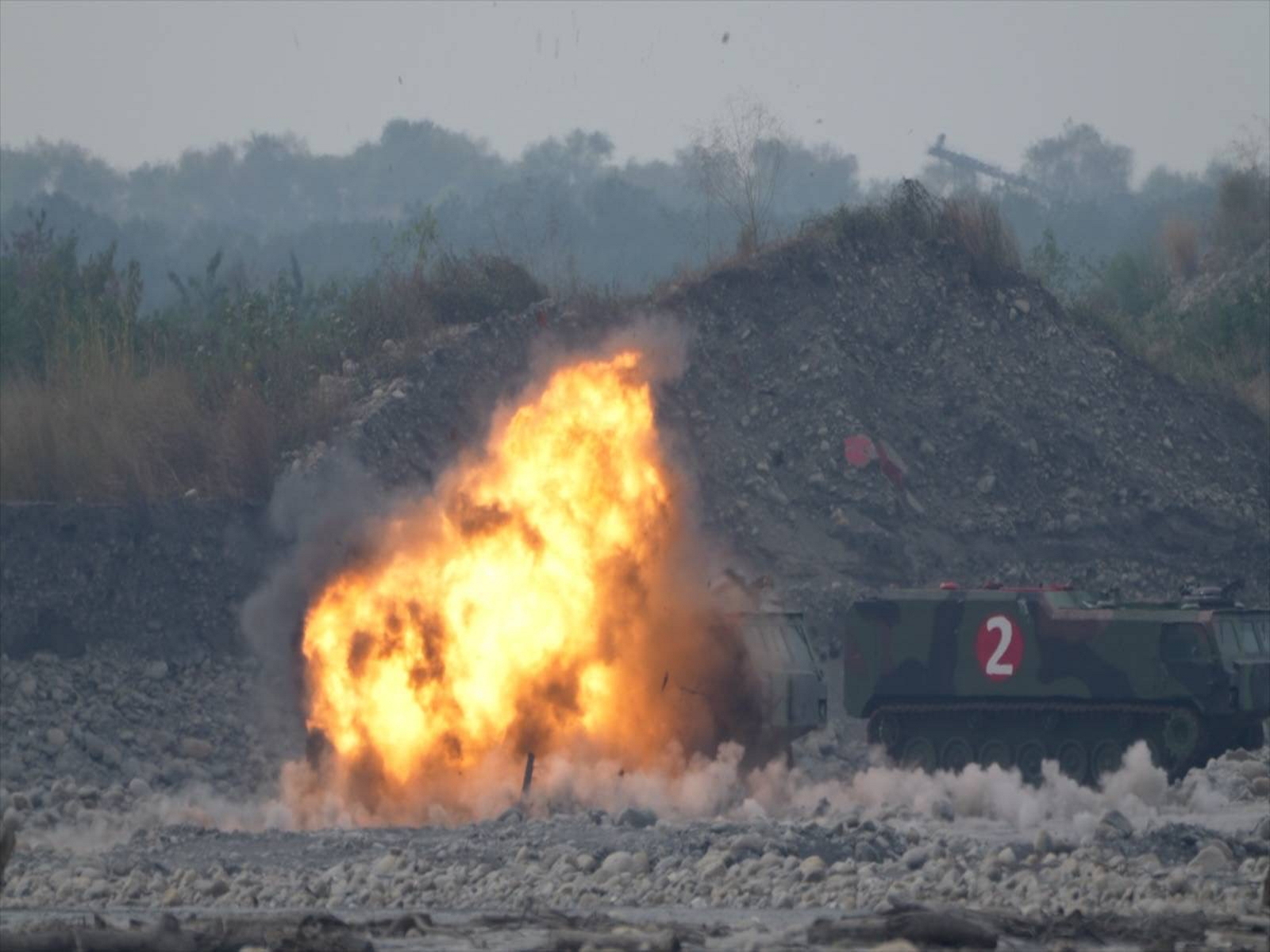
Taiwan's Ministry of National Defense recorded 130 PLA aircraft sorties on the first day, 29 December, plus it listed 14 PLA Navy (PLAN) vessels (eleven of which entered Taiwan's contiguous zone), 14 China Coast Guard (CCG) vessels and four amphibious ships taking part in the exercise. China also fired 27 rockets from PCH191 multiple rocket launchers (MRL) from Fujian Province in China.
Aircraft included J-20 and J-16 fighters, H-6K bombers, KJ-500 early warning aircraft and drones that conducted coordinated missions. The number of aircraft and vessels did not reach historical highs, as those records belong to Joint Sword 2024 exercises.
Of interest, no ballistic missiles were fired. Instead, PCH191 rockets pose a low-cost, high-quantity threat to Taiwanese infrastructure and military bases.
Rick Joe, an independent analyst of the PLA, said these 370mm rockets have a range exceeding 300km, carry a 180kg warhead payload and are as accurate as equivalent GPS-guided systems. He said the PCH191 is "rather optimized for a Taiwan conflict".
Each high-mobility 8x8 launcher truck carries eight rockets, and these are rapidly reloaded thanks to modular pods.
Joe added, "Arguably, the significance of this platform (and the specific caliber) is still a bit underrated. This platform provides near short-range ballistic missile capabilities and reach, in a heavy MRL package and magazine capacity, with road strategic mobility. In context of modern intelligence, surveillance and reconnaissance, and a systems confrontation scenario, the credible fires bandwidth this thing offers in a cross-strait conflict is a major uplift."
On Justice Mission 2025's second day, the PLA flew 71 aircraft sorties (of which 35 crossed the median line), and 13 PLAN ships (eleven entering the contiguous zone) and 15 CCG vessels took part too. The army again fired 27 rockets from PCH191 MRLs. The rockets' target zones were the closest to Taiwan to date, with some weapons landing within 50nm of the coast.
The highest concentration of naval vessels occurred southwest of Taiwan. This was also the first time a 30,000-tonne Type 075 landing helicopter dock ship joined such an exercise. Amphibious operations are the most difficult to master, but China is demonstrating increasing confidence and competency.
Zhu Anqing, spokesperson of the East Sea Bureau of the CCG, commented: "The patrol focused on drills such as verification and identification, warning and expulsion, as well as visit, board, search and seizure, which tested the regional control capabilities."
Regarding this, Lyle Morris, Senior Fellow on Foreign Policy and National Security at the Asia Society Policy Institute, noted, "The deployment underscores the role of the CCG in a Taiwan contingency to patrol, intercept and inspect during a blockade, demonstrating the ability to conduct 'law enforcement control' over Taiwan's maritime sea lines of communication and coordinating with the missions of the Eastern Theater Command, PLAN and Air Force."
The PLA's Eastern Theater Command said the wargames "tested capabilities of sea-air coordination and integrated blockade and control". The exercise "focused on subjects of all-dimensional force projection, breaching and raid by elite forces, as well as seizure of key ports. The drills tested capabilities of task force coordination, systemic operations and precision strikes on key targets".
Indeed, the exercise shut down most Taiwanese international air routes, affecting 941 civilian flights and 100,000 passengers. The intent was clear - for China to demonstrate control over Taiwan at will. Taipei described China's show of force as "highly provocative and reckless". President Lai issued the "strongest condemnation," saying Beijing was "deliberately undermining regional stability through military intimidation".
Xi's New Year's address featured just two phrases on Taiwan. He said, "We Chinese on both sides of the Taiwan Strait share a bond of blood and kinship. The reunification of our motherland, a trend of the times, is unstoppable!"
Yet Xi's abrupt resumption of such exercises sends a sharp message that the PLA is ready to attack Taiwan. Interestingly, they came just a week after General Yang Zhibin assumed leadership of the Eastern Theater Command, which faces Taiwan. Central to the exercise was the ability to go swiftly from a regular to a forward attack posture.
This is important, as the PLA will not want to telegraph any incoming invasion of Taiwan by a long and easy-to-read mobilization of units.
China said Justice Mission 2025 practiced fighting "interventionist" forces beyond the First Island Chain. This was a direct reference to the USA, who analysts expect would come to Taiwan's aid if China did invade.
Xi's timing of the exercise was likely significant too, coming at a time when much of the West was on holiday. The action may also have been a response to the bumper US$11.1 billion sale of military equipment that the USA approved to Taiwan on 17 December. Japan's Prime Minister Sanae Takaichi may have been a trigger for the exercise too.
On 7 November 2025, Takaichi responded to questions in Japanese parliament about any Chinese threat to Taiwan, saying Chinese warships using military force against Taiwan could lead to a "survival-threatening situation" for Japan. Beijing considered the Japanese leader's comments provocative, construing that the Japan Self-Defense Force would engage in collective self-defense activities if China did attack Taiwan.
Beijing essentially backed itself into a corner by demanding a retraction of Takaichi's comments, something that did not occur. Three of the zones were north of Taiwan, basically blocking intervention from places like Japan. As Beijing turns up the heat against Taiwan, Xi can usefully measure Washington DC's, Tokyo's and others' reactions.
Ryan Fedasiuk, Adjunct Professor at Georgetown University, predicted Beijing will push the limits of its detente with the USA by escalating cross-strait tensions. "Now, at the risk of saying the quiet part out loud, the Trump administration faces pressure to look the other way. The president doesn't want to rock the boat with Beijing ahead of his April state visit to China. That's understandable. It's a reality of high-level diplomacy that constrains every administration."
Fedasiuk warned, "But the United States cannot allow China's escalating campaign of coercion - which our military analysts assess to be 'rehearsal' for a genuine use of force against Taiwan - to go unchecked. At this moment, the message to Beijing should be that 'President Trump does not negotiate under the shadow of a blockade'."
Justice Mission 2025 was a straight-out act of aggression designed to instill fear in Taiwan and to normalize military action. If the USA fails to respond with red lines and suitable punishment that damages China's decision calculus, then President Donald Trump is giving Xi carte blanche to do as he wishes with Taiwan. Therefore, the US needs to find an appropriate noose that tightens the more China lashes out.
Xi's move to restrict exports of rare earth elements boosted Xi's hand, as Trump was forced to reach an accommodation with China. Xi will meet Trump in April, and he has obviously calculated that beating his war drums will not hinder that. Trump concurred with a dismissive response to the exercise. "They've been doing that for 20-25 years." He added, regarding any invasion, "I don't believe he's going to be doing it."
If Taiwan did fall, the US presence in the western Pacific and East Asia would be irrevocably lost. The USA would lose the trust of Japan and South Korea, and those alliances would be irretrievably damaged. The US military presence would stretch only as far as Guam and Hawaii.
Mick Ryan, a retired Australian Army general, concluded: "In many respects, these large-scale Chinese joint exercises are a gift to foreign intelligence agencies. Even with the best operational security and deception plans, it's unavoidable that the Chinese will unveil the capability of many different elements of their military institution. While the aggression of these activities is unwelcome, they do provide Taiwan, America and those who support Taiwan with a wide range of activities to observe, assess and respond to China's developing theater-level campaigning and warfighting capacity."
Ryan noted: "The final, and most important, question that emerges when these PLA exercises are conducted is this: when might the Chinese decide that the political and military conditions are just right for them to turn one of these joint exercises around Taiwan into the real thing? Only Xi knows. Until then, we must watch and learn from these exercises, and use what we have learned to deter Xi from making that fateful decision."
Yet, James Lilley, a US ambassador to China in 1989-91, insisted the Chinese "always telegraph their punches". The PLA's incessant and intensifying military activities
around Taiwan are evidence of what Xi's true intentions are.