Cyclone Ditwah inundates 1.1 million hectares in Sri Lanka; 2.3 million people exposed: UNDP
Dec 10, 2025
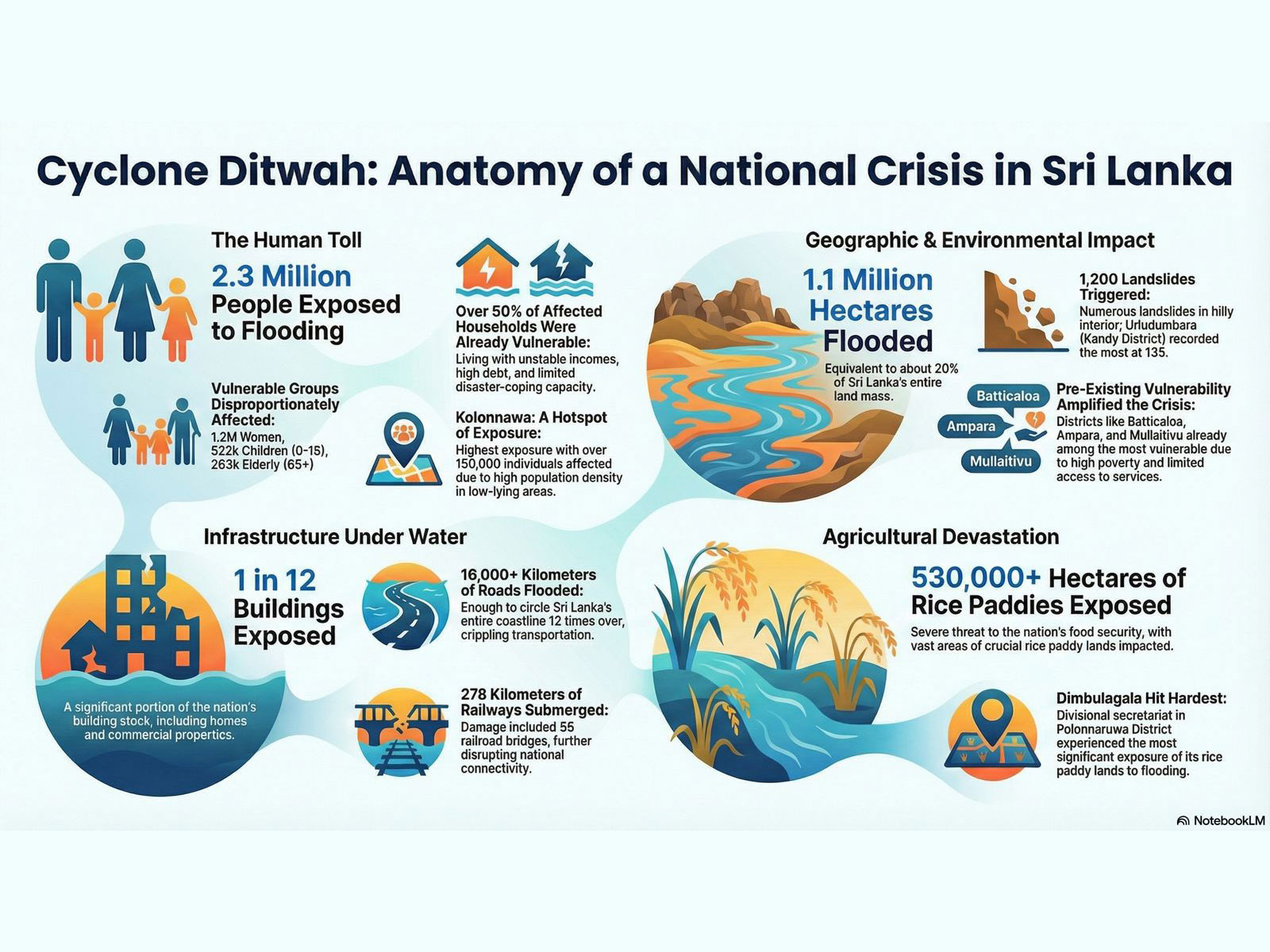
New Delhi [India], December 10 : Cyclone Ditwah has caused one of the largest flood events in Sri Lanka's recent history, submerging 1.1 million hectares, roughly 20 per cent of the country's land mass, and directly exposing 2.3 million people to cyclone-driven flooding, according to the United Nations Development Programme (UNDP).
The cyclone made landfall on Sri Lanka's eastern coast on November 28, unleashing intense rainfall, widespread inundation and multiple landslides across the island. UNDP's detailed impact assessment, in collaboration with Sri Lanka's Disaster Management Centre, warns that the physical impacts of the cyclone are compounded by deep pre-existing vulnerabilities in several districts.
According to the assessment, nearly 720,000 buildings were exposed to flooding, including 243 hospitals and hundreds of educational institutions. Some of the worst-hit administrative areas--such as Dimbulagala in Polonnaruwa, Kandavalai in Kilinochchi and Maritimepattu in Mullaitivu--recorded extensive flood extents, while central highland districts such as Nuwara Eliya, Badulla and Kegalle saw intense rainfall triggering more than 1,200 landslides.
The UNDP noted that its analysis integrates satellite-derived flood mapping, landslide data, infrastructure exposure and population density with its Multidimensional Vulnerability Index (MVI), revealing where cyclone impacts intersect with chronic socioeconomic fragilities.
"This analysis examines how disaster impacts intersect with pre-existing vulnerabilities and livelihood systems," the report said, stressing that the layered approach helps identify communities where recovery will be most difficult.
It added that "over half of the people in flooded areas were already living in households facing multiple vulnerabilities before Cyclone Ditwah, including unstable income, high debt, and limited capacity to cope with disasters."
These conditions, UNDP warned, heighten the risk that the immediate disaster could evolve into prolonged socioeconomic distress without targeted interventions. Many of the districts facing the heaviest flooding--such as Batticaloa, Ampara, Mullaitivu, Kilinochchi, Puttalam and Nuwara Eliya--were already among the most vulnerable, with high poverty levels, limited access to services and fragile livelihoods.
Damage to essential infrastructure has further complicated recovery efforts. More than 16,000 km of roads and 278 km of railways were exposed to flooding, along with over 480 road bridges and 35 rail bridges, severely affecting mobility and access to critical services.
The UNDP emphasised that early recovery must prioritise debris clearance, rapid rehabilitation of community infrastructure, livelihood support, restoration of documentation and measures to protect vulnerable groups. Without swift and targeted assistance, the cyclone's impacts could push already fragile communities deeper into long-term economic and social hardship.