Dalai Lama launches 'Forest Resources in India' focused on climate, conservation and community
Dec 05, 2025
Dharamshala (Himachal Pradesh) [India], December 5 : Spiritual leader, the Dalai Lama, on Friday unveiled the National Book Trust's publication titled 'Forest Resources in India: Integrative Governance and Community Participation for Sustainable Future' at McLeod Ganj in Dharamshala.
The book has been authored by Sushil Kumar Singla, Rakesh B. Sinha, and Krishan Kumar Raina.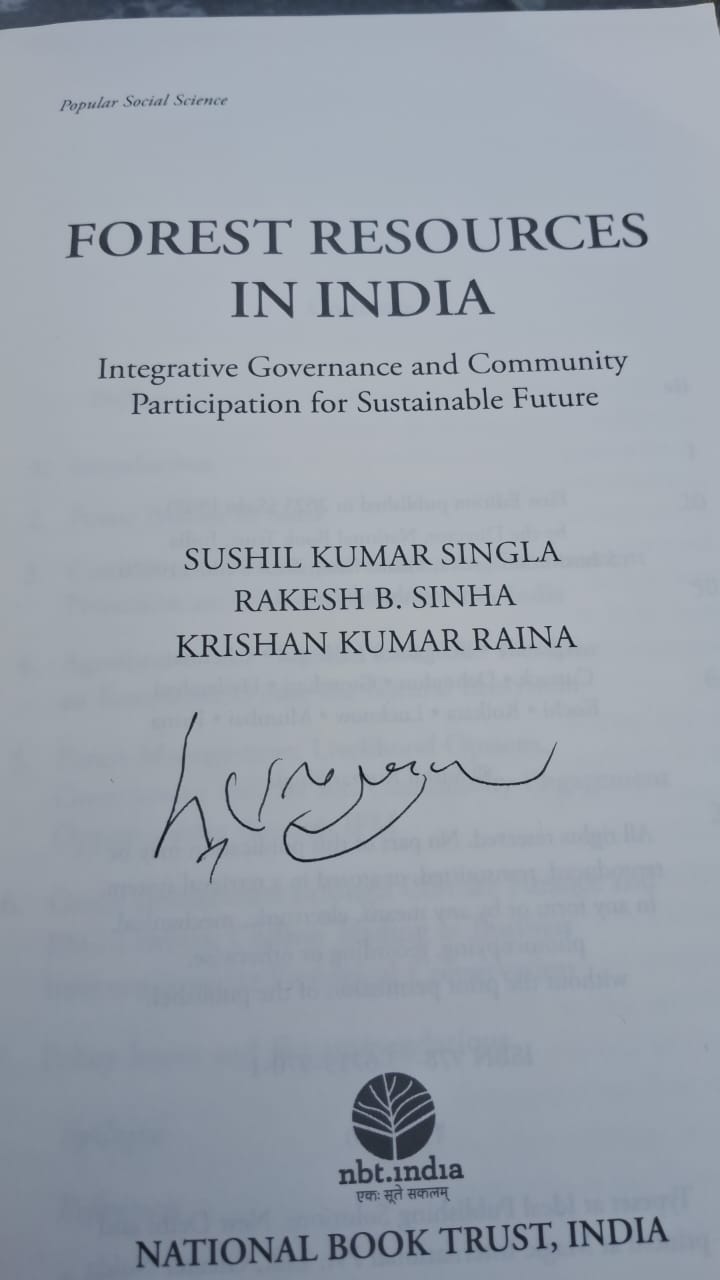
During the launch event, the Dalai Lama also signed a copy of the book. Author Sushil Kumar Singla briefed him about the themes, structure, and research insights presented in the publication.



The book provides a comprehensive exploration of sustainable forest management in India, highlighting the deep cultural ethos of nature conservation rooted in Indian traditions, the pivotal roles of women and local communities, and the governance mechanisms that shape forest policies. It emphasises the interconnectedness of sectors such as agriculture, the environment, tribal development, and climate change, while highlighting the shared responsibility of States and Union Territories to balance development with conservation.
It underscores the interconnectedness of sectors such as agriculture, environment, tribal development, and climate change, while emphasising the shared responsibility of States and Union Territories to balance growth with conservation.
https://x.com/nbt_india/status/1996640262416953767?s=20
The epilogue in the book noted that "India is making great strides in achieving the national forest policy goal of bringing 1/3rd of the land area under forest and tree cover by following the principle of Sabka Saath, Sabka Vikas, Sabka Vishwas, and Sabka Prayas. Our hearts and heads must huddle together so that all our efforts are in unison, bearing fruits that bring meaningful changes in the life of the last person in the row. Forestry has to focus on the creation of livelihoods and self-sufficiency, and enhance its share in the country's GDP and the Agriculture Sector."
"Over the years, the constitutional provisions and central / state regulations regarding forest management and its protection have successfully contributed to the sustainable management of forest resources. However, in this era of growing pressure on the forests and other natural resources, fear of the invisible should not stop us from deregulation, simplification, and wide-ranging reforms in the forest sector with an aim of not only assuring Ease of Doing Business but also Speed of Doing Business, translating it to Ease of Living," the book's epilogue reads.
The publication calls for a balanced approach between regulation and development, encouraging strategic collaboration between public and private sectors to ensure both "Ease of Doing Business" and "Ease of Living." India aims to achieve the national forest policy goal of bringing one-third of its land under forest and tree cover through the principles of Sabka Saath, Sabka Vikas, Sabka Vishwas, and Sabka Prayas.
It also stresses forestry's focus on livelihoods, self-sufficiency, and contribution to GDP, while advocating collaboration across allied sectors such as agriculture, horticulture, animal husbandry, fisheries, tribal affairs, environment, rural development, Panchayati Raj institutions, and tourism. The book emphasises stakeholder and local community participation in governance and monitoring processes.