
From Assam to Delhi: Total lunar eclipse turns Moon dusky red across Indian cities
Mar 03, 2026
Mumbai (Maharashtra) [India], March 3 : Skywatchers across the country turned their gaze upward as a dramatic lunar eclipse unfolded on Tuesday evening, turning the full moon into a darker orb.
As Earth's shadow moved steadily across the lunar surface, the Moon shifted its shade from a bright white to deeper shades of amber and red. The changing hues drew many to gather on terraces and open grounds for a clear view of the spectacle. 
In the northeastern state of Assam, striking visuals of the moon were observed, showing a dusky red disc. For enthusiastic skywatchers, telescopes with high-resolution lenses were also set up for the people to witness the lunar eclipse.
Further, residents in metropolitans like New Delhi and Kolkata also watched the Moon gradually darkening as the eclipse progressed. In one instance, the lunar eclipse was captured beside the illuminated India Gate in the national capital. 

The celestial spectacle was also witnessed in several other parts of the country, including Tamil Nadu, Rajasthan, Gujarat, Maharashtra, Odisha and Uttar Pradesh where residents stepped outdoors to watch the eclipse.
In Odisha's Puri, the lunar eclipse created a striking visual as the glowing amber Moon appeared just behind the 'Neel Chakra' atop the temple, forming a dramatic silhouette against the night sky. 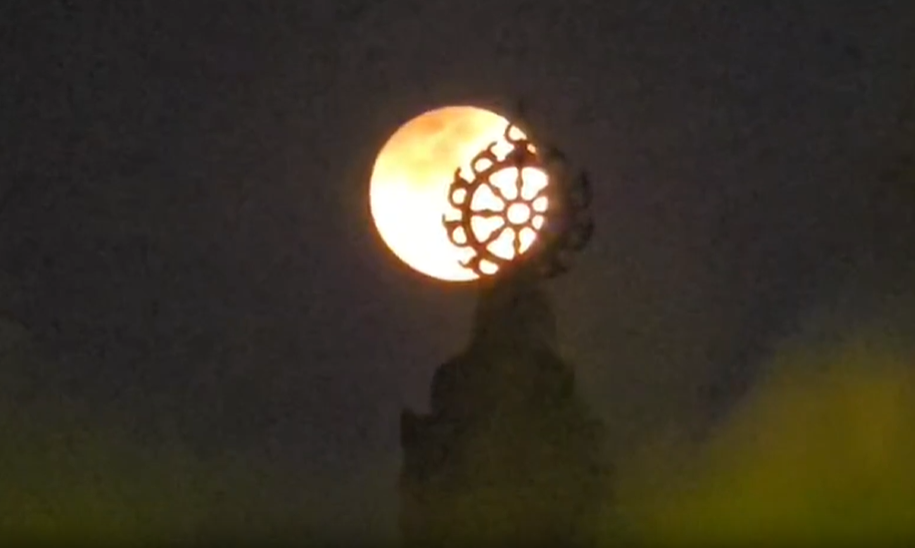
Meanwhile, social media platforms quickly filled with images of the shadowed Moon.
A total lunar eclipse took place on Tuesday, March 3, across several time zones.
The phenomenon occurs when the entire Moon passes through the Earth's umbral shadow. A partial lunar eclipse, in contrast, takes place when only a part of the Moon moves into the Earth's shadow.
In a post on X, the IMD earlier stated that the total lunar eclipse on March 3 will have a magnitude of 1.155, said to be visible across India, as well as in parts of Eastern Asia, Australia and the America.
The next total lunar eclipse is not like likely to place until 2029.