Gau Swastha: India's first image-based AI for cattle health and disease protection
Mar 06, 2026
New Delhi [India], March 6 : Gau Swastha, is revolutionizing Indian dairy farming by combining computer vision (CV), vision-language models (VLMs) and large language models (LLMs) to analyse cattle photos, farmer-reported symptoms and veterinary knowledge in one unified clinical reasoning engine.
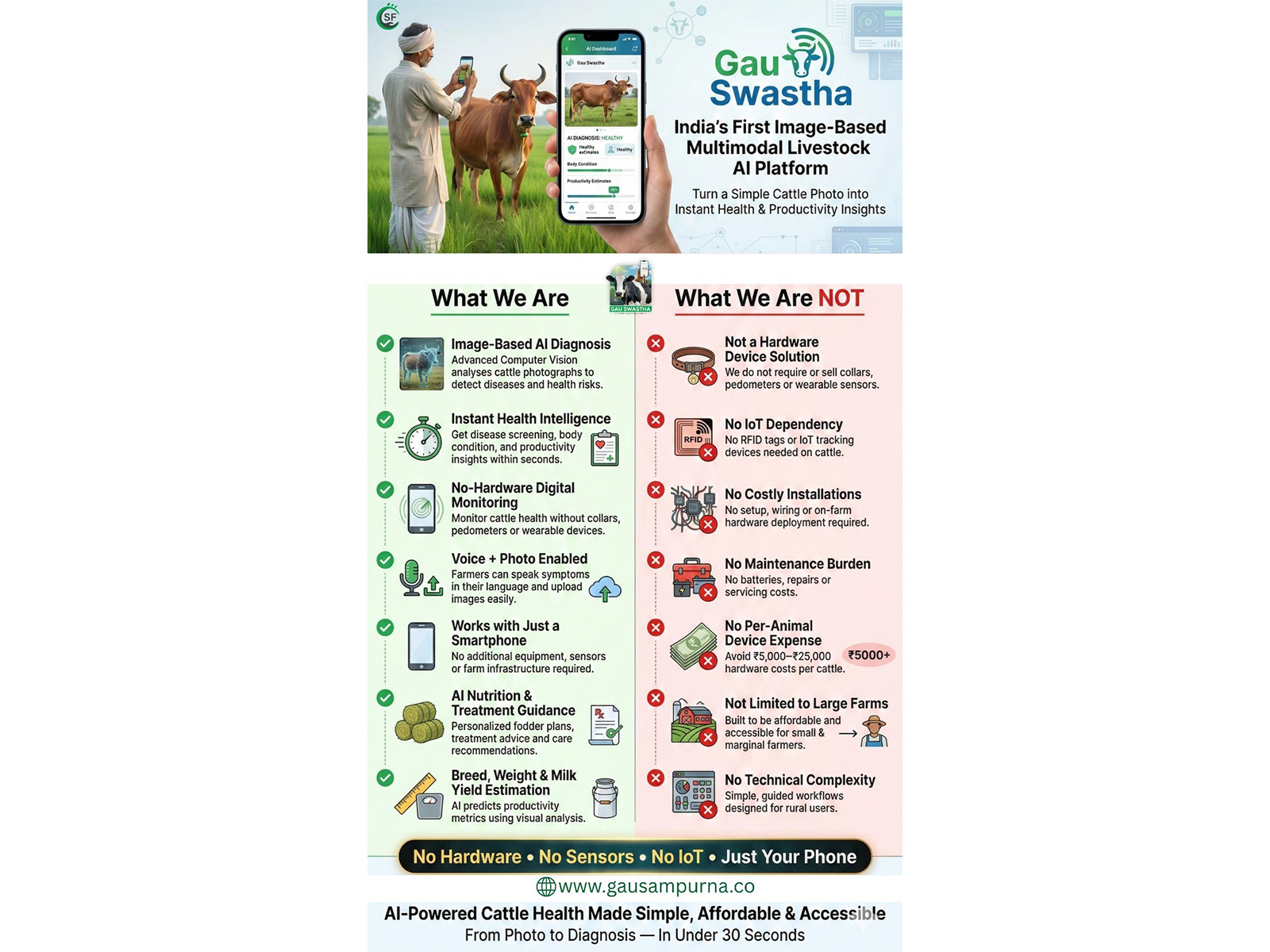
With their multimodal made-in-India AI approach, farmers only need their phones to click a photograph of their cow from their mobile phone, and they can then access clinical-grade livestock intelligence, thereby removing dependency on expensive hardware, wearable sensors, or IoT devices.
The existing current livestock technology landscape has a heavy dependence on IoT hardware such as pedometers, smart collars, wearable sensors and RFID tagging devices that must be physically attached to cattle.
These systems not only come at a significant cost (about ₹25,000 per animal) but also issues around servicing, battery replacement, connectivity etc. While large commercial dairy farms may find it viable, such investments become prohibitively expensive for India's small and marginal farmers, who form the backbone of the dairy economy.
Gau Swastha addresses this structural affordability and accessibility gap through a radically different, image-first AI architecture to do away with any dependence on pedometers or smart collars to collect sensor data. The GauSwastha AI platform extracts rich physiological, anatomical and behavioural signals directly from a simple side-angle photograph of the cow.
The LLM-driven "symptom intelligence" engine blends these textual inputs with visual findings to generate probabilistic disease scores, severity grading and differential diagnoses, closely mirroring how a veterinary doctor thinks through a case. For more nuanced problems, a guided "disease diagnosis" workflow asks farmers simple, everyday questions - such as whether the cow is eating less or has facial swelling - then prompts them to upload targeted images (udder, eyes, face), and returns disease likelihoods and clear recommendations.
On top of diagnosis, Gau Swastha leverages generative AI with retrieval-augmented generation (RAG) to deliver actionable, science-backed treatment and care protocols. The platform structures thousands of veterinary procedures into AI-readable knowledge graphs linking diseases, symptoms, severity, treatment and prevention, enabling machine-learning-driven clinical reasoning rather than simple pattern matching.
The result is a system that can explain what disease is likely, how serious it is, what dosage to give (based on automatically estimated body weight), and what preventive steps the farmer should take next.
In the last 10 months, the AI platform has already been validated on over 7,000 cattle in the field and is live across 26 Karnataka Veterinary Department polyclinics, where more than 50,000 farmers have benefited. A single side-angle image of a cow triggers a 360-degree "animal intelligence" to provide full health, nutrition and productivity assessments in under 30 seconds. From one photograph, the system simultaneously screens for 33 diseases, identifies breed and even assesses breeding capacity. It also generates buy/sell recommendations, market value and personalized nutrition and fodder suggestions tailored to the animal's health and productivity indicators. What was once the domain of an experienced veterinarian with years of field practice is now available as a structured dashboard on a farmer's phone. Best of all, the pricing has deliberately been kept negligible, so it can be affordable with no hidden costs that are prevailing in the current solutions.
Crucially, Gau Swastha is not a static model; it is a continuously learning system. Licensed veterinarians review AI-generated diagnoses and recommendations, validating correct cases and flagging misclassifications. It has been proved to make livestock monitoring dramatically more cost-effective, scalable and inclusive, by handling all observational-based diseases.
Another key differentiator is that Gau Swastha is built on India-specific livestock datasets. The system is trained on 40,000 annotated cattle health images, 1,000 symptom-to-disease mappings and 30+ veterinary treatment protocols. Geo-tagged scans feed into spatio-temporal machine-learning models that power outbreak clustering, regional risk heatmaps and disease spread forecasting, helping governments and cooperatives take proactive measures.
Accessibility is central to Gau Swastha's mission. The platform is available via app, web link and WhatsApp chatbot, and has already been deployed in eleven Indian regional languages with a conversational voice-AI assistant that allows farmers to speak in their own language.
Gau Swastha sits inside the larger Gau Sampurna ecosystem created by Silo Fortune, alongside free online veterinary teleconsultations, cattle trading and e-commerce for animal inputs. Together they form an integrated AI-driven stack that helps farmers detect disease early, optimize nutrition, get fair prices for their animals and access the right products and veterinary support in one place. In doing so, it's a demonstration of how frontier AI can be reimagined for rural India.
Its founder, Naveen Honnegowda, grew up in a farming family and left a high-profile 2-decade long corporate career for US firms in AI/ML, to empower India's dairy farmers with affordable tech solutions.