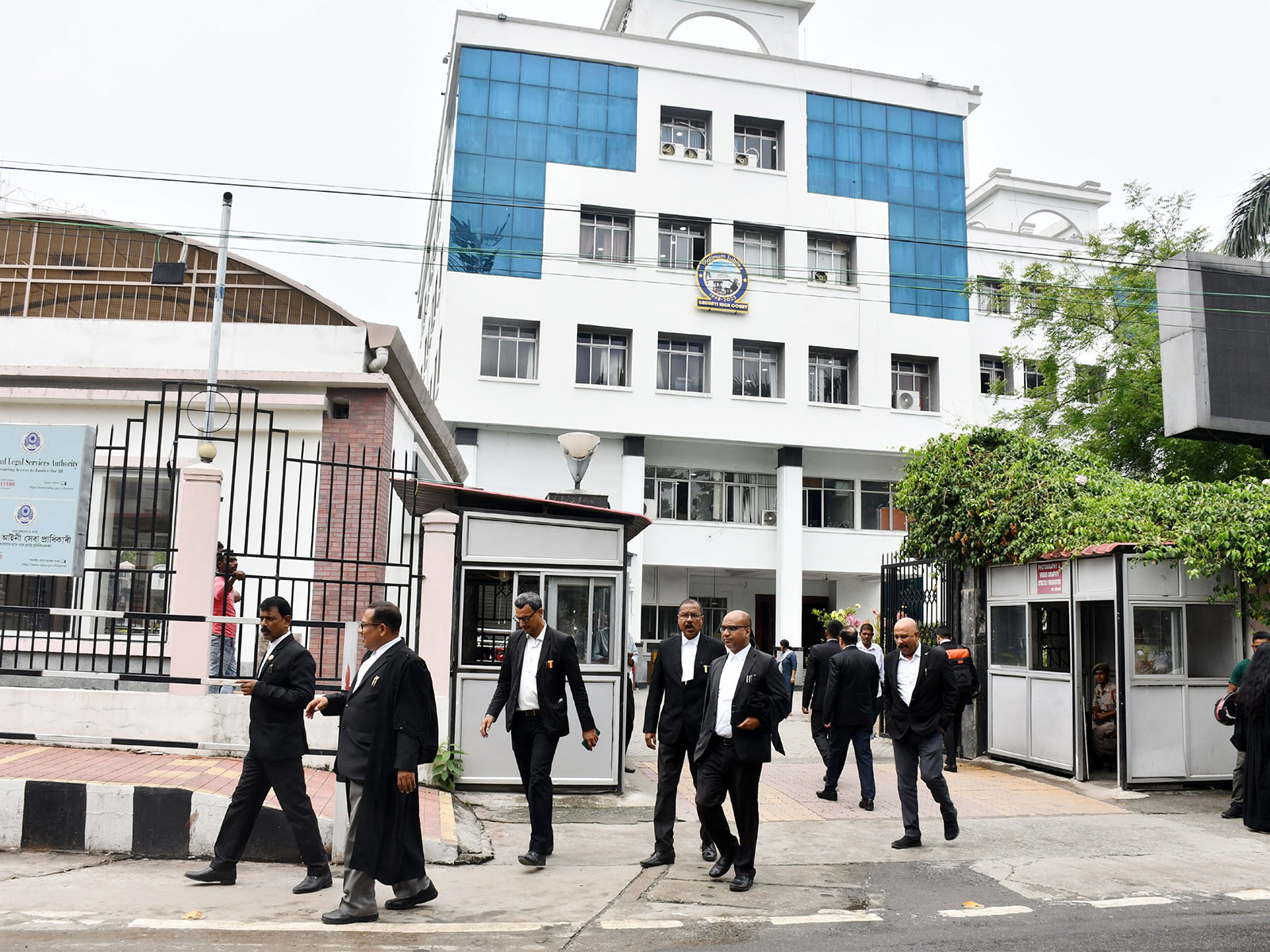
Gauhati HC allows Assam govt to proceed with Maa Kamakhya Temple Access Corridor
Feb 14, 2026
Guwahati (Assam) [India], February 14 : The Gauhati High Court has permitted the Assam government to proceed with the proposed "Maa Kamakhya Temple Access Corridor" at Nilachal Hills in Guwahati.
The court also disposed of a Public Interest Litigation (PIL) and a writ petition regarding the matter on Friday.
A bench comprising Chief Justice Ashutosh Kumar and Justice Arun Dev Choudhury stated, "There is a further assurance that the project would be executed without even in the least affecting the underground holy water springs. With the above-noted assurances and the structural design of the project incorporating the suggestions of the National Institute of Hydrology, Roorkee, and the IIT, Guwahati, we find no reason to continue with this PIL (PIL No. 12/2024) and the writ petition [WP(C) 2700/2024] any further."
The PIL (12/2024) was filed seeking a White Paper on the proposed construction of the corridor. Another writ petition [WP(C) No. 2700/2024], filed by Navajyoti Sarma, challenged the tender process initiated by the State vide NIT dated November 27, 2023, alleging violations of the Ancient Monuments and Archaeological Sites and Remains Act, 1958 and the Assam Ancient Monuments and Records Act, 1959.
The petitioners contended that the project could adversely affect the Maa Kamakhya Temple premises and disrupt religious practices, potentially leading to desecration.
The court noted, "During the course of the arguments, D. Saikia, learned Advocate General, Assam, had assured this Court verbally, as also in writing, that till all clearance are received from all the authorities concerned, including the Research and Analytical Report from the IIT, Guwahati, as also by another research body regarding hydrological impact coming in the way of the execution of the project, no construction shall take place."
The court said that an affidavit, sworn by the Special Commissioner and Special Secretary, PW (B&NH) Department, Assam, has been filed earlier wherein it has been averred that the project, namely, 'Maa Kamakhya Temple Access Corridor Project' has been taken up for the purposes of development of the temple area under the PM-DEVINE Scheme. The frontal facade and vista of the temple appear to have been compromised over a period of time because of unplanned residential and commercial buildings, most of which present rebarbative look, which have come up cramming the open spaces in front of the temple, which could be used by the pilgrims, or which could have been used for the State to develop amenities and allweather facilities for the pilgrims.
The Advocate General had stated that the project was initially conceived with the understanding that there shall be no interference with the architecture and ancient sculptures of the temples in and around the main sanctum sanctorum.
"The State is also conscious of the possibilities of the adverse impact to the underground holy water springs that may occur with the initiation and completion of the project. With this apprehension in mind, the IIT, Guwahati, had been entrusted to carry out hydrological and geophysical studies of the proposed construction area to find out as to how the execution of the project should be carried out without damaging the sacred underground natural water spring," the court noted.
An MOU was entered into between the PWD (Building), Assam and the IIT, Guwahati in the month of June, 2024. In order to avoid any adverse impact to the main temple and the holy underground water springs as also for preservation of the ancient and sacred monuments in and around the temple, the services of the National Institute of Hydrology, Roorkee, have also been commissioned for conducting a study with regard to the possible hydrological and geophysical impact.
The National Institute of Hydrology, Roorkee has also submitted its report, which has been vetted by the IIT, Guwahati withj the report finding it to be a viable and nondamaging option for the State to carry out the project, according to the court.
The report submitted by the National Institute of Hydrology, Roorkee, and the recommendations of the IIT, Guwahati were also taken taken into consideration by the consultant/concessionaire for preparation of drawings/designs. The court said that the structural plans and their design have already been submitted to the Government, which has also been brought on record in these petitions vide affidavit dated January 20.
"With all these checks, the learned Advocate General has submitted that he may be permitted to withdraw his oral undertaking that till the time all clearances are received and proper hydrological and geophysical studies are made confirming that the execution of the project would not adversely affect the temples and underground water springs, no construction work shall proceed. We find that with all the research material/reports incorporated in the structural design of the project, there should not be any embargo for the State to proceed with the construction/execution of the project for giving a facelift to the temple(s) and provide easy access for the pilgrims to the shrines located inside the temple premises," noted the Gauhati High Court.
The bench further said, "We also reiterate the assurance given by the learned Advocate General that the execution of the project work would be as per the drawings and designs approved by the IIT, Guwahati and the project would be executed without affecting the temples in any manner whatsoever. There is a further assurance that the project would be executed without even in the least affecting the underground holy water springs. With the above-noted assurances and the structural design of the project incorporating the suggestions of the National Institute of Hydrology, Roorkee, and the IIT, Guwahati, we find no reason to continue with this PIL (PIL No. 12/2024) and the writ petition [WP(C) 2700/2024] any further. Accordingly, we close the same with the liberty to the petitioners to have these petitions revived, in case any breach is noticed hereafter till the final execution of the works, by filing a two-page affidavit. Both the petitions stand disposed off."