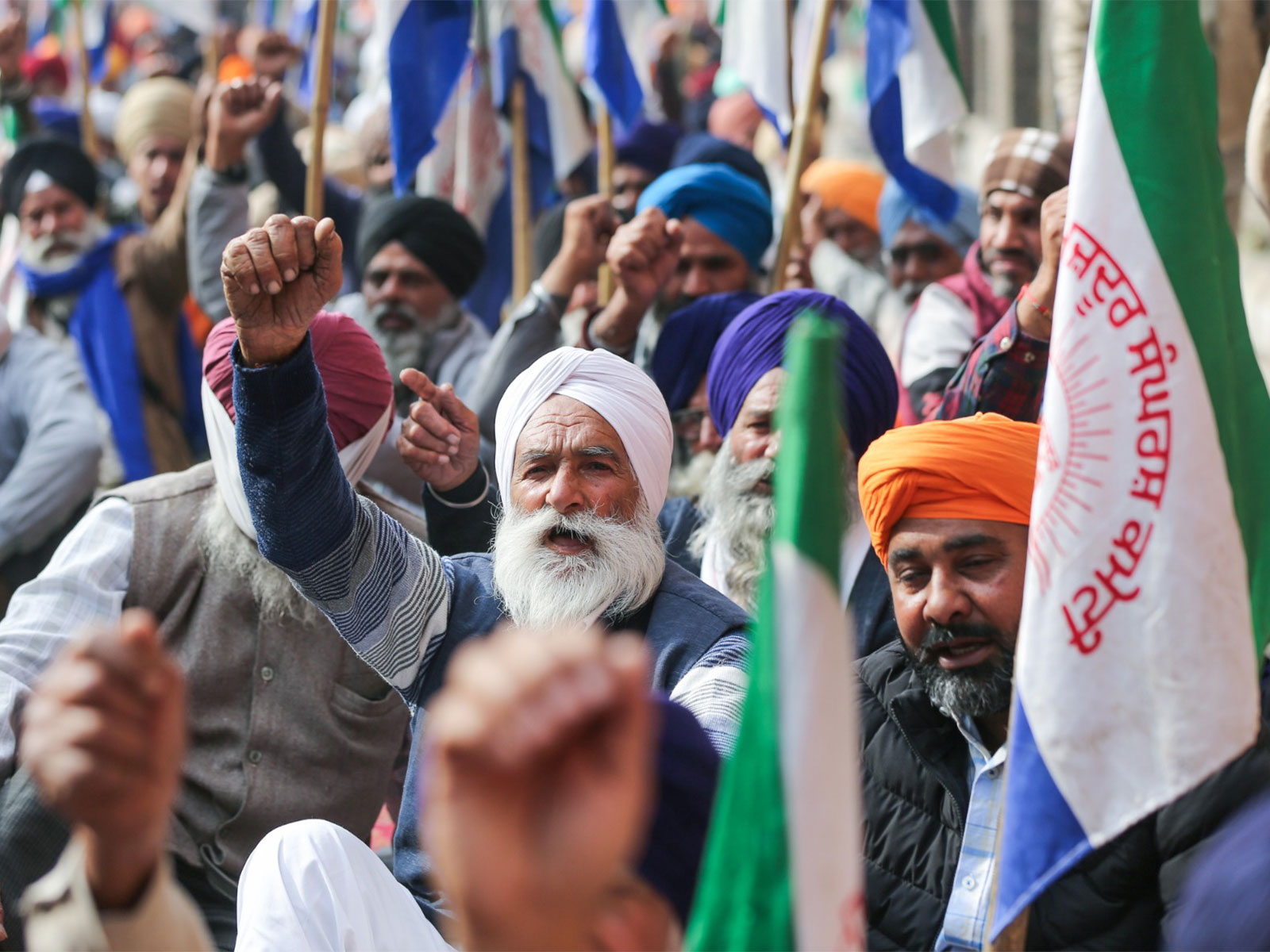
Kisan Mazdoor Morcha to burn effigies across Punjab on Dec 29 over MGNREGA Overhaul
Dec 24, 2025
Amritsar (Punjab) [India], December 24 : The Kisan Mazdoor Morcha Bharat has strongly criticised the Modi Government's recent legislative changes to the Mahatma Gandhi National Rural Employment Guarantee Act (MGNREGA), alleging that the new policies are aimed at depriving MGNREGA workers of employment across the country. By stripping DDPO offices and Panchayats of their implementation powers, the Morcha argues that the Centre is centralising control over work approvals, a shift they plan to oppose through a series of district-level demonstrations starting later this month.
The organisation stated that the Centre has effectively decided to curtail MGNREGA by reducing its funding by nearly 40 per cent. It further alleged that powers previously vested in Panchayats and state government institutions--particularly the DDPO offices, which played a key role in implementing MGNREGA works--are being stripped. According to the Morcha, the Central Government is now centralising decisions on which works will be approved and who will be employed, thereby weakening local self-governance.
The Morcha also claimed that several categories of permissible work under MGNREGA are being cut down. In Punjab alone, there are around 11-12 lakh job cards, while across India, nearly 12 crore workers depend on MGNREGA for their livelihoods. The organisation alleged that by pushing these workers into unemployment, the Centre is attempting to provide cheap labour to corporate houses.
In protest against these policies, Kisan Mazdoor Morcha Bharat announced that it will burn effigies of the Modi Government on December 29 at district headquarters across Punjab.
The Morcha demanded that MGNREGA be restored and implemented in its earlier form. It also called for increasing guaranteed work to 200 days per year and raising daily wages to 700rupees. Additionally, the organisation announced its opposition to the four labour codes implemented by the Central Government, alleging that they undermine workers' rights nationwide.
The Morcha concluded by stating that the struggle will continue until the rights of workers and labourers are fully protected.
Earlier, the ruling DMK-led alliance in Tamil Nadu staged a protest in Chennai against the Viksit Bharat Guarantee for Rozgar and Ajeevika Mission (Gramin) (VB-G RAM G) Act. The demonstration saw participation from leaders of the DMK and its allies, who termed the move an attempt to erase Mahatma Gandhi's legacy from the MGNREGA.
Addressing the media during the protest, Dravidar Kazhagam president K Veeramani strongly criticised the proposed renaming, asserting that Gandhi's ideals cannot be removed through legislative changes. "Gandhi cannot be removed from the hearts of the people. His thoughts, principles and sacrifices are deeply embedded in Indian society," Veeramani said.
Referring to recent remarks by RSS chief Mohan Bhagwat, Veeramani alleged that there are differences within the broader Sangh Parivar. "They are dramatic people. There is a cold war between the RSS and the BJP leadership. You have to read between the lines," he remarked, suggesting that ideological contradictions were surfacing within the ruling establishment at the Centre.
VCK chief and MP Thol. Thirumavalavan accused the BJP-led Union government of attempting to undermine one of the country's most significant social welfare programmes by removing Gandhi's name from it.
"The BJP government is willing to eradicate or eliminate this scheme named after Gandhi," he said, adding that the programme symbolised social justice and employment security for the rural poor.
Thirumavalavan also reiterated his party's support for the Tamil Nadu government's stance on the issue.
"We support the Tamil Nadu government, which is taking steps to condemn the AIADMK and the BJP for supporting such moves," he said, accusing the opposition parties of remaining silent on what he described as an ideological attack on Gandhian values.
The revised Bill guarantees 125 days of wage employment per rural household, up from the existing 100 days, for adult members willing to undertake unskilled manual work.
As per Section 22 of the Bill, the fund-sharing pattern between the Centre and the states will be 60:40. For the Northeastern states, Himalayan states, and Union Territories, including Uttarakhand, Himachal Pradesh and Jammu and Kashmir, the ratio will be 90:10.
Section 6 of the Bill allows state governments to notify in advance a period aggregating up to 60 days in a financial year, covering peak agricultural seasons such as sowing and harvesting.