"Last generation" of hand-pulled rickshaw pullers struggle to stay afloat in Kolkata
Apr 04, 2026
By Rajnish Singh
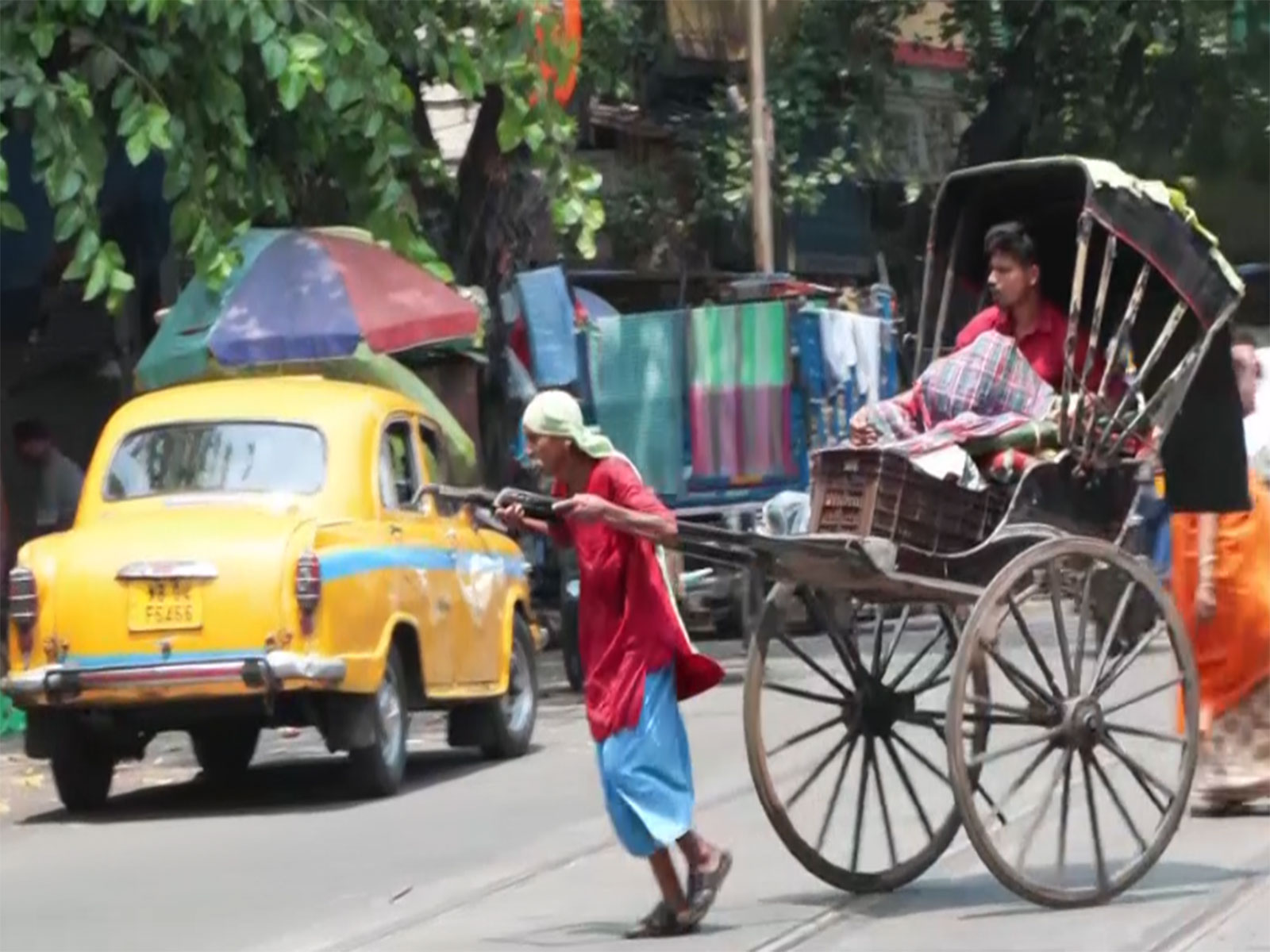
Kolkata (West Bengal) [India], April 4 : The fading presence of hand-pulled rickshaws in West Bengal's Kolkata is not just a story of changing transport preferences, concerns of human dignity, but also of the struggle for livelihood for those still engaged in it.
The erstwhile Left Front government had attempted to ban the hand-pulled rickshaws in 2006 through legislation, stemming from concerns over human dignity. These rickshaws are still present in a few areas, including the older quarters. Locals said that no new licences have been issued for decades and the implementation of the 2006 legislation has been slow.
With a rapid rise of app-based mobility services and improved public transport, those still dependent on hand-pulled rickshaws are finding it increasingly difficult to sustain themselves. Some of them have also tried taking on other vocations, but their efforts have not entirely borne fruit.
Mohd Siddqui, a resident of Bihar's Muzaffarpur, who has been pulling a hand rickshaw in Kolkata since 1979, said that the practice is coming to a natural end.
"This is the last generation pulling a rickshaw. This will end automatically," Siddqui told ANI.
He said there is dwindling income and reduced demand. "There is now minimal income and people rarely prefer to sit on these rickshaws as it is relatively more costly and time-consuming compared to other transport facilities," he said.
The emergence of app-based transport services has significantly altered the urban mobility landscape in Kolkata. Affordable fares, convenience, and faster travel times have made services like bike taxis and cab aggregators the preferred choice for commuters.
In contrast, hand-pulled rickshaws, introduced during the colonial era, are seen as outdated and expensive and not in keeping with the spirit of human dignity.
Siddqui's daily routine reflects the hard realities of the task. "I pull this rickshaw from 6 am to 3 pm regularly," he said.
Despite long working hours, his earnings remain modest. He also has to pay Rs 200 per week to the owner of the rickshaw, further reducing his already limited income.
Most hand-pulled rickshaw pullers in Kolkata are migrants from states like Bihar and Jharkhand, who come in search of livelihood opportunities. With little formal education or alternative skills, many continue in this physically demanding occupation despite declining returns.
Urban experts believe that while modernisation is inevitable, there is a need for rehabilitation policies to support workers like Siddqui. Skill development programs, financial assistance, and inclusion in social welfare schemes could help ease the transition for those still dependent on it for subsistence.
For now, men like Mohd Siddqui continue to pull their rickshaws through the streets of Kolkata.
Umesh Shao, 60, a hand-pulled rickshaw puller from Motihari in Bihar who has been living in Kolkata for over two decades, said the situation has changed drastically over the years.
"Earlier, we used to earn a decent amount, but now the income is very limited. The number of rickshaws is also decreasing steadily. The number of garages has dropped significantly--from around 1,000 earlier to nearly 500, and in some cases even down to 200," he said.
"There are no new rickshaw pullers. Many garage owners are selling off their spaces due to a lack of demand. Commuters are our main customers, but our daily earnings are now only around Rs 400 to Rs 500. We usually charge between Rs 80 and Rs 100 per ride. In the Bahubazar area, there are roughly 200 rickshaws left. Only those who are physically able can continue pulling them," he added.
Chandar, 65, originally from Bihar's Darbhanga and living in Kolkata for nearly 35 years, narrated similar concerns.
"Our income has dropped significantly compared to earlier days. Now we earn around Rs 300 to Rs 400 a day. With the increase in vehicles, the demand for hand-pulled rickshaws has gone down," he said.
Another puller, Ramdhani Yadav from Aurangabad in Bihar, said the decline in customers is noticeable. "Most of our customers are locals," he noted.
A Kolkata-born resident, Chen Jun, who occasionally uses hand-pulled rickshaws, said his choice is driven by empathy. "I have lived here all my life. I use these rickshaws mainly to support the pullers. While we have other transport options, sometimes I pay them around Rs 100 to help them earn," he said.
A 60-year old Nakul Thakur, a native of Hajipur in Bihar and a carpenter specialising in rickshaw repair and manufacturing, said the vocation has lost its value over time. "I have spent my entire life in this work and don't know any other profession. Earlier, there was demand for these rickshaws, but now no one wants to buy them. There used to be occasional orders from cities like Mumbai, with prices ranging between Rs 20,000 and Rs 25,000, but that market no longer exists," he said.
He added that he once owned a workshop but had to shut it down due to poor business. "Now I work in another garage. Earlier, I used to earn around Rs 3,000, but now my daily income has fallen to about Rs 450," he said.
He pointed out that there are only about 10 rickshaw-making garages remaining in Kolkata. "Nowadays, rickshaws are mostly rented out at around Rs 30 per day or Rs 200 per week. There is hardly any profit, especially since the cost of materials has increased significantly," he added.
Jai Kumar Rana, a rickshaw garage owner, said he has been associated with the work for many years.
He said the rickshaws have numbers and if a rickshaw gets damaged, the replacement has the same number.
"Modern transport options such as 'tumtum', app-based services, cycle rickshaws, and auto-rickshaws have significantly reduced demand. Hand-pulled rickshaws are also comparatively more expensive. The number of pullers is decreasing every day," he said
"We have approached the transport department seeking alternatives, but so far, there has been no concrete response," he added.
Despite efforts to phase out man-pulled rickshaws, they remain visible in certain pockets of the city, particularly in north and central Kolkata.