RBI simplifies banking rules, eases MSME financing and expands market participation to boost liquidity
Apr 08, 2026
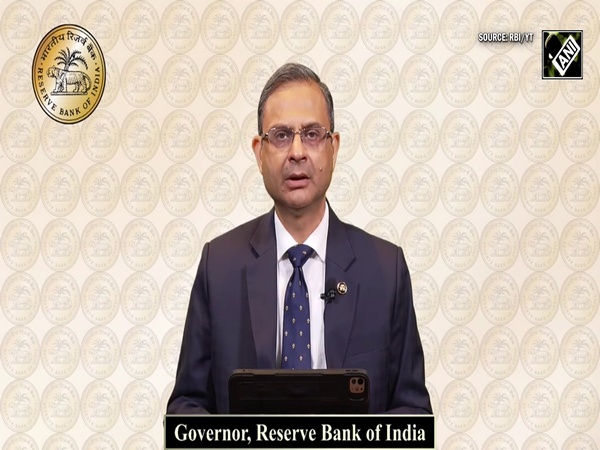
Mumbai (Maharashtra) [India], April 8 : The Reserve Bank of India on Wednesday announced a set of measures aimed at simplifying regulations for banks, improving access to finance for small businesses, and enhancing liquidity in financial markets.
In its official statement, the central bank outlined steps to reduce compliance burden for banks while strengthening the overall financial system.
It stated, "Statement on Developmental and Regulatory Policies... This Statement sets out various developmental and regulatory policy measures relating to Regulations; Supervision; Payment Systems; and Financial Markets".
On the regulatory front, the RBI proposed to ease norms related to capital adequacy by removing certain conditions for including quarterly profits in the Capital to Risk-weighted Assets Ratio (CRAR) calculation. This move is expected to provide greater flexibility to banks in managing their capital.
CRAR is a measure of a bank's financial strength. It shows how much capital a bank has compared to the risks it is taking (like loans). It tells whether a bank has enough buffer to absorb losses if borrowers don't repay.
The central bank also proposed to do away with the requirement for Investment Fluctuation Reserve (IFR) for commercial banks, citing the presence of other prudential safeguards such as capital charge for market risks and updated investment norms. The move is aimed at reducing regulatory overlap and simplifying compliance.
IFR (Investment Fluctuation Reserve). IFR is a reserve that banks keep to protect themselves from losses in investments (like bonds). If the value of bonds or investments falls, IFR acts as a safety cushion to absorb that loss.
In a bid to improve governance, the RBI said it is reviewing the number of items that need to be placed before bank boards. This is expected to allow boards to focus more on strategic decision-making and risk management rather than routine compliance matters.
On the supervision side, the RBI has streamlined its framework by consolidating thousands of existing instructions into a smaller set of master directions. Drafts of 64 such directions covering supervisory guidelines have been released for public consultation, aimed at improving clarity and reducing complexity.
To support Micro, Small and Medium Enterprises (MSMEs), the RBI announced measures to simplify onboarding on the Trade Receivables Discounting System (TReDS). The requirement of due diligence for MSMEs during onboarding will be removed, making it easier for small businesses to access working capital through invoice discounting.
In the financial markets segment, the central bank has decided to broaden participation in the term money market. Non-bank entities such as All India Financial Institutions (AIFIs), Non-Banking Financial Companies (NBFCs), and housing finance companies will now be allowed to participate. Borrowing limits for standalone primary dealers have also been increased.
These steps are expected to deepen market liquidity and improve the transmission of monetary policy by linking short-term and long-term interest rates more effectively.
The RBI's measures are aimed at reducing regulatory burden, improving ease of doing business, and strengthening the efficiency of India's financial system.