Readying the Wings: Inside HAL’s Robotic Revolution
Sep 07, 2026
VMPL
New Delhi [India], September 7: Somewhere on the floor of Hindustan Aeronautics Limited's Aircraft Division in Bengaluru, a robot will soon begin walking slow circles around a fighter wing. It is due eighteen months after the order is placed, which means by the close of 2027. The Indian Air Force has 83 Tejas Mk1A fighters on order and a further 97 contracted, at a moment when squadron strength is thin. Every wing set finished sooner puts an Indian-designed fighter on the flight line sooner. That is the entire argument, and it is a national one.
The obstacle standing in the way is disarmingly small: a hole. Drilled by hand, one hole through a Tejas wing takes twenty-five to thirty-five minutes. A wing pair needs sixteen thousand of them, counting attachment and temporary-fastener holes. The multiplication is merciless, and weeks vanish into a single wing set. No technician was ever at fault here. The arithmetic was.
Understanding why demands a look inside the wing itself. The compound-delta wing is not carved from one material but layered like a sandwich. The outer skins are carbon-fibre composite rated at roughly 1,600 MPa ultimate strength. Underneath sit the bones: front and rear spars, root ribs, pylon and wing-fuselage brackets, made of aluminium-copper alloy and titanium. Each wing needs about 3,200 holes in sizes of 5, 6, 8, 10 and 12 mm passing clean through that mixed stack, plus roughly 2,700 anchor-nut rivet holes of 2.5 mm through skin and spar. Every one must sit within ±0.30 mm of its programmed spot, hold an H8/H9 fit tight enough that the fastener neither wobbles nor jams, and be countersunk so the rivet lies perfectly flush with the surface.
Mistakes here are not forgiven. Carbon fibre cannot be flooded with coolant the way metal can, so the heat of cutting has to be handled dry. Push the drill too hard and the composite layers separate like a wet book drying badly, a defect called delamination, while the metal below throws up burrs. A single flawed hole can become a fuel leak or a weak point in an aircraft manoeuvring at the very limit of what it was designed to bear.
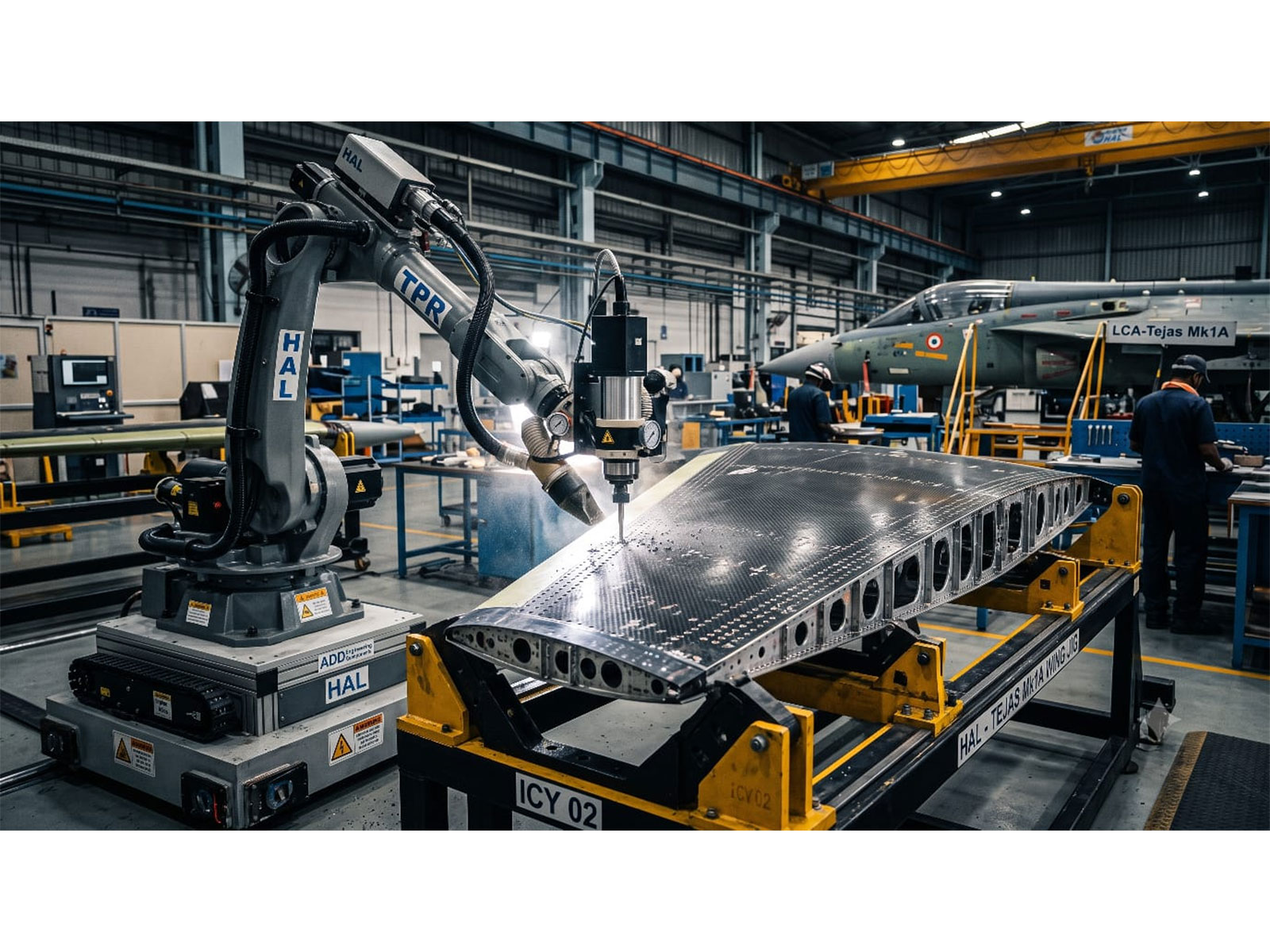
HAL's reply is a first for the division: a fully automated, turnkey robotic cell that clamps, squares up, drills, countersinks, measures and then passes or rejects every hole in one unbroken cycle. The specification leaves no room to negotiate. Under sixty seconds per hole including countersink. Five days at most per wing side across two eight-hour shifts. Twenty wing sets, meaning forty left- and right-hand modules, every year, with room to grow. It forms part of a broader automation push under Chairman and Managing Director Ravi Kota, long associated with the Tejas.
The work is being led by ADD Engineering Components (India), the Bengaluru arm of Germany's ADD Engineering GmbH and an HAL-registered MSME headed by Girish Linganna, through a consortium spanning three countries. Britain's True Position Robotics contributes automated drilling and inspection technology already flying on Boeing and BAE programmes, with lightweight drill heads and optical guidance that keeps the aim honest. Germany's Robot-Technology GmbH provides the cell, its mobile seventh axis, the controls and the integration. Tooling and fixtures come from India's Ripple Technologies, while German specialists Norbert Kreller and Dr Werner Gryksa bring NASA and fighter-programme experience.
The machine itself is a six-axis articulated arm, jointed roughly like a human shoulder, elbow and wrist, carrying secondary encoders for aerospace-grade precision and mounted on a mobile platform. The wing stays still; the robot travels, floating on air bearings for fine positioning before locking onto floor references and working as steadily as if bolted down. A thirty-station tool changer, cameras, probes and a test-coupon station ride along with it. A fixture cradles both wings at their ICY points, the master features around which the airframe is built.
At the working tip, a water-cooled spindle spins from just over 200 rpm for titanium up to 20,000 rpm for softer stacks, delivering at least 10 Nm of continuous torque, with nose-piece dust extraction aiming at 95 per cent capture and chilled air blowing at the cutting edge. A camera locates the programmed coordinate by reading reference points and existing holes against the digital model. A pressure foot fitted with normality sensors presses the stack square so the drill bites perpendicular and the layers stay bonded. One dry pass produces both hole and countersink. A probe then verifies diameter to ±0.005 mm, countersink depth to ±0.05 mm and trueness at top, middle and bottom, storing each result under a unique identity. Any hole outside tolerance stops the cell. Cutter wear is monitored live, and tools replace themselves.
Programming happens offline from the design model, complete with collision avoidance and escape paths, and HAL's own engineers can edit it. The software is specified to accept Tejas Mk2 and AMCA data, with perpetual licences and twenty years of spares and service. Design reviews fall due within two months, followed by coupon trials, inspection at the builder's works and final acceptance on a wing set in Bengaluru. Two years of warranty give way to five of full maintenance, with a specialist present every working day and a 90 per cent uptime target. The cell must survive twenty years of Indian heat and humidity.
What shifts is more than tempo. Quality stops depending on how steady a pair of hands remains at the end of a long shift and becomes a property built into the machine. Human skill does not disappear; it climbs, into programming, into judgement, into supervision. More wings, more Tejas, sooner.
(ADVERTORIAL DISCLAIMER: The above press release has been provided by VMPL. ANI will not be responsible in any way for the content of the same.)