Why HR Software in India Is Moving to Employee Self-Service
Jan 21, 2026
VMPL
New Delhi [India], January 21: HR teams in India operated behind the scenes for many years. Employees reached out to HR teams for leave details, payslips, policy questions, or basic updates through email, phone, or spreadsheets. This approach worked when organisations were smaller, and everyone worked from the same office. In today's larger and more spread-out workplaces, it no longer holds up.
As organisations grow larger, more distributed, and more dynamic, the way HR operates is changing. This shift is one of the key reasons HR Software in India is steadily moving towards HRMS ESS (Employee Self-Service) models. What was once seen as a "nice-to-have" feature is now becoming a core requirement.
The Pressure HR Teams Are Facing Today
There is increasing strain on HR departments throughout India. There are more workers dispersed across states, cities, and time zones. There are stricter criteria for compliance. Employees also want easy access to information and prompt responses.
In many organisations, HR teams still spend a significant part of their day responding to repetitive questions:
* "Can you resend my payslip?"
* "What is my leave balance?"
* "Where can I find the policy document?"
* "Can you update my bank details?"
None of these tasks is complex. But when multiplied across hundreds or thousands of employees, they consume time and slow down HR teams.
This is where HRMS ESS is making the difference.
What Employee Self-Service Really Means in Modern HR Software
Employee Self-Service is often misunderstood. It is not about shifting HR work onto employees but giving employees direct access to information they already own.
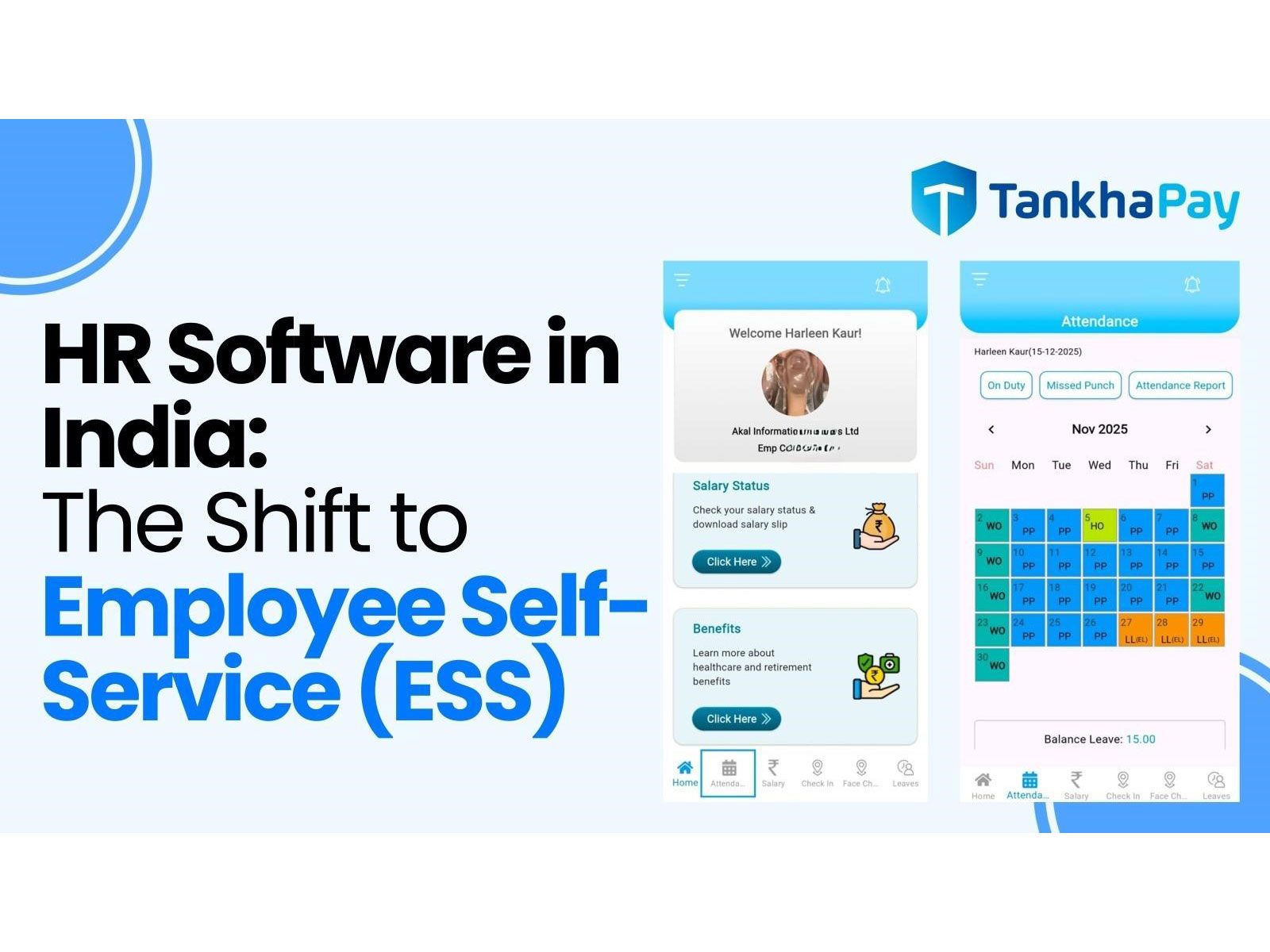
In simple terms, ESS allows employees to:
* Access payslips & tax documents whenever required, without having to request them. * Check attendance records & leave balances on their own, without waiting for approval or confirmation.
* Personal information, like address or bank data, can be updated on their own * Access HR policies and official letters in one place
* Raise requests and track their status without repeated follow-ups
Modern HR Services is built around this idea of access and transparency. Instead of HR acting as a gatekeeper, the system becomes the single point of reference. Employee friction is decreased, and HR staff are relieved of ongoing manual intervention with this method.
Why Indian Organisations Are Embracing ESS Models
The shift towards employee self-service is not accidental. It is driven by clear operational realities.
* Hiring has picked up pace. Teams are growing faster and expanding across locations. Handling HR through email and spreadsheets starts to break down, leading to mistakes.
* Work no longer happens in one place. Employees cannot approach an HR desk in remote or hybrid setups. Information must be available to them at all times, not just during business hours.
* Expectations have shifted. People are used to apps that show information instantly. Waiting days for basic HR answers now feels slow and outdated.
This is why many of the Best HR Companies in India are building ESS into the core of their HR strategy, not as an add-on.
How HR Software in India Supports This Shift
Employee self-service works only when the system behind it is reliable. Modern HR platforms are designed to support this shift in a few key ways.
* Everything remains in one location. When something is updated, it appears everywhere it should, since employee information, attendance, payroll data, and documents are all linked.
* Workflows are consistent and easy to understand. Instead of becoming buried in emails and back-and-forth correspondence, leave requests, approvals, and changes adhere to a predetermined procedure.
* Access is well-defined. Employees can view their own information, while sensitive details remain restricted and protected.
* The system is easy to use. If people struggle to find what they need, self-service doesn't work. That's why modern HR tools focus so much on simple, intuitive design.
What Changes for HR Teams
When employee self-service is implemented well, HR teams notice a visible shift in how their time is spent.
Every day, HR questions have reduced significantly. There are fewer reminders to chase, fewer follow-ups to handle, and inboxes are no longer filled with requests for basic information.
This gives HR departments more time to concentrate on work that has a real impact on the organisation, such as:
* Workforce planning: Understanding current needs, future hiring, and how teams will grow or change over time.
* Employee engagement: Devoting more effort to projects that enhance employee satisfaction, retention, and morale.
* Performance and skill development: Assisting supervisors and staff in developing skills rather than merely finishing paperwork.
* Policy and governance: Examining and modifying HR regulations to keep them transparent, equitable, and in line with corporate objectives.
Over time, HR stops functioning like a support desk and starts playing a more strategic role in the business. This shift is one of the biggest reasons leadership teams are investing in modern HR Companies in India.
Why CXOs Are Paying Attention
For CXOs and founders, ESS is not just an HR efficiency tool. It brings clarity and consistency.
* Better visibility for leaders: Workforce data is available when needed, without waiting for manual reports or follow-ups.
* More predictable processes: HR workflows follow a clear structure, making day-to-day operations easier to manage.
* Smoother audits and reviews: Records are already organised, so audits take less time and effort.
* Increased employee trust: Employees feel more assured about how HR procedures operate when they are able to examine their personal information and papers.
ESS is increasingly viewed as a way to improve control and accountability rather than just a software update because of these advantages.
When Employee Self-Service Becomes Essential Employee Self-Service stops being a nice-to-have and becomes essential in certain situations:
* When organisations are large or growing quickly
* When teams are situated across multiple locations or states
* When employees work in remote or hybrid setups
* When there is frequent hiring or high employee turnover
* When the business operates in compliance-heavy sectors
In these cases, relying on manual HR processes leads to delays, confusion, and frustration for both employees and HR teams.
A Quiet Shift Already Underway
Many of the Best HR Companies in India are no longer debating whether to adopt employee self-service. They are refining how well it works.
The focus is shifting from "Do we have ESS?" to "Is our ESS actually being used and trusted?"
This reflects a broader change in how HR viewed, not as an administrative layer, but as an experience function supported by the right systems.
Closing Perspective
The move towards ESS is not about reducing HR's role. It is about redesigning how HR operates in a modern organisation.
Access, openness, and quickness are more crucial than ever as workforces expand and expectations change. With the help of dependable HR software in India, HRMS ESS is emerging as the cornerstone that enables HR staff to stay up to date without experiencing burnout.
For organisations that want to scale responsibly and build trust with their workforce, employee self-service is no longer a future concept. It is already becoming the new standard.
(ADVERTORIAL DISCLAIMER: The above press release has been provided by VMPL. ANI will not be responsible in any way for the content of the same.)