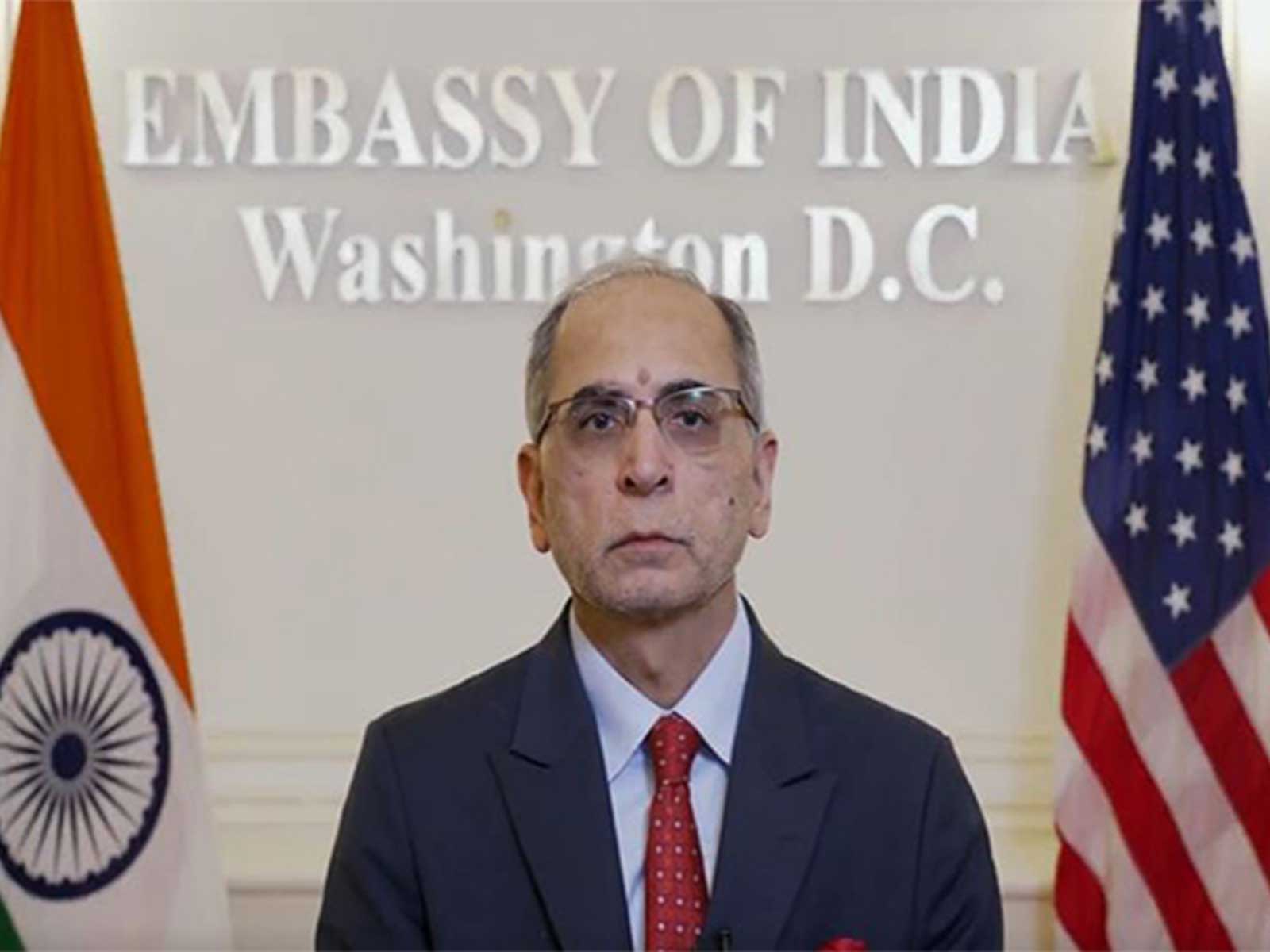
Ambassador Vinay Kwatra dispels "myths" around FCRA Bill 2026; highlights asset protection, religious neutrality
Aug 10, 2026
New Delhi [India], August 10 : Amid intense political debate over the proposed Foreign Contribution (Regulation) Amendment Bill, 2026, India's Ambassador to the United States Vinay Kwatra has moved to dispel "myths" regarding the takeover of NGO assets and allegations of religious targeting, placing protection mechanisms for charities and places of worship at the forefront of the government's stance.
The FCRA Bill 2026 was reintroduced in the Lok Sabha during the Monsoon Session. The Bill seeks to amend the Foreign Contribution (Regulation) Act, 2010, with the stated objective of enhancing transparency and accountability in the regulation of foreign contributions.
On concerns regarding the potential seizure of NGO assets, including places of worship, hospitals, and educational institutions, Kwatra clarified that statutory provisions governing asset custody following registration cancellation or surrender have been in place since 2010 and are not new.
"When a registration is cancelled or surrendered, foreign contributions and the assets created from them already vest in a State Government authority. This has been in force since 2010. It is not new," Kwatra stated. "What the 2026 Bill adds is a designated authority to safeguard those assets -- and a way back. If the organisation restores its registration, all assets and unused funds are returned in full," he wrote on X.
He further underscored specific statutory safeguards designed to protect religious properties and ensure continuity of worship across faiths.
"Places of worship carry their own protection. Where a cancelled association has created property connected to a place of worship, that property goes to another FCRA-registered association of the same faith to ensure continuity of worship," he added.
He further explained that the 2026 Bill establishes a designated authority to safeguard these assets and introduces a mechanism for restoration.
"What the 2026 Bill adds is a designated authority to safeguard those assets -- and a way back. If the organisation restores its registration, all assets and unused funds are returned in full."
Directly responding to assertions that the legislation targets specific religious groups or minority charities, the Ambassador maintained that the legal framework operates on absolute religious neutrality.
"Nothing could be farther from it. The Act applies uniformly to all organisations regardless of religion, community or ideology," Kwatra noted, clarifying that "faith-based welfare activities, including religious education, maintenance of places of worship, and charitable work by organisations of every faith, continue to be eligible for foreign funding."
Dismissing claims that FCRA measures have curtailed NGO operations or diminished foreign funding inflows, Kwatra shared data illustrating sustained growth in foreign contributions.
"In reality, foreign money inflows into India have been rising, not falling. Foreign contributions to registered organisations grew from roughly $1.2 billion in 2010-11 to $2.67 billion in 2024-25," the Ambassador wrote.
Highlighting the scope of the law, Kwatra pointed out that "India has over 3 million NGOs. A bare fraction of these, only 14,450, hold FCRA registration. Thus, the overwhelming majority of the civil society organizations are entirely outside the Act. FCRA does not stop anyone from accepting foreign charity, research grants or humanitarian aid. It asks three things -- register, receive the money through laid down process, report what you did with it."
Responding to assertions regarding the legislative framework governing foreign donations in India, Ambassador Kwatra presented a fact check addressing key concerns raised across international media and civil society.
Clarifying the global context of such regulatory measures, Kwatra noted that India is far from being an anomaly in regulating foreign financial flows.
"The US has had FARA since 1938 and FATCA since 2010. Australia legislated in 2018, Canada in 2024. The UK's scheme came into force in July 2025. The EU is legislating now," Kwatra wrote in a post on X.
Refuting claims that the measure aims to cut off foreign aid, the Ambassador traced the evolution of the FCRA framework from its inception in 1976 through updates in 2010, 2016, 2018, and 2020.
"The 2026 Bill and Rules are the next step in the same direction: more transparency, better governance, clearer rules," Kwatra stated, reassuring that tens of thousands of registered associations continue to routinely receive foreign donations for health, education, research, disaster relief, and humanitarian work.
Emphasising national security as the foundation for financial oversight in public and political spheres, Kwatra characterised the proposed legislation as a sovereign measure aligned with modern democratic governance standards.
"Regulation of foreign financial flows in public and political spaces is a sovereign step driven by national security concerns. It is an accepted feature of modern governance in many democracies around the world," Kwatra wrote.
https://x.com/AmbVMKwatra/status/2086635461250879980
The proposed legislation provides that an organisation's FCRA registration will cease upon expiry, non-renewal or refusal of renewal by the government. It also provides for the creation of a designated authority to oversee the vesting, supervision, management and disposal of foreign contributions and related assets.
The Union Government is likely to take up the Foreign Contribution (Regulation) Amendment Bill, 2026, for discussion in Parliament on August 12.