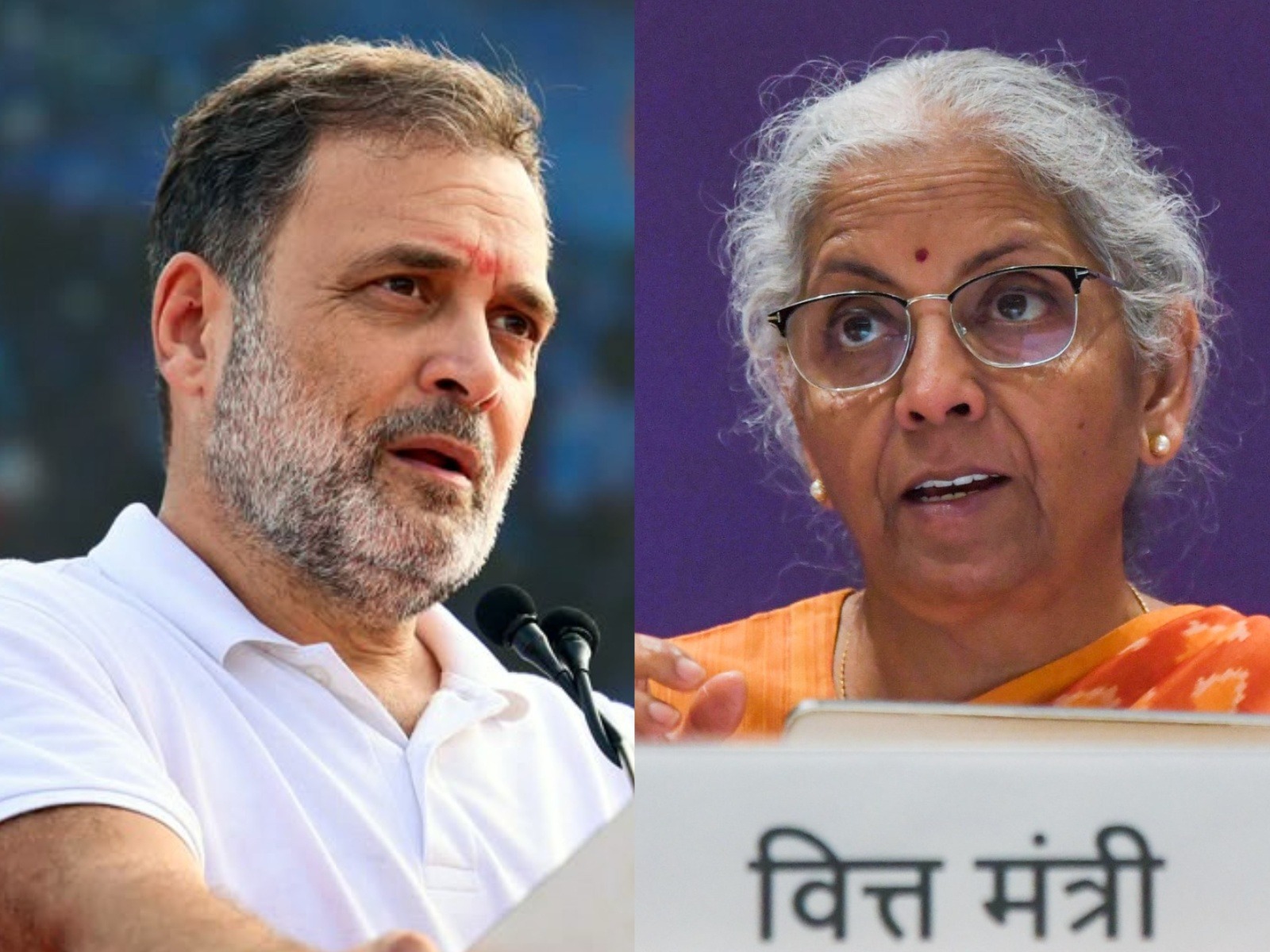
"Congress-era banking had phonebook for powerful and rulebook for common citizens": Sitharaman fires back at Rahul Gandhi over IDBI Bank stake sale
Oct 30, 2026
New Delhi [India], October 30 : Targeting the Congress party, Union Finance Minister Nirmala Sitharaman on Friday launched a robust defence of the NDA government's strategic disinvestment of IDBI Bank, while accusing past Congress-led administrations of systemic financial mismanagement, political cronyism, and coercing public sector banks into reckless lending.
The statement comes in direct response to Leader of Opposition Rahul Gandhi's sharp criticism regarding the proposed sale of a controlling stake in IDBI Bank to a subsidiary of Canada's Fairfax Financial Holdings.
In a post on X, Sitharaman cited a litany of historical controversies and economic mismanagement spanning decades to illustrate how previous administrations allegedly subverted financial institutions for political patronage, flipping the narrative on institutional stewardship.
Recalling milestones of historical political interference, the Finance Minister pointed out the 1957 Mundra scandal, the 1976 dismissal of the then-SBI Chairman RK Talwar, Maruti and loan pressures and the 1980s and UPA era.
"We all know how @INCIndia has used Banks and financial institutions as personal entities and pressured bank employees to extend loans at their whim, bypassing prudent lending norms. Let me list a few instances. - In 1957, Haridas Mundra got money from LIC due to influence by the Congress leaders. - In 1976, Indira Gandhi's government removed SBI Chairman R.K. Talwar after he refused political pressure to relax lending conditions for a company linked to Sanjay Gandhi's circle. - Sanjay Gandhi pressured the Central Bank of India over loans to Maruti. - B. Janardhana Poojary, MoS Finance under Indira Gandhi and Rajiv Gandhi — pressured bank employees to issue loans in the 1980s. - Pawan Kumar Bansal, as a minister in the UPA, pressured Canara Bank to give loans to his family-linked businesses," she posted on X.
Furthermore, Sitharaman highlighted that IDBI Bank was handed over to the NDA administration in a heavily distressed state due to forced loans extended to prominent business groups with political connections—such as Videocon, Winsome, ABG Shipyard, and Kingfisher—which eventually devolved into massive non-performing assets (NPAs).
"The IDBI Bank was handed over to us in poor shape, as IDBI itself was forced to lend to large business groups with close connections to @INCIndia leaders such as Videocon, Winsome, ABG Shipyard, Kingfisher, etc. These turned into bad loans, causing huge losses for IDBI Bank, which we recognised," she added.
Highlighting the turnaround achieved over the last decade, Sitharaman noted that the NDA government under Prime Minister Narendra Modi successfully revived IDBI Bank through professional management, rigorous prudence, and a capital infusion exceeding ₹25,000 crores.
Reiterating the government's official stance on the current strategic restructuring process, the Finance Ministry clarified that all due procedures, independent valuations, and transparent bidding protocols have been strictly followed under the purview of the Core Group of Secretaries on Disinvestment (CGD).
"The NDA govt led by Hon'ble PM Shri @narendramodi revived the IDBI bank through professionalism, prudence and recapitalisation of more than Rs 25,000 crores. The IDBI Bank is now poised for its next phase of growth. All due process has been followed in the IDBI Bank strategic restructuring, and we have already clarified this yesterday," she added.
Addressing ongoing apprehensions and opposition narratives, Sitharaman invoked the findings of the White Paper on the Indian Economy (released in February 2024), drawing a sharp dividing line between past practices and modern economic governance.
"Congress-era banking had a phonebook for the powerful and a rulebook for the common citizens. The era of 'connection and setting banking' is over," Sitharaman asserted.
According to the Ministry's statement, the initial bidding round in FY 2025–26 followed Department of Investment and Public Asset Management (DIPAM) indicative guidelines, allowing necessary procedural flexibility for complex transactions.
The reserve price remained unchanged during the second round, and revised processes successfully enhanced the discovered bid price by ₹3,917 crore. Asset and business valuations were conducted independently using recognised methods, including comparable company multiples based on listed public sector banks.
The Ministry’s defence heavily referenced the White Paper on the Indian Economy (released in February 2024), which contrasts contemporary banking reforms with the state of public sector lending under previous UPA administrations.
Sitharaman emphasised that common citizens today enjoy straightforward access to credit without financial employees facing phone-call pressures from political elites, dismissing opposition claims as politically motivated rhetoric akin to past failed allegations.
"Many more instances of blatant scams and economic mismanagement have been covered in the White Paper on the Indian Economy released in February 2024. It remains relevant even now. Your lies with respect to Rafale had failed and were exposed. You had to apologise. The same will happen here. Common people now have easy access to loans, and employees are not under pressure to extend loans over the phone calls," added Sitharaman.
Earlier today, Rahul Gandhi strongly criticised the central government’s decision to sell a controlling stake in IDBI Bank to a subsidiary of Canada's Fairfax Financial Holdings.
The friction follows the Union Cabinet's approval of a ₹52,878 crore (USD 5.56 billion) deal to divest a 60.72 per cent combined stake held by the central government and the Life Insurance Corporation of India (LIC).
Extending staunch support to protesting bank employees, Rahul Gandhi accused the ruling administration of dismantling public sector banking pillars established during the Congress era. "During Congress's time, IDBI was established—to build the nation's industry. During Modi's time, first the bidding was seen, then the price was set. During Congress's time, banks were being created. During Modi's time, they are being sold," Rahul Gandhi wrote in a post on X.
In a personal letter to IDBI employees, Gandhi warned that privatisation would strip away institutional protections. "When IDBI is privately owned, reservation for SC, ST and OBC candidates will go with it. Your service conditions, already weakened, will lose their last protection. The Congress has always believed in a strong public sector working alongside the private sector. Public banks are not assets to be sold off, they are tools to build the nation," he cautioned.
The Union Cabinet on October 14 approved a deal worth Rs 52,878 crore (USD 5.56 billion) to sell a 60.72 per cent controlling stake in IDBI Bank to a subsidiary of Canada's Fairfax Financial Holdings.
Under the proposed transaction, the government will sell its 30.48 per cent stake, while Life Insurance Corporation of India (LIC) will divest 30.24 per cent. Following the sale, the government's shareholding will fall to 15 per cent and LIC's to 19 per cent.