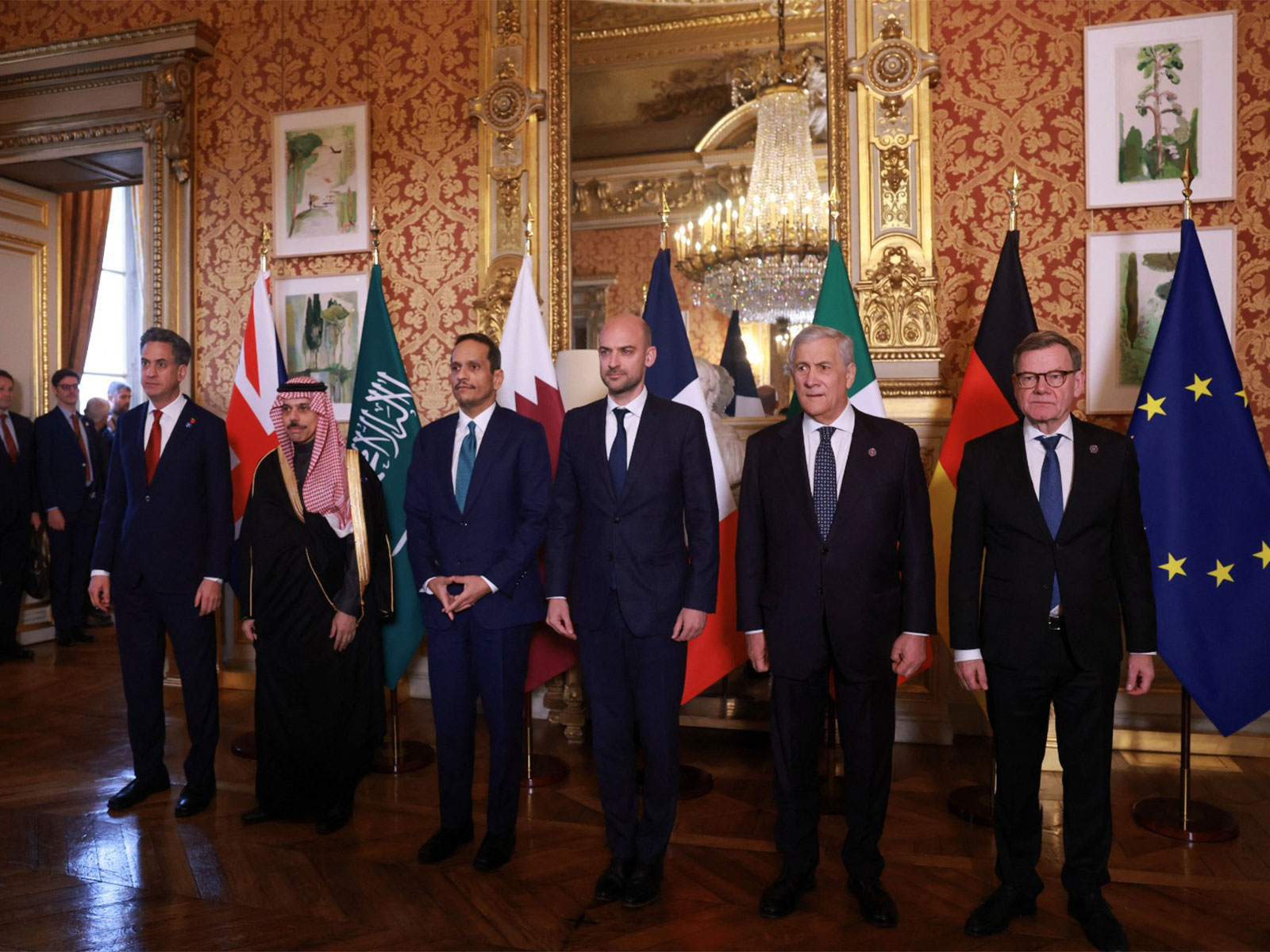
G7 foreign ministers condemn Iranian maritime aggression and Houthi strikes, reaffirm backing for Ukraine
Nov 15, 2026
Washington, DC [US], November 15 : The US Embassy in Saudi Arabia has highlighted key security commitments from last week’s G7 Foreign Ministers’ Meeting in Paris, spotlighting the bloc's strong condemnation of Iranian aggression in the Strait of Hormuz and continued Houthi strikes against Saudi Arabia and Yemen.
In a social media update emphasising takeaways from the diplomatic gathering, the embassy underscored the G7 ministers' sharp rebuke of Tehran and its regional proxies over threats to Gulf stability and global trade routes.
"We strongly condemned Iran’s attacks against its neighbours and the disruption of international trade, energy security, and the global economy caused by the obstruction of transit passage through the Strait of Hormuz," the highlighted statement read.
The embassy also drew attention to the bloc's solidarity with Riyadh and Sana'a amid cross-border hostilities.
"We condemned in the strongest terms the unacceptable continued strikes carried out by the Houthis in Yemen and against the Kingdom of Saudi Arabia, including those on civilians and civilian infrastructure," the ministers stated, calling on the Houthis to immediately halt military actions to allow an inclusive political process to resume.
Reaffirming the right of Saudi Arabia and the Yemeni government to defend their sovereignty and territorial integrity under international law, the G7 further urged all external actors, explicitly naming Iran, to cease arming and supporting the Houthis in violation of United Nations Security Council resolutions.
The points amplified by the US Embassy form part of a broader Joint declaration released by the G7 Foreign Ministers of Canada, France, Germany, Italy, Japan, the United Kingdom, the United States of America and the High Representative of the European Union following the Meeting in Paris on November 9 and 10, which detailed coordinated military, diplomatic, and economic measures across the Middle East.
https://x.com/USAinKSA/status/2121963690282864857
In the full statement, the ministers demanded that Iran stop attacking civilian vessels in the Strait of Hormuz and rejected any illegal tolls, fees, or transit restrictions. The bloc praised defensive demining and vessel-escort operations by US Central Command alongside a multinational defensive initiative led by France and the United Kingdom to clear mines and restore maritime traffic.
On Iran’s nuclear program, the G7 reiterated that Tehran must never acquire a nuclear weapon, urged full cooperation with the International Atomic Energy Agency (IAEA), and pledged to enforce UN sanctions reinstated via the snapback mechanism in September 2025. The ministers also backed the UK’s attribution of Iranian involvement in a September 27 incident at RAF Fairford, warning that the bloc remains united against Iranian plots targeting their citizens and territories.
Addressing the wider conflict in Yemen and the Red Sea, the G7 demanded the urgent opening of a humanitarian corridor in Taiz, the unconditional release of 70 unjustly detained UN staff, and praised EU naval missions EUNAVFOR ASPIDES and ATALANTA for protecting shipping in the Bab al-Mandeb Strait and Gulf of Aden.
Elsewhere in the region, the ministers called for the full implementation of UN Security Council Resolution 1701 in Lebanon, including the disarmament of Hezbollah, progress on Israeli-Lebanese pilot zones as the Lebanese Armed Forces deploy, and financial reforms toward an IMF program.
On Gaza and the West Bank, the bloc urged swift implementation of UN Security Council Resolution 2803, the decommissioning of Hamas weapons with no future governance role for the group, progressive Israeli withdrawal from Gaza, expanded humanitarian crossings, and an end to violence in the West Bank.
Regarding Syria, the ministers reaffirmed support for a peaceful, inclusive political transition, the integration of Northeast Syria, the protection of civilians in Southern Syria, and economic reconstruction.
Turning to Eastern Europe, the G7 Foreign Ministers reaffirmed their "unwavering support to Ukraine and its courageous people as they defend their territorial integrity, sovereignty, freedom, and independence" amid daily Russian strikes on residential areas and infrastructure.
The bloc voiced backing for ongoing US-led diplomatic negotiations toward a full, reciprocal ceasefire, starting with a mutual halt to strikes on energy infrastructure and civilian shipping in the Black Sea, while insisting that European nations must be included in talks concerning Europe's future security architecture.
Building on pledges from the Évian Summit, the ministers reviewed deliveries of air defense systems, interceptors, and long-range capabilities to Kyiv, pledged coordinated financing for Ukraine in 2027 and beyond, and announced stepped-up winter energy support, including repairs to the Chornobyl New Safe Confinement and cyber resilience projects under Italy's Tallinn Mechanism.
Finally, the G7 vowed to tighten sanctions on Russia’s war economy, specifically targeting shadow-fleet vessels, false-flag ships, insurers, and oil traders, while condemning military support provided to Moscow by North Korea and Iran, as well as China's supply of weapons, military training, and dual-use components.