Green growth, faster environmental reforms to drive India's electric mobility future: Bhupender Yadav
Jul 02, 2026
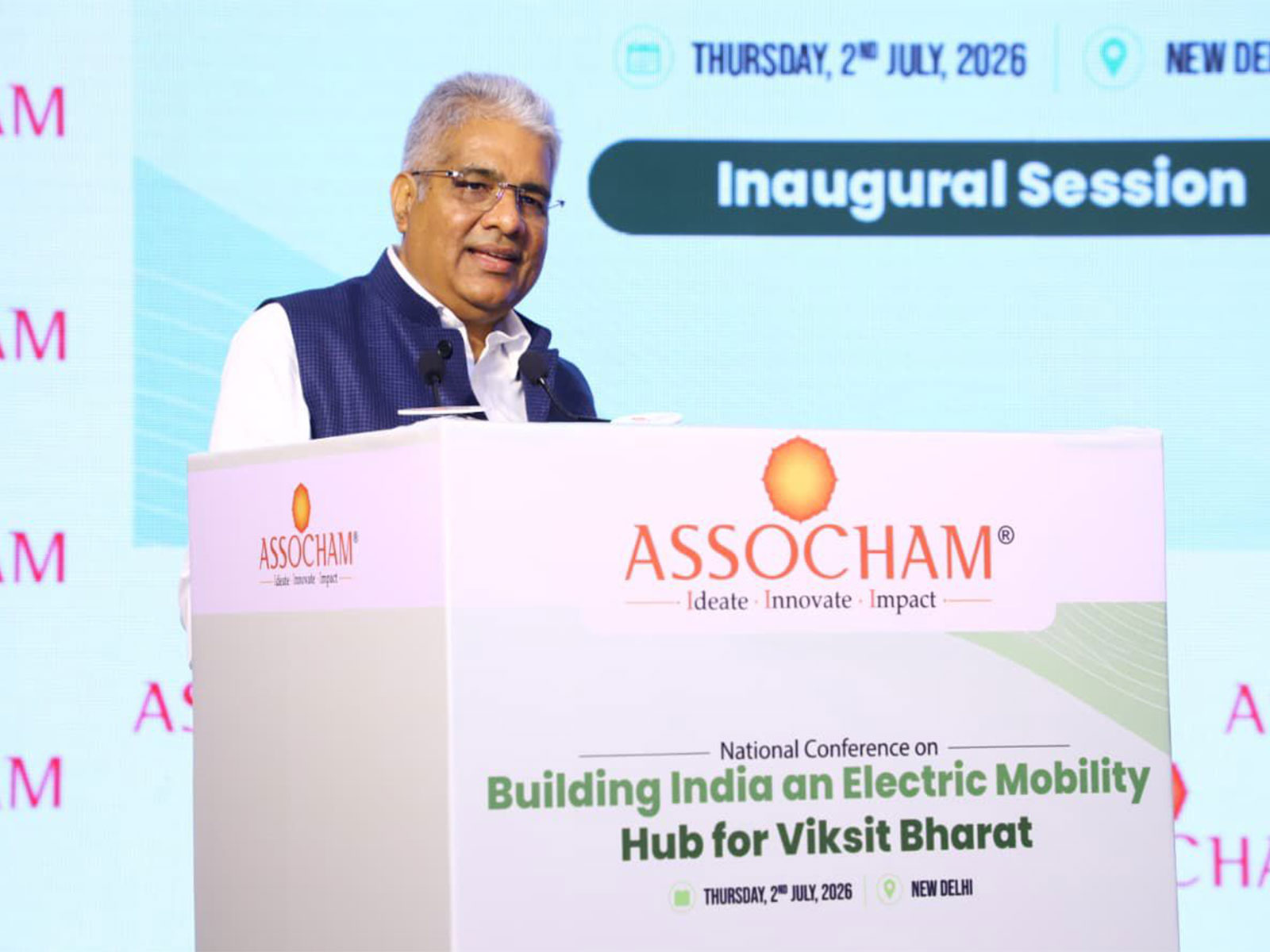
New Delhi [India], July 2 : Green growth, faster environmental reforms, and a circular economy will drive India's electric mobility future, said Union Minister for Environment, Forest and Climate Change, Bhupender Yadav.
Speaking at ASSOCHAM's National Conclave on Building India as an Electric Mobility Hub for Viksit Bharat, he stated that the country's transition must rest on sustainable infrastructure, transparent governance, and robust manufacturing. The Minister detailed recent administrative reforms designed to accelerate sustainable industrial development while improving the ease of doing business.
The government focused on faster environmental clearances, simplified compliance, and the expansion of the PARIVESH digital platform with AI-enabled decision support. These measures lengthen the validity of approvals and support a resilient supply chain, battery recycling, and critical minerals sourcing.
"India's transition to electric mobility must be viewed as part of a larger vision of sustainable industrial development. As we move towards Viksit Bharat, our reforms must be guided by four priorities--green growth, improved quality of life, resilient infrastructure, and transparent governance," Yadav said.
"The Government has undertaken wide-ranging reforms to simplify environmental clearances, strengthen digital governance through PARIVESH, reduce approval timelines, and improve the ease of doing business while ensuring robust environmental safeguards," he added.
"The future of electric mobility depends on building strong domestic manufacturing capabilities, secure critical mineral supply chains, battery recycling, and a circular economy. India's development model is one where ecology and economy move together, enabling sustainable growth, greater competitiveness, and long-term prosperity," the Minister stated.
Advisor to the Prime Minister, Tarun Kapoor, noted that electric mobility evolved from an environmental priority into an economic and strategic imperative. He stated that while progress remained strong in the two and three-wheeler segments, the next phase required accelerated adoption across commercial vehicles, buses, and freight transport.
"With continued policy support and industry participation, India has the opportunity to emerge as a global manufacturing and technology hub for electric mobility," Kapoor said.
ASSOCHAM President, Nirmal K Minda, stated that government initiatives like PM E-DRIVE and Production Linked Incentive schemes created strong momentum. He called for deeper collaboration among government, industry, and academia to build globally competitive supply chains.
ASSOCHAM National Council on Green Mobility Chairman, Nishant Arya, emphasized that India possessed the potential to design, engineer, and manufacture electric mobility solutions for the global market. He said that strong partnerships would allow the country to emerge as a hub for clean technology exports.
Metropolitan Transport Corporation (Chennai) Ltd Managing Director, Thiru D Mohan, added that the transition reached a decisive stage, citing the Delhi EV Policy as a strong blueprint for states to expand electric public transport and strengthen infrastructure.
The event concluded with ASSOCHAM Secretary General, Saurabh Sanyal, reaffirming the chamber's commitment to working with the government through policy advocacy and industry collaboration.