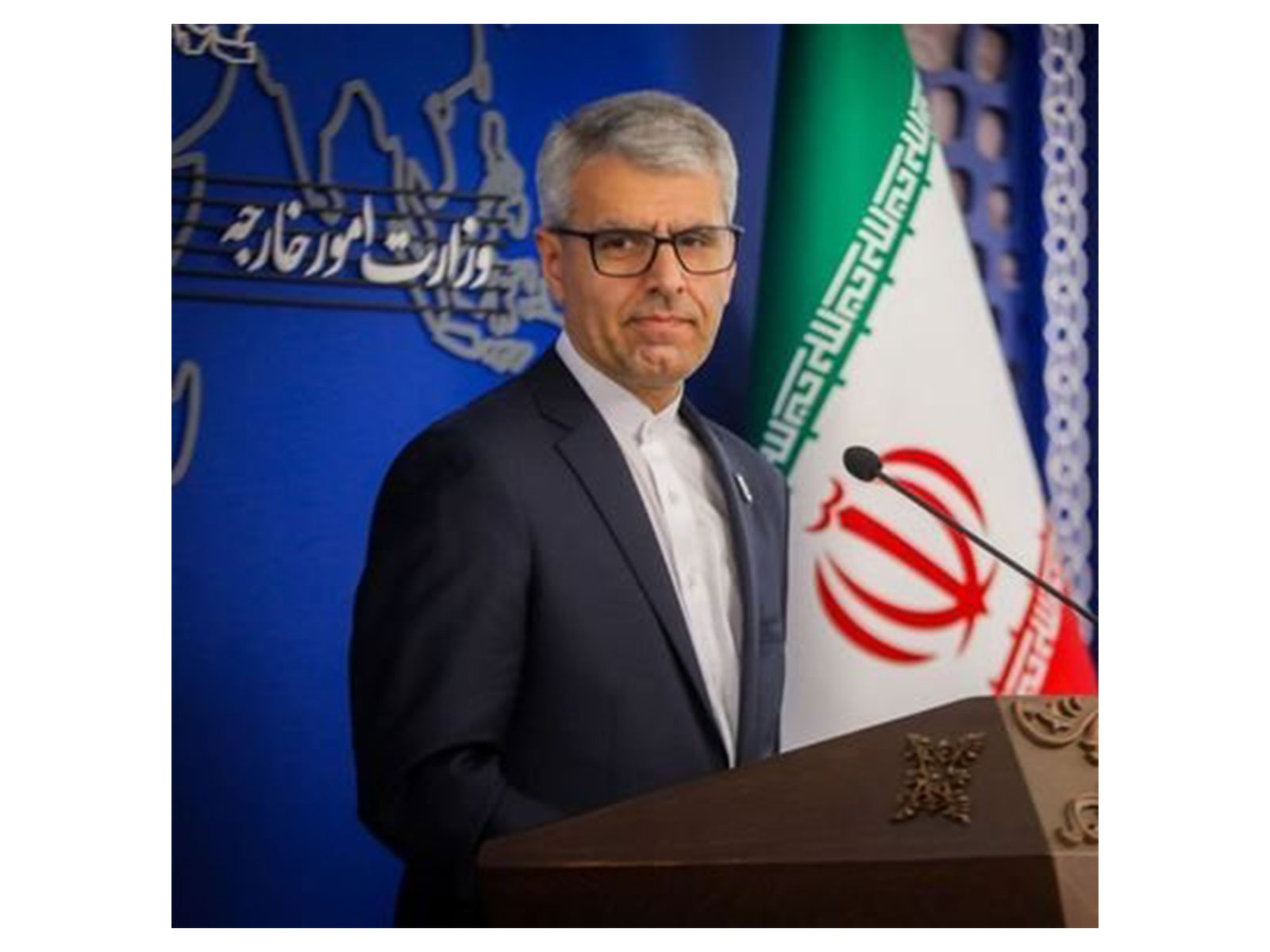
Iran FM spokesperson Baghaei says "US left negotiating table, destroyed it twice in 9 months"; urges focus on Hormuz and ending regional conflict
May 11, 2026
New Delhi [India], May 12 : Iran accused the United States of repeatedly sabotaging diplomatic efforts over Tehran's nuclear programme, with Foreign Ministry spokesperson Esmaeil Baghaei saying Washington "destroyed" negotiations despite Iran's compliance with the 2015 nuclear deal and years of engagement through international mediators.
In an interview with India Today, Baghaei defended Iran's right to peaceful nuclear energy under the Nuclear Non-Proliferation Treaty (NPT), criticised what he called America's "maximalist demands", and said Tehran now wants talks to prioritise ending regional conflict, reopening the Strait of Hormuz, and easing maritime tensions affecting global trade.
The original JCPOA (signed by the P5+1 and the EU) was designed to limit Iran's nuclear program in exchange for sanctions relief, a framework Trump has systematically dismantled in favour of a new, yet-to-be-finalised agreement.
"We have been in a diplomatic process with the United States for more than 10 years now. We started negotiations on the nuclear issue in 2012, and that process led to the formation of the JCPOA in 2015. Then, in 2018, the United States decided to unilaterally withdraw from the JCPOA. Iran waited for one long year, hoping that the European partners would somehow compensate for the US withdrawal. They didn't, so as of May 2019, Iran decided to scale back its commitments. Every two months, we decreased the level of our commitments, again giving time and opportunity to other parties to make it up, but they didn't," he said.
Baghei argued that the prerogative remains that Iran has the right to have nuclear energy for peaceful purposes.
"As I said, basically the difference is between Iran, which says that as long as we are a member of the NPT, we have to be able to use the prerogatives granted to us, the right to have nuclear energy for peaceful purposes, and the other side, which says they are concerned about our nuclear programme and do not care about the IAEA's reporting reaffirming that Iran's nuclear programme has been absolutely peaceful," Baghaei said.
Baghaei said that countries must recognise that each nation has its own vital national interests, which would be the beginning of compromise.
"We also have another actor in the region that, for the past three decades, has been talking about Iran's nonexistent nuclear weapons. If countries recognise that each nation has its own vital national interests, that would be the beginning of compromise. Any negotiation needs a middle ground and compromise. Unfortunately, the American administrations do not think they should agree to a middle ground that takes care of everyone's concerns and interests," Baghaei said.
Bagahei said that Iran is unable to come to a conclusion because of the United States' obsession with Iran's nuclear programme.
"Look, at this stage we have not gone into the details of our nuclear programme because what's the logic? The logic is that we have talked about the nuclear programme twice in less than a year, and we were unable to come to a conclusion because of the United States' obsession with Iran's nuclear programme. It was not Iran, by the way, that left the negotiating table. Not only did they leave the negotiating table, but they also destroyed it twice in less than nine months," he said.
Baghaei added, "So if we were unable to take care of the nuclear issue, and we have already tested it, let's focus on another issue that is of utmost concern for the region and the international community. Don't you think that this is the most responsible way of dealing with an international issue? Iran said, "Let's focus on ending the war," and by ending the war, we mean taking care of the Strait of Hormuz issue and discontinuing the so-called blockade that the US has imposed on Iran."
The Iranian Foreign Ministry spokesperson said that they are under a nominal ceasefire, as, under international law, the blockade itself is considered an act of war.
"Again, we have been in a nominal ceasefire, but under international law, the blockade itself is considered an act of war. So we have exercised maximum self-restraint in the face of continued US reneging on its commitments under the ceasefire," he said.
Esmaeil Baghaei recounted that even after thorough checks by the International Atomic Energy Agency, which said that Iran's enrichment was less than 4%, the US assassinated their commander.
"Under the JCPOA, we agreed to the most robust verification and inspection regime by the IAEA. Iran was enriching at less than 4%. But then the United States withdrew during the first Trump administration. We did everything to avoid a conflict, but still they assassinated our great commander, Hajj Qasem Soleimani," he said.
Baghaei said that during the implementation of the JCPOA, the IAEA issued 15 consecutive reports affirming Iran's impeccable performance.
"Then, during the Biden administration, we tried hard to forge another agreement to take care of their concerns about our nuclear programme. We believed from day one that these concerns were not authentic or genuine, but we said, "OK, if that's your concern, we can take certain measures to build confidence and be more transparent about our activities." If you go through the history of our nuclear activities, you will find that during the implementation of the JCPOA, the IAEA issued 15 consecutive reports affirming Iran's impeccable performance," he said.
Baghaei further told that even though Iran did not trust the US, they attempted to hold truce talks but were attacked in the midst of it.
"Then, during the second Trump administration, even though we didn't have any trust in the United States, out of our responsible approach, and after many leaders across the region demanded that we give it another try, we agreed to engage diplomatically with the United States through Oman, a friendly country and a professional mediator between Iran and the United States. But you remember what happened last year. In the midst of negotiations, they torpedoed the negotiating table. We had a war, and then they repeated it again on 28 February," he said.
Baghaei said that even after this war, Iran continues to focus on reopening the Strait of Hormuz.
"So this is the story of Iran-US engagement on the nuclear issue. After the war, after we managed to have these ceasefires, we again started this diplomatic process and exchanged some texts. We said, "Let's focus on priority number one, which is important for the whole region and the whole world economy. Let's focus on ending the war. Let's focus on reopening the Strait of Hormuz, and you, the United States, stop maritime piracy against freedom of navigation," he said.
"Basically, this attempt was aimed at resolving the most immediate issue affecting international maritime routes and the world economy. But unfortunately, the United States does not seem to understand the importance of this opportunity," he added.
Baghaei said that Iran is open to negotiations but does not believe in the imposition of the US' will.
"We're not going to yield to their maximalist demands because we think it is basically unjust. It has been part of their unjust campaign. It was an unjust war, an unlawful aggression against Iran. So at this stage they have declared that they cannot go along with Iran's proposal, but I guess we are going to receive more details and assessments of the situation through Pakistani mediators," he added.
Baghaei's remarks come amid US President Donald Trump's comment on Monday, where he said in the Oval Office that the US simply wants Iran not to have a nuclear weapon.
"It was just unacceptable. A lot of people said, "Well, does he have a plan?" I have the best plan ever. Iran has been defeated militarily, though they probably built up during this period of time. But I have a plan. Very simple plan: Iran cannot have a nuclear weapon. They are very dangerous. They killed 42,000 people in the last two months, that we know of. They were unarmed protesters, and they started taking them out, shooting them. So we're not going to let them," Trump said.