Over half of those who made China’s famous Terracotta Army women and children: Study
Oct 20, 2026
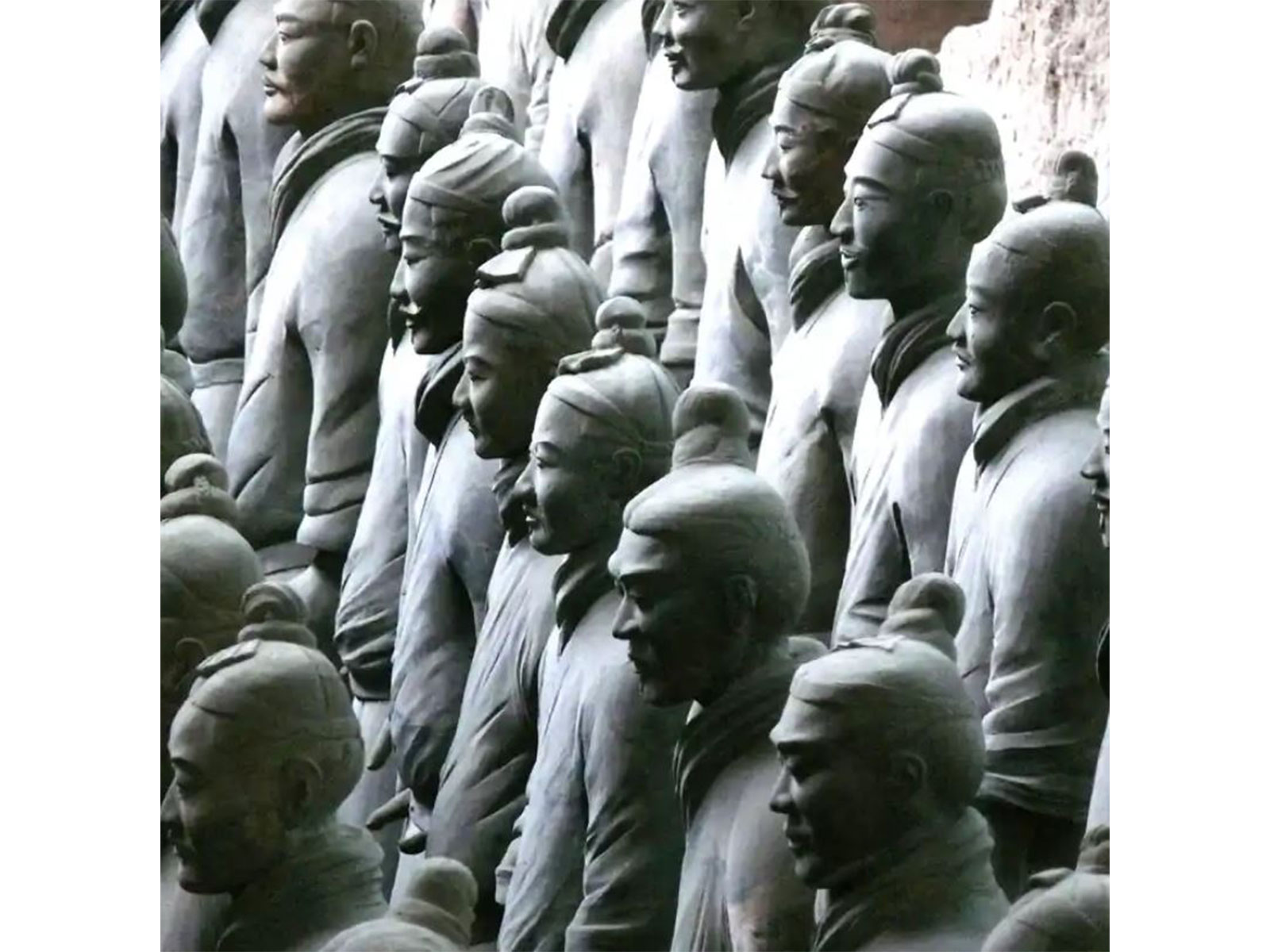
Xian (China), October 20, ANI: The Terracotta Army, discovered first in 1974 in China’s Xian, may have been built by women and child labourers, a new study has postulated.
Women labourers could have made up nearly 33 per cent, while juveniles under 15 could have made up 22 per cent of the workers who ultimately made the archaeological marvel, according to the paper.
The Terracotta Warriors were first discovered in March 1974. “On March 29, 1974, Terracotta Warriors, an extraordinary archaeological find, were discovered by local farmers in Xi’an, China. This remarkable army of life-sized terracotta warriors was buried with Qin Shi Huang, the first emperor of China, to protect him in the afterlife,” the website notes.
Qin Shi Huang is famous in history as the emperor who politically united various Chinese kingdoms and laid the foundations of the first Chinese state.
The paper, titled Who produced Emperor Qin Shihuang’s Terracotta Army, China? A Bayesian mixture model approach to fingerprint age and sex determination, published in the Journal of Cultural Heritage, added: “As a major national project of the Qin Empire during the third century BCE, the construction of Emperor Qin Shihuang’s mausoleum and the manufacture of the associated burial objects reflected the ability of the Qin Empire to organise and implement large-scale construction projects. The cultural relics buried in Qin Shihuang’s mausoleum, especially a large number of Terracotta Warriors and Horses, provided a rich source of materials for the exploration of important handicraft production issues within the Qin Empire, including important aspects such as labour distribution, standardisation, and organisational management.”
It also stated: “The prevailing assumption in Qin studies holds that large-scale craft production relied exclusively on adult male labour. However, this view is challenged by sporadic textual evidence from Qin legal documents and excavated artifacts. Inscriptions on Qin lacquerware include titles such as “da nüzi” (大女子, adult woman), “xiao nüzi” (小女子, young girl), and “xiao nanzi” (小男子, young boy), indicating that women and children participated in lacquer production under state supervision.”
Until now, though, there was no concrete proof to validate these claims.
The authors of the paper — Xiaoxi Li, Jingyi Shen, Desheng Lan, Jingyi Wang, Yang Yu, Jingye Cai, Yin Xia and Ping Zhou— thought of a different approach to answer this question. They used a statistical model called a Bayesian mixture model, which analyses an entire group of fingerprints at once rather than trying to classify every single mark individually. It compares ancient prints with modern fingerprint data for different ages and sexes, according to the website .
They used the Bayesian mixture model to analyse and categorise fingerprints unintentionally left on the artefacts.
The results they found have now challenged long-held assumptions about who actually manufactured the Terracotta Warriors.
“The model results indicate that the artisan community was not exclusively composed of adult males,” quoted the study authors as writing in their paper.
“In fact, the model estimated that adult men accounted for only about 45% of the fingerprints,” the portal added further.
“Our results provide the first biological evidence for a diverse workforce including adult females and juveniles, challenging long-held assumptions about Qin imperial labour organisation,” the paper adds.