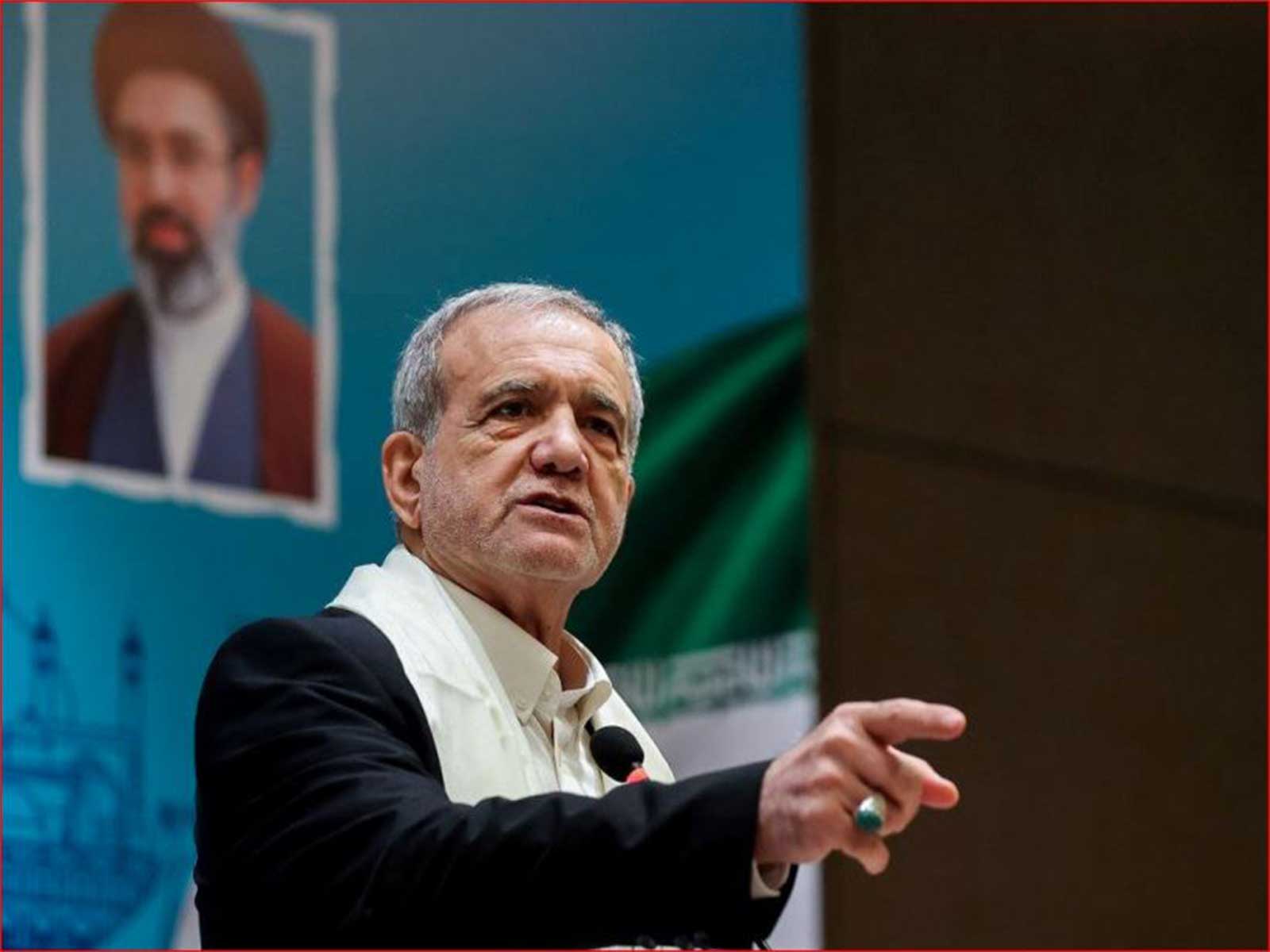
Pezeshkian says Iran is open to dialogue, but "will not surrender to force and bullying"
Nov 09, 2026
Tehran [Iran], November 9 : Iranian President Masoud Pezeshkian has said that Tehran is open to dialogue and negotiations but would not give in to pressure or coercion, asserting that any negotiations must take place based on "justice and equal" terms, as per Iranian news agency ISNA.
According to ISNA, Pezeshkian made the remarks on Sunday during a ceremony marking the 72nd anniversary of the establishment of the Iranian Milk Industries Company (Pegah), attended by the company's management and employees.
Referring to what he described as attempts by Iran's "enemies", the United States and Israel, to strike the country, Pezeshkian said, "The Supreme Leader [Ayatollah Mojtaba Hosseini Khamenei] ordered us to end the situation of neither war nor peace."
"We can talk with dignity and end the issue with dignity. We are people of dialogue and negotiation, and logic dictates that if we can get our rights through dialogue, we should not get ourselves involved in war. But we will not surrender to force and bullying," he said.
Pezeshkian further referred to his address at the United Nations General Assembly in September, reiterating that Iran was willing to pursue diplomatic engagement based on fairness and mutual respect.
"In my speech to the UN General Assembly, I also emphasized that we are people of dialogue based on justice and on equal and fair terms, and we demand our rights, but we will not submit to force," he said.
His remarks come as Iran's Foreign Ministry Spokesperson Esmail Baghaei on Monday said that Tehran's two-day proposal to resolve the ongoing crisis remains on the table, asserting that security in the strategically important Strait of Hormuz could be restored within 48 hours if the United States meets Iran's demands.
According to Iranian news agency ISNA, Baghaei, speaking at a weekly press conference, described the proposal as the "most reasonable possible plan" and indicated that positive developments in the region could follow if Washington responds to Tehran's conditions.
"Iran's two-day plan is the most reasonable possible plan and remains on the table; if the United States meets Iran's demands, the region will see positive developments within two days, and security will return to the Strait of Hormuz," Baghaei said, according to IRNA.
“The Americans must make a genuine decision, if they have properly understood the message of their own people,” he added.
Baghaei also said that Iran’s proposal demonstrated its goodwill, dismissing US Secretary of State Marco Rubio’s claims that Tehran’s demands were irrational.
Iran’s demands, including the lifting of the economic blockade and an end to hostilities on all fronts, are entirely logical. Iran wants these demands to be met before negotiations with the United States resume.
“What is irrational and absurd is the US attack on Iran in the middle of negotiations. By any logic, norm or standard, the US attack was not only absurd, illegal and irrational, but also criminal,” Baghaei said.
His remarks come amid uncertainty surrounding diplomatic efforts to resolve the ongoing conflict, with negotiations between Washington and Tehran witnessing little progress in recent days.
Iranian Foreign Minister Abbas Araghchi also indicated that diplomatic activity had slowed following the results of the US elections, which he said had affected efforts by mediators to facilitate negotiations.
Araghchi said, "US election results have shocked the mediators' shuttle diplomacy; we need to wait a little. There has been no movement over the past few days, and the main reason is the results of the US election, which have ultimately come as a shock to everyone. It will take some time for the situation to calm down and for conditions to become favourable again for mediators to resume their visits. We need to be a little patient."
Meanwhile, on Sunday (local time) US President Donald Trump said fresh military strikes against Iran remain “highly unlikely”, provided that ongoing negotiations continue to advance, though he stopped short of completely ruling out the prospect of further military action.
During a telephone interview with CNN, President Trump asserted that Washington had already delivered a crushing blow to Tehran, rendering additional military action “highly unlikely” to be required.
“It depends on whether or not they sign a very strong agreement,” Trump noted, addressing Iran's nuclear ambitions and the unblocking of the Strait of Hormuz.
The US leader also maintained that American forces had mapped out critical infrastructure targets across Iran, highlighting that power plants and bridges had been identified, and boasted that authorities could destroy 38 bridges in an hour.
“Most likely it will not be necessary,” Trump reiterated. “They want to make a deal so badly.”