Qatar, Türkiye sign "Mutual Defence Agreement" amid Gulf tensions; vow to strengthen strategic partnership
Nov 13, 2026
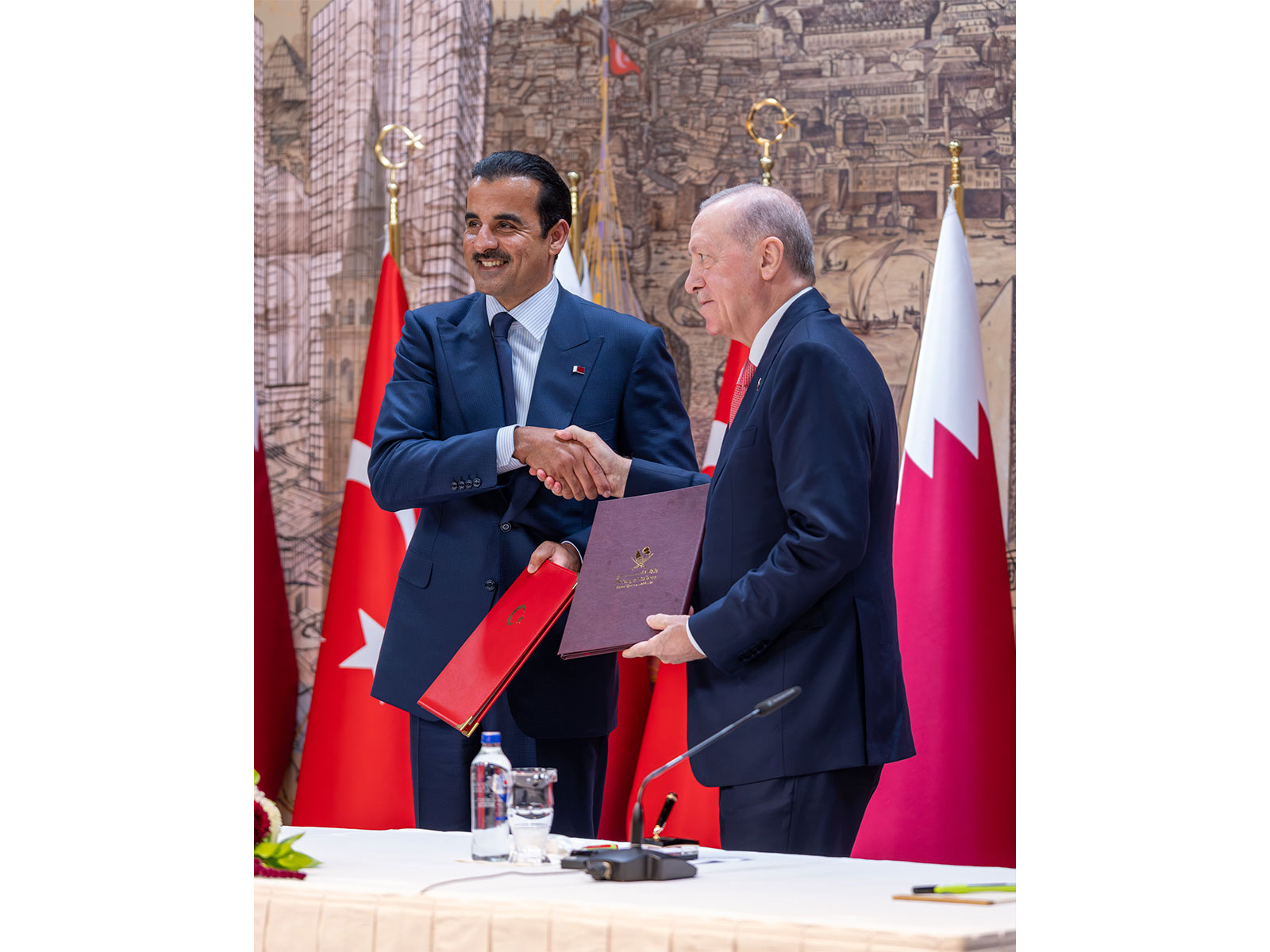
Istanbul [Türkiye], November 14 : Qatar and Türkiye on Friday (local time) signed a Mutual Defence Agreement amid heightened tensions in the Gulf region, with Qatar's Amir Sheikh Tamim bin Hamad Al Thani and Turkish President Recep Tayyip Erdoğan formalising the pact during the 12th session of the Supreme Strategic Committee meeting in Istanbul.
The two leaders also discussed regional developments, including efforts to prevent a resumption of hostilities in the Gulf, promote dialogue and establish peace, according to a statement issued by Türkiye's Directorate of Communications.
The agreement was signed at Dolmabahçe Palace in Istanbul, according to a statement issued by Qatar's Amiri Diwan, which said the two leaders also witnessed the exchange of several bilateral agreements and memoranda of understanding.
Following the meeting, Qatar's Amir highlighted the growing strategic partnership between Doha and Ankara, emphasising the importance of building on existing achievements and identifying new priorities for cooperation.
"The strategic partnership between Qatar and Türkiye continues to develop across various fields, as reflected in today’s meeting of the 12th session of the Supreme Strategic Committee between our two countries, which I co-chaired in Istanbul with my brother President Recep Tayyip Erdoğan. We discussed ways to build on what has been achieved and identify priorities for joint action in the coming period," Sheikh Tamim said in a post on X.
According to Türkiye's Directorate of Communications, President Erdoğan said the Mutual Defence Agreement signed between the two countries would add a new dimension to their longstanding bilateral ties.
Erdoğan also highlighted progress in economic relations, noting that the Trade and Economic Partnership Agreement, which entered into force last year, had brought the two countries closer to achieving their bilateral trade volume target.
"President Erdoğan stated that the Mutual Defence Agreement signed by Türkiye and Qatar today would add a new dimension to the brotherly ties between the two countries, noting that the Trade and Economic Partnership Agreement, which entered into force last year, had brought the two countries closer to achieving the bilateral trade volume target," the Türkiye's Directorate of Communications said in a post on X.
He further underscored Türkiye's efforts to expand and diversify its partnership with Qatar in the energy sector, adding that cooperation in the defence industry would continue to grow.
On regional developments, Erdoğan stressed the importance of preventing a resumption of hostilities in the Gulf region, facilitating dialogue and establishing peace. He also called for encouraging the parties concerned to resolve their differences through diplomatic means.
The discussions also covered Israel's attacks on Gaza and the humanitarian situation in the region, steps towards normalisation in Syria and the latest developments in Libya, the Turkish Directorate of Communications said.
Apart from the Mutual Defence Agreement, the two countries also witnessed the exchange of agreements and MoUs covering cooperation in consumer protection and market surveillance, education, and peace, reconciliation and conflict resolution. A joint communiqué of the 12th session of the Supreme Strategic Committee was also exchanged.
The latest agreement comes amid wider regional defence cooperation involving Türkiye. In August, Türkiye, Pakistan and Saudi Arabia signed a regional defence pact under which the three countries would come to each other's assistance if one of them came under attack.
The pact, ratified by the Turkish parliament last week, brings together NATO member Türkiye, which has the alliance's second-largest military, and Pakistan, the Muslim world's only nuclear-armed state.
The agreement between Qatar and Türkiye further formalises their defence partnership while reinforcing their broader strategic engagement through established bilateral mechanisms.