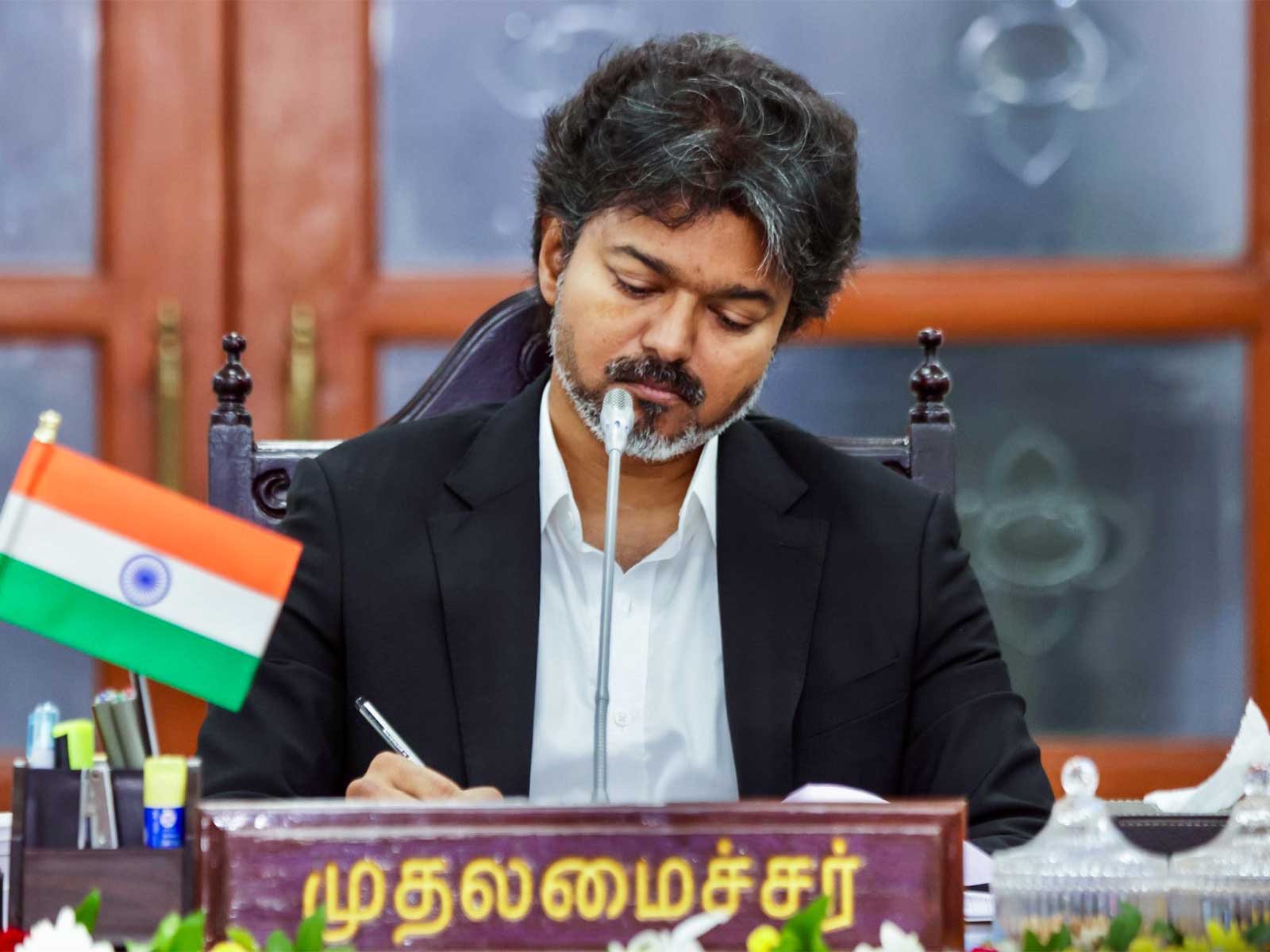
"Scheme imposes additional financial burden of Rs 5000 cr on Tamil Nadu": CM Vijay seeks amendment in Centre-State share under VB-G RAM G
Jul 01, 2026
Chennai (Tamil Nadu) [India], July 1 : Tamil Nadu Chief Minister C Joseph Vijay on Wednesday criticised the 60:40 share of funds between the central government and the state government under the Viksit Bharat--Guarantee for Rozgar and Ajeevika Mission (Gramin) Act.
The VB-G RAM G came into effect on July 1, with the Centre notifying the wage rate in the Gazette.
In a letter addressed to Prime Minister Narendra Modi, Vijay claimed that the implementation of the VB-G RAM G scheme from Wednesday will impose an additional financial burden of over Rs 5000 crore on the state. He requested the Centre to provide 100 per cent funding for the Wage and Administrative components, with the Material component shared on a 75:25 basis between the Centre and the State.
He noted that the "abrupt shift" from MGNREGA to VB-G RAM G will burden the state exchequer.
"This scheme imposes an additional financial burden of over Rs 5000 crore under the new sharing pattern and restrictive operational implications on the State Government. However, certain provisions of the VBGRAMG Act, 2025 require critical modifications and relaxations, without which the seamless and effective execution of this scheme on the ground would suffer significantly and will affect the rural population which is dependent on the rural employment programme," Vijay said.
"On the fund-sharing pattern, the current guidelines mandate a 60:40 ratio between the Union and State across the Wage, Material, and Administrative components. As MGNREGS operated under a different structure for two decades, this abrupt shift places an unsustainable strain on the State exchequer, which may reduce available wage employment days or crowd out other essential welfare schemes. I therefore request that 100 per cent funding be maintained for the Wage and Administrative components, with the Material component shared on a 75:25 basis between the Government of India and the Government of Tamil Nadu," the Chief Minister suggested.
Further, Vijay called for the state government's control over the distribution and decentralisation approach in notifying the 60-day period during which the works under the VB-G RAM G will be suspended annually.
He said, "The proposed centralised methodology for classifying Village Panchayats and distribution within the State normative allocations introduces micromanagement. A uniform, formulaic national approach fails to account for regional socio-economic diversity and risks lopsided grassroot allocations. The State Government should therefore be permitted to formulate its own customised methodology for intra-state distribution based on localised, ground-level needs."
"The Act mandates that the State notify a fixed 60-day period per financial year covering peak sowing and harvesting, during which works are suspended. However, unpredictable climate fluctuations such as El Nino frequently alter agricultural timelines, creating sudden unseasonal labour demand or a sharp need for safety-net employment during pre-notified peak periods. Instead of advance notification, authority should be decentralised to District Collectors to notify the 60-day peak period dynamically as per local conditions," he added.
He also noted that the Act "excludes State-funded housing initiatives" and suggested including State Housing Schemes under the VB-G RAM G to "accelerate the welfare targets and help in ensuring housing for all."
The Chief Minister also urged the Centre to continue the flagship employment guarantee scheme under the name of Mahatma Gandhi, "in order to honour his legacy and to foster public goodwill aligned with the core ethos of the scheme."
The Viksit Bharat-Guarantee for Rozgar and Ajeevika Mission (Gramin) Act, or VB-G RAM G Act, was passed in the Winter Session of Parliament in 2025 and came into effect on July 1, 2026.
The legislation replaced the 100-day employment guarantee with a 125-day guarantee. However, the Opposition has criticised the legislation for removing Mahatma Gandhi's name from the scheme and bringing in the 60:40 share of funds between the Centre and States.