Thinking of Buying a Business Analyst Course? Avoid These 5 Costly Mistakes in 2027
Nov 25, 2026
VMPL
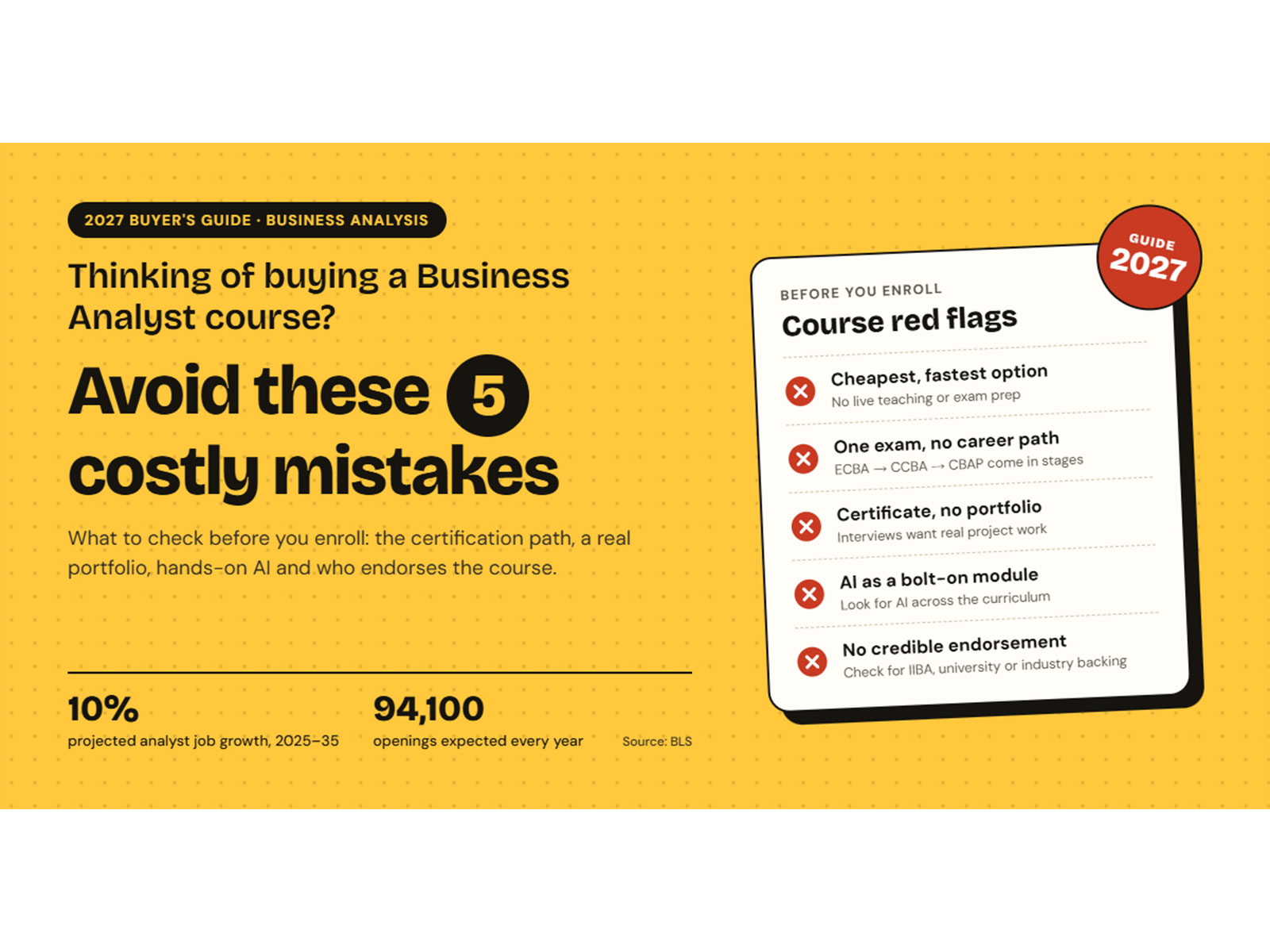
New Delhi [India], November 25: Behind most product launches, process overhauls, and automation projects is someone who figured out what the business actually needed. That person is often a business analyst, and companies want more of them. The BLS projects analyst jobs to grow 10% from 2025 to 2035, more than three times the average for all occupations, with about 94,100 openings every year. For anyone looking to move into the field or grow in it, there is no better time than now.
However, that opportunity comes with a catch: not all business analyst courses lead to the same outcome. Pick the wrong one, and the time and money you spend may not move your career forward at all. Here are five costly mistakes to avoid before enrolling, and the programs worth a closer look in 2027.
5 Costly Mistakes to Avoid When Choosing a Business Analyst Course
1. Picking the cheapest or fastest option. A short, low-cost course can cover the basics but often leaves out live instruction, mentoring, or exam prep. Learners then end up paying again to fill the gaps.
2. Paying for one exam instead of a career path. IIBA credentials are built in stages: the ECBA to start, the CCBA after two to three years, and the CBAP after five or more. A course that covers only one level means paying for prep again later, while one that covers all three grows with the learner.
3. Choosing a certificate instead of a portfolio. A certificate gets a resume noticed. Requirements documents, process maps, and dashboards built on real data are what make the profile stand out in an interview.
4. Choosing a course where AI is just an add-on. A single AI module at the end is not the same as AI used across the curriculum. Learners should look for generative AI applied to real tasks, such as drafting requirements or writing SQL.
5. Not checking who stands behind the course. An endorsement from a body like IIBA, a university, or an industry partner signals that the curriculum meets a recognized standard. Learners should confirm what that endorsement actually covers.
Business Analyst Courses to Consider in 2027
The programs below avoid the five mistakes above. Each one has a clear focus, states who it is for, and gives learners something concrete to take into their next role. Here is how each one runs and what learners gain.
1. AI-Powered Business Analyst Course by Simplilearn, Endorsed by IIBA
Best for: Graduates and working professionals moving into business analysis.
Simplilearn's 20-week live online business analyst course requires no prior experience and prepares learners for the IIBA® ECBA®, CCBA®, and CBAP® exams. Learners build core skills in requirements, stakeholder management, and solution evaluation, and work hands-on with Excel, SQL, Power BI, Tableau, and generative AI tools such as ChatGPT and Copilot.
Skills: Learners build the core business analysis toolkit, from elicitation, strategy analysis, and solution evaluation to product thinking, Agile, RPA, and process mining. On the data side, they learn to clean, model, query, and visualize data, including Excel macros, VBA, and dashboarding.
What learners gain: A portfolio from 10+ industry projects and a capstone, including an Excel sales dashboard, a requirements document for an RPA initiative, and a BPMN process map. Learners also receive live CBAP training aligned to the BABOK Guide V3, with 35 PDs/CDUs and 900+ practice questions. Graduates get a Simplilearn certificate and Microsoft Learn badges; together, these support a path toward senior business analyst, product owner, or business architect roles.
2. IIBA Business Analysis Certifications
Best for: Learners and practitioners who want a globally recognized credential to validate their business analysis skills.
IIBA is the professional body behind the most widely recognized business analysis credentials. Its core path runs from the ECBA® for those starting out, to the CCBA® for professionals with two to three years of experience, to the CBAP® for those with more than five years of experience. Specialized certifications cover agile analysis, business data analytics, cybersecurity analysis, and product ownership analysis.
Skills: Learners develop business analysis knowledge, skills, and behaviors expected at each career stage, from foundational to advanced. On the specialist side, they extend into agile analysis, business data analytics, cybersecurity analysis, and product ownership analysis.
What learners gain: Independent proof of skill at their current level, based on a global standard rather than a single tool. As with exams, the certifications validate skills rather than teach them, so most learners prepare through a structured course.
3. Business Analysis Certificate by UC Irvine Division of Continuing Education
Best for: Business and IT professionals, such as product managers, QA analysts, and programmer analysts, who prefer a university-paced program.
UCI's online certificate takes about 12 months and includes four required courses totaling 12 units. The curriculum aligns with IIBA's BABOK® Guide and PMI's Guide to Business Analysis, and the instructors are practicing business analysis professionals.
Skills: Learners build analytical thinking, problem-solving, and communication skills, and learn to assess business problems and evaluate solution options. On the requirements side, they learn to elicit, verify, validate, and manage requirements across the full lifecycle.
What learners gain: The ability to assess business problems, compare solution options, and manage requirements from elicitation through validation. Learners also get access to UCI's Career Advancement Network for coaching and mentorship, and a university certificate that supports roles such as systems analyst, functional analyst, or program manager.
4. Business Analytics Training by KPMG in India
Best for: Engineering and management graduates, and professionals with up to five years of experience, who want to build business analytics skills.
KPMG's five-week, instructor-led program covers analytics fundamentals, spreadsheet modeling in Advanced Excel, data cleaning and predictive modeling in R, and storytelling with visualization. Learners who score 65% in both exams and assignments earn a KPMG in India certificate, with 90 days of LMS access after the course.
Skills: Learners build business analytics foundations, from descriptive and inferential statistics to predictive modeling and customer segmentation. On the tools side, they learn to clean and analyze data in R, connect Excel to live web data, and turn findings into dashboards and data stories.
What learners gain: The ability to clean and analyze data in R, build dashboards and data stories, create predictive models, and segment customers by behavior. It suits learners leaning toward analytics, as it does not cover requirements management or IIBA exam prep.
5. Postgraduate Certificate Program in Business Analytics by Manipal Academy of Higher Education (MAHE)
Best for: Graduates and working professionals who want a university certificate in business analytics with flexible online study.
MAHE's online PGCP runs for 12 months across two semesters, at 15 to 20 hours a week, through live sessions and recorded lectures. The curriculum moves from business statistics, economics, and programming in R and Python to machine learning, big data analytics, and visualization with Tableau and Power BI. Applicants need a degree with Statistics as one of the subjects and a minimum 50% aggregate.
Skills: Learners build a grounding in business statistics, econometrics, applied multivariate analysis, machine learning, and big data analytics. On the tools side, they learn R and Python programming, database management, and visualization in Tableau and Power BI, along with Excel, SQL, and SPSS.
What learners gain: A UGC-entitled certificate from a NAAC A++-accredited university, also accredited by the Institute of Analytics, plus skills in Excel, Python, R, SQL, Tableau, and SPSS. Placement support includes an AI-powered placement portal, mock interviews, and job fairs, with career paths in marketing, risk and pricing analytics, process improvement, and analytics consulting.
The Bottom Line
The right business analyst course fits a learner's experience, goals, and schedule. Before enrolling, learners should be clear on which certification level they are eligible for, and how much hands-on AI practice the program includes.
Those starting out may lean toward a program that builds from the fundamentals and prepares for the ECBA and beyond, such as Simplilearn's AI-Powered Business Analyst Course. Professionals who prefer a longer, university-paced route may look at UC Irvine's certificate. Learners focused on data and modeling may find KPMG's analytics training or MAHE's postgraduate certificate a good fit, while IIBA's certifications offer a way to validate skills at each stage. Avoiding the five mistakes above helps learners choose a program that supports their business analyst career in 2027.
(ADVERTORIAL DISCLAIMER: The above press release has been provided by VMPL. ANI will not be responsible in any way for the content of the same.)