When ChatGPT enters the classroom: Can teachers keep up with Gen Z?
Sep 05, 2026
By Isha Das
New Delhi [India], September 5 : A student gets homework. Instead of asking the teacher or opening the textbook, they take out their phone and type into ChatGPT or Gemini: "Explain this like I'm 15." Within seconds, they have an answer, examples, and perhaps even a quiz.
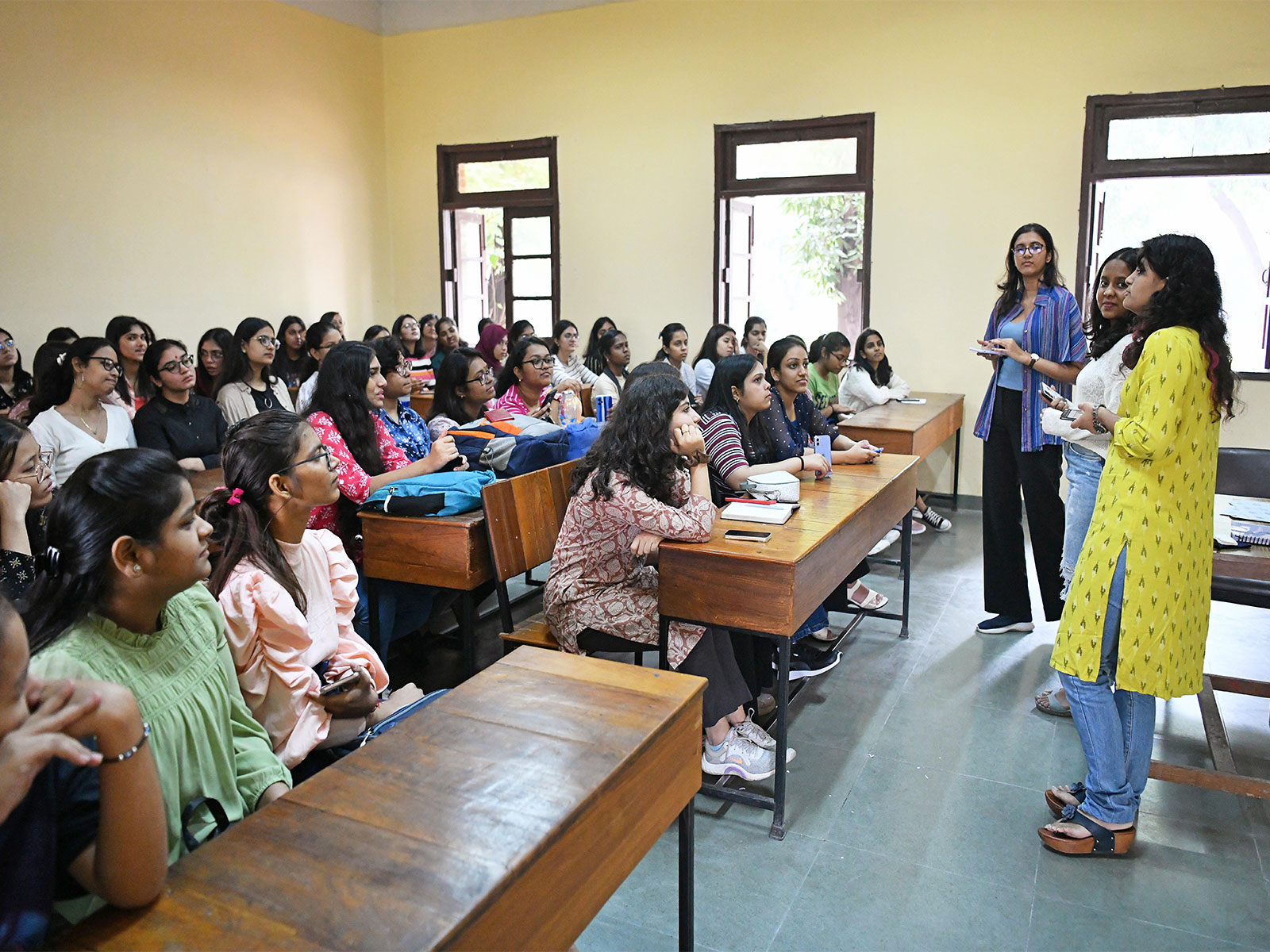
The next morning, the teacher walks into class facing a very different challenge -- not explaining the chapter, but explaining why the AI's answer may be wrong.
For generations, the teacher stood between the student and knowledge. For Gen Z, that gate has quietly disappeared.
As the country marks Teachers' Day, paying homage to Dr Sarvepalli Radhakrishnan, whose words -- "The true teachers are those who help us think for ourselves" -- remain the guiding philosophy of Indian education, a new question is forcing itself into classrooms: if information is available everywhere, what exactly should a teacher teach?
The progression has been swift -- teacher, then textbook, then Google, then YouTube, then social media, and now generative AI. Earlier, students waited for teachers to explain a concept. Google made information searchable. YouTube made it visual. Generative AI has made it interactive and personalised.
The AI does not merely define photosynthesis. A student can now say: "Explain it like I'm five," "Explain it in Hindi," "Give me an example," "Quiz me," or "Tell me where I went wrong." That is a fundamentally different relationship with knowledge.
United Nations Educational, Scientific and Cultural Organization (UNESCO) describes this shift as transforming the traditional teacher-student relationship into a "teacher-AI-student" dynamic, and has developed competency frameworks for both teachers and students to navigate it -- frameworks that, notably, stress "human agency and responsible use" rather than mere technical skill.
Gen Z, having grown up with smartphones and now AI, is used to instant answers, learns through short-form video, treats YouTube as an informal classroom, and is comfortable fact-checking a teacher on the spot. As one observation puts it: the teacher is no longer competing with another teacher -- the teacher is competing with an algorithm that never gets tired, never takes attendance, and is available at 2 am.
AI can personalise explanations, generate quizzes and lesson plans, provide instant feedback, translate material, help students at different learning levels, and handle a teacher's administrative load. India is already formalising this shift -- the Education Ministry announced in October 2025 that Artificial Intelligence and Computational Thinking would be progressively introduced from Class 3 onwards from the 2026-27 academic session, in coordination with CBSE, NCERT, KVS, NVS and states and Union Territories.
But there is a great deal AI cannot do. It cannot reliably sense a student's emotional state, recognise when a child struggling silently says "I'm fine," motivate a disengaged learner, maintain classroom discipline, mentor, resolve conflicts, or serve as a trusted adult in a child's life.
That is where the central argument takes shape: AI may replace some functions of a teacher. It cannot replace the teacher's entire role.
If AI becomes a classroom assistant, who curates its knowledge base? An AI asked to explain Partition, the freedom struggle, caste, religion, the Constitution, political movements, Kashmir or India's foreign policy will answer through the lens of its training data -- data that can carry its own biases.
That turns AI in classrooms from a technology question into an education-policy and political one. Complex, contested subjects, many educators argue, can still only be responsibly taught by a human teacher.
Addressing the nation from the ramparts of the Red Fort on the 80th Independence Day, Prime Minister Narendra Modi announced that one crore youth would be trained in AI skills over the next year, alongside free online coaching for competitive examinations and a nationwide sports talent hunt for children aged five to 15.
This builds on the National Education Policy (NEP) 2020, which recognises AI's potential for "economic growth, solving educational challenges, enhancing teacher capabilities, and personalising learning," and "emphasises the importance of AI-learning across all educational levels," according to an official release. India's AI talent pool, estimated at 6-6.5 lakh in 2024, is projected to need 1.25 million professionals by 2027 at a 15 per cent CAGR, according to NASSCOM, as the Indian AI market is expected to grow "25 per cent to 35 per cent through 2027."
On the ground, CBSE already offers a 15-hour AI skill module from Class VI and AI as an optional subject for Classes IX-XII; NCERT has embedded AI in Class XI Computer Science and used AI/ML to translate Grade 1-2 textbooks into 22 Indian languages. The DIKSHA platform uses AI for inclusivity, including read-aloud features for visually impaired students; the SOAR initiative trains classes 6-12 students and educators in AI readiness; and SWAYAM offers over 110 free AI courses from IITs and IISc with more than 41.2 lakh enrolments.
Google CEO Sundar Pichai, marking 75 years of his alma mater IIT Kharagpur, said AI would soon move well beyond labs and early adopters.
"When I look at the next five years, I see AI moving away from the lab and the early adopters and into the hands of people doing the work, the healthcare workers, the government officials, the farmers, developers and entrepreneurs," Pichai said in a video message.
"We are building AI so that it can help all of us do our work at the next level and do it in a more fulfilling way," he added, noting that "more and more, India is creating innovations that can benefit the whole world," and that "this ambitious, optimistic new generation of Indians have the chance to reimagine what's possible for the country."
Moreover, consider two students entering the same AI era. Student A, in a private school, has a laptop, Wi-Fi, paid AI tools and English fluency. Student B, in a government school, shares a single smartphone at home with patchy internet and limited digital literacy. Both are technically part of the AI generation -- but are they entering it equally? The question that follows is unavoidable: could AI democratise education, or deepen India's existing educational divide?
AI's ability to explain quantum physics in Hindi, Tamil, Bengali, Marathi or Malayalam is a genuine opportunity to bridge India's English-language education gap -- but it raises its own questions: how good are AI models really in Indian languages, and who decides correct terminology?
Then there is the cheating dilemma. A student submits an essay; the teacher suspects AI involvement; the student insists, "I wrote it." Should AI use be banned, disclosed, or simply accepted as part of brainstorming? If an AI can produce the answer instantly, the deeper question is why students are still asked to reproduce information in exams at all -- a gap that points to assessment reform, shifting evaluation toward reasoning, oral presentation, projects, debate and application of knowledge rather than memorisation.
The most practical challenge may be this: how can teachers teach AI when many have not been trained to use it themselves? UNESCO's framework lists 15 teacher competencies across five dimensions, including AI ethics, foundations and pedagogy. Google has separately expanded AI training for educators across India, with an explicit emphasis on retaining human connection in the classroom even as digital tools expand.
Concerns remain well documented -- AI hallucinations that can harden into a student's "fact," reproduction of bias, privacy risks when children share personal information with AI systems, questions over classroom surveillance, unclear ownership of AI-generated material, and the risk that students learn to prompt rather than to think.
The emerging consensus is not that AI is dangerous, but that it needs a boundary. AI can handle information delivery, personalisation, repetition, administrative work and basic feedback. The teacher retains judgement, empathy, mentorship, discussion, ethics and social development. As the argument goes: don't replace the teacher with AI -- give the teacher AI.
Dr Sarvepalli Radhakrishnan once said, "We must be a nation of thinkers to become creative and not remain content with being merely a nation of consumers of ideas produced elsewhere." In a classroom where AI can produce ideas instantly, teaching students to think for themselves, rather than simply consume answers, may be the truest measure of a teacher's purpose.