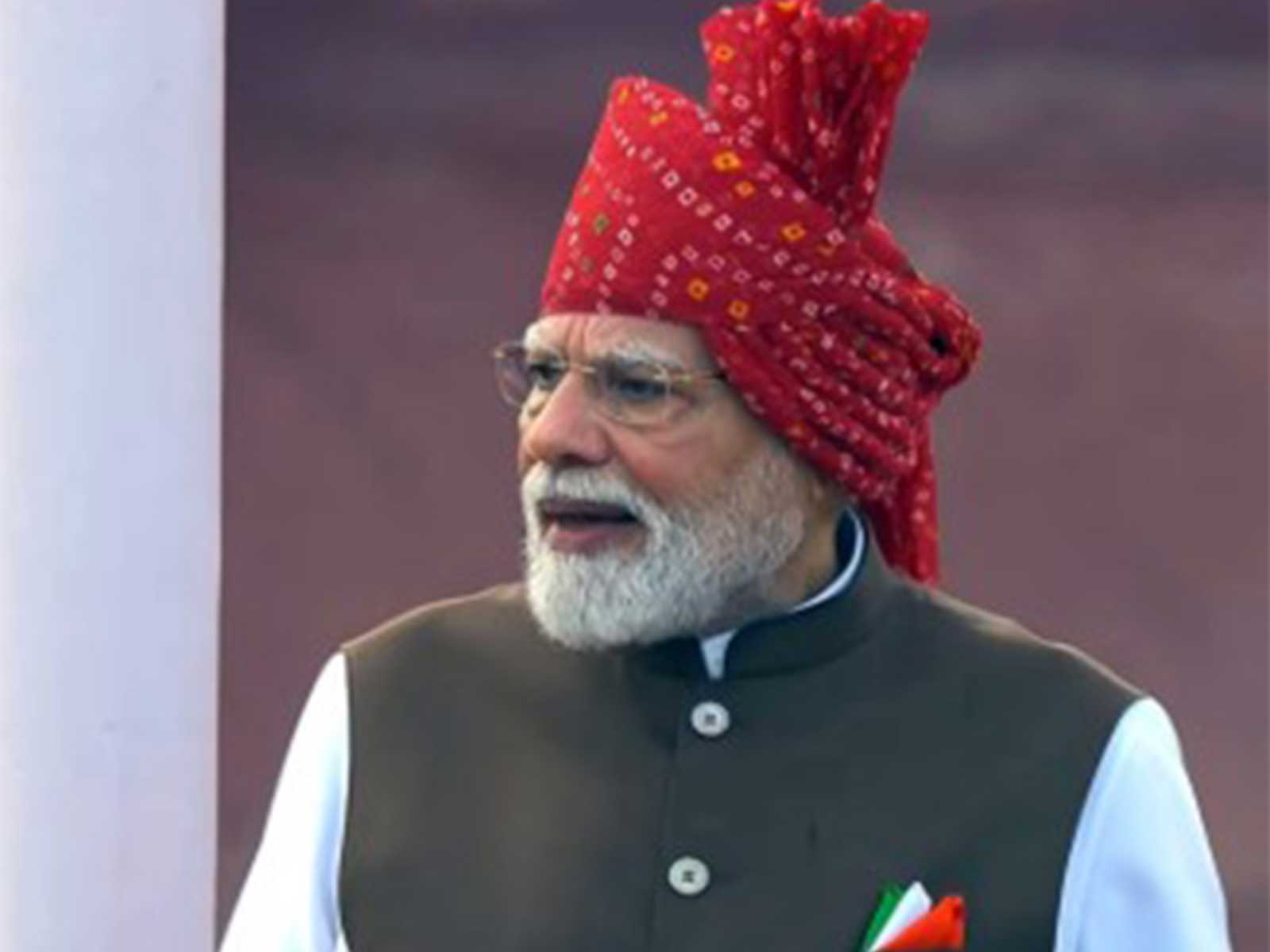
India must lead in hypersonic, next-gen defence technologies: PM Modi names 'Defence' fifth 'Shakti' of 'Saptadhara' vision
Aug 15, 2026
New Delhi [India], August 15 : Prime Minister Narendra Modi, addressing the nation from the ramparts of the Red Fort on India's 80th Independence Day, identified defence power as the fifth 'Shakti' of his 'Shakti Ki Saptadhara' vision and called for greater self-reliance in defence, while urging India to emerge as a global supplier of military equipment and a leader in next-generation technologies, including hypersonic systems.
Reiterating the government's push for an Aatmanirbhar defence sector, the Prime Minister said India could not afford to remain merely a market for other countries and must build the capabilities to supply advanced defence technologies to the world.
PM Modi said, "The fifth strength of the Saptadhara is defence power. It is important for us to become self-reliant in defence. When the world is thinking about itself, India cannot remain merely a market for the world. We have to become global suppliers. We have to take leadership in hypersonic defence technologies."
India has been steadily advancing its indigenous hypersonic weapons programme, with the Defence Research and Development Organisation (DRDO) working on hypersonic glide and cruise missile technologies.
The country is also pursuing indigenous technologies for long-range strike capabilities and advanced propulsion systems.
Highlighting the expansion of India's defence manufacturing base, PM Modi said, "In the last 12 years, defence production has increased by four times."
The Prime Minister's comments come as India's domestic defence production and exports have increased considerably, as the government seeks to strengthen indigenous manufacturing and reduce reliance on foreign suppliers.
Defence Minister Rajnath Singh said on the eve of Independence Day that annual defence production had reached a record Rs 1.78 lakh crore in the financial year 2025-26, compared with Rs 46,000 crore in 2014.
Singh attributed the growth to the government's Aatmanirbhar Bharat and Make in India initiatives, saying India was increasingly meeting its own security requirements while strengthening its position as a defence manufacturing hub and exporter.
"Under the inspiring leadership of PM Shri @narendramodi, India's defence production is reaching new heights every year. I am delighted to inform everyone that India's annual defence production has surged to an all-time high of Rs 1.78 lakh crore in the Financial Year (FY) 2025-26."
According to the Ministry of Defence, defence production rose 15.6 per cent in FY 2024-25 and 110 per cent from Rs 84,643 crore in FY 2020-21. Indigenous defence production has increased nearly fourfold from FY 2013-14.
Defence exports also reached a record Rs 38,424 crore in FY 2025-26, with India now exporting defence products to more than 80 countries.
Singh said the government was targeting defence exports of Rs 50,000 crore by 2029.
The private sector has also emerged as an increasingly important contributor to India's defence industrial base. It accounted for 24 per cent of total defence production in FY 2025-26, while Defence Public Sector Undertakings and other public sector entities contributed around 76 per cent.
Singh said modernisation of the armed forces remained a key priority, pointing to higher defence spending, capital expenditure and funding for research and development.
He also highlighted recent tests and vindication of advanced systems, including the Long-Range Land Attack Cruise Missile, RudraM-II Air-to-Surface Missile, Naval Anti-Ship Missile-SR and Pinaka Long-Range Guided Rocket.
On hypersonic technology, Singh said the successful test of an active-cooled full-scale scramjet combustor for more than 1,200 seconds had placed India among a select group of countries capable of developing hypersonic missile technology.
The focus on defence power forms part of PM Modi's broader 'Shakti Ki Saptadhara' vision, under which he outlined seven areas that he said would drive India's growth and global standing.
The first strength is manufacturing power, with the Prime Minister calling for the creation of a complete value chain spanning design and manufacturing.
"We must build a complete value chain. From design to manufacturing, India must establish itself as a trusted global supply chain partner for the world.We must rise to global standards of cost, quality and scale." PM said.
The second strength is agriculture and food production, while the third is technology and innovation. PM Modi highlighted artificial intelligence, quantum technology, space, robotics and data centres, and called for India to become a global hub of innovation.
"We have proven our mettle in UPI and digital public infrastructure.
Now India has to take digital public technologies to every corner of the world. India has to lead in Next Generation Communication Technology. Made in India 6G should reach every corner--this should be our goal," PM added.
The fourth strength is Gati Shakti, with the Prime Minister focusing on high-speed connectivity, high-speed rail and port-led development.
The sixth is the Green and Blue Economy, encompassing green hydrogen, renewable energy, energy storage, fisheries, coastal tourism and ocean technology.
The seventh strength is India's soft power, with PM Modi highlighting the global reach of yoga.