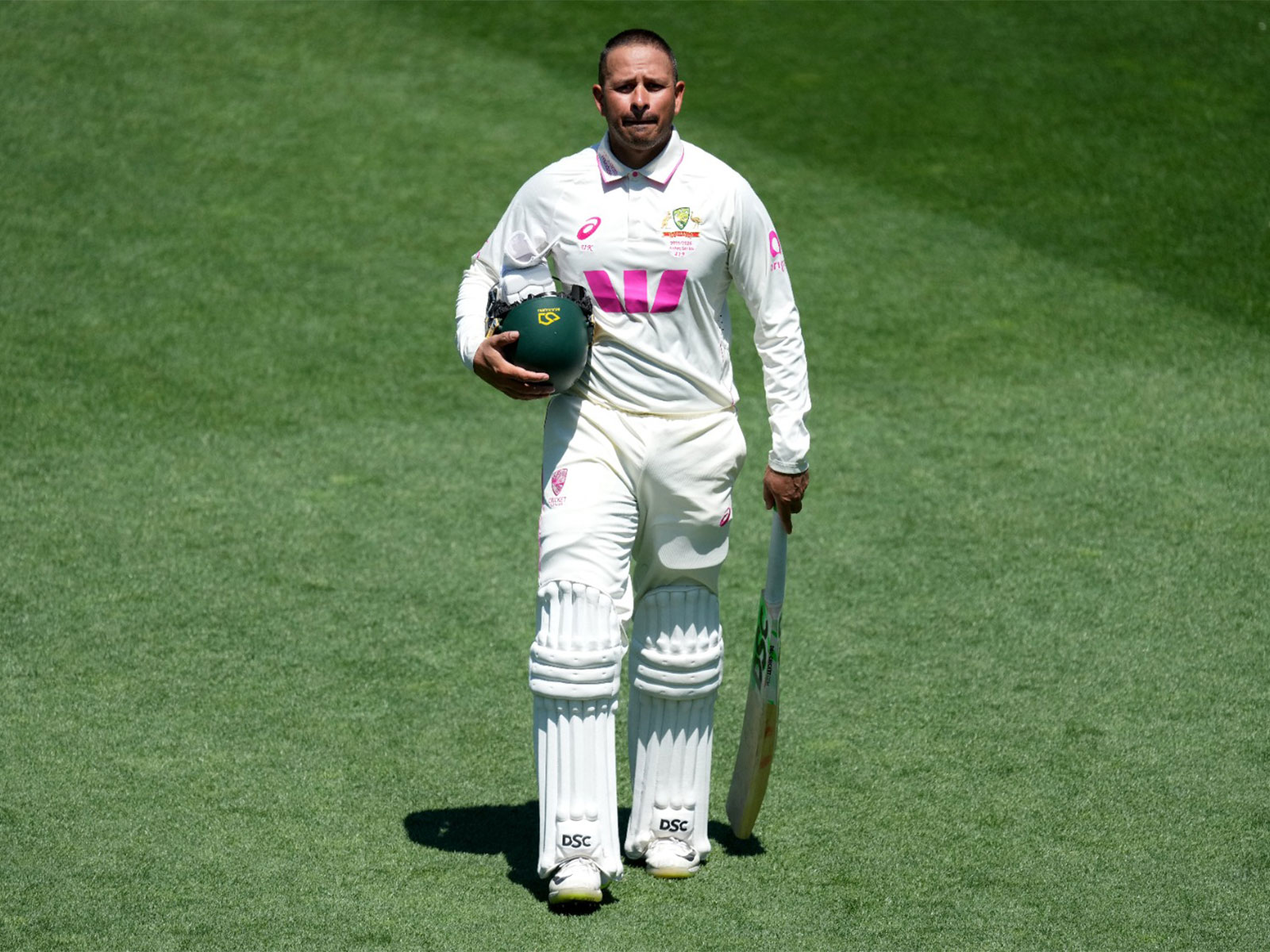
Usman Khawaja says ‘Sandpapergate’ revelations not a “witch hunt”, questions Cricket Australia’s “rushed” investigation
Nov 10, 2026
Sydney [Australia], November 10 : Former Australian cricketer Usman Khawaja has maintained that his revelations about the 'Sandpapergate' in 2018 are not intended to target individuals, reiterating that he wants the entire team to take collective responsibility for the incident. He also questioned the thoroughness of Cricket Australia's investigation, saying it felt rushed and that he was never interviewed despite being present alongside Cameron Bancroft during the episode.
The 'Sandpapergate' scandal refers to ball-tampering by Australia during the third Test of the 2018 series against South Africa at Cape Town, for which then-captain Steve Smith and vice-captain David Warner received one-year competitive cricket bans, while Cameron Bancroft was also handed sanctions, including a nine-month international/domestic cricket ban.
Ahead of the release of his autobiography 'Sabr', Khawaja had claimed that the entire Australian team, including players and support staff, was involved in the 2018 ball-tampering scandal during the South Africa tour. He said the responsibility was collective, contrary to Cricket Australia's findings that implicated only Steve Smith, David Warner and Cameron Bancroft. Khawaja stressed that he had expected the truth to emerge over the past eight years and spoke out to ensure the three players were not left carrying the blame alone.
Warner later came out in support of Khawaja's statements in a social media post.
Now, in an interview with ABC on Tuesday, Khawaja said he was not interested in conducting a “witch hunt” or pointing fingers at individual players, but wanted the three cricketers who faced sanctions to no longer carry the burden of the controversy alone.
“I mean, I've written in my account from what I've seen. I've told you again, time and time again, like the easiest way for me to do it, and people want to know the answers and lots of different answers. And I've left it open-ended to some respects because I've told my story and I've told my truth and I'll speak for myself and there's other times where I'm talking about what's happened in that situation, but this has never been a witch hunt for me. It's only been those three guys who've had to cop this flak for a long time. I'm hoping other people will come up and talk about it honestly. That's what I'm hoping but I'm not forcing anyone to do anything,” he said.
“And you got to remember, Pat Cummins, Pat Cummins is a good friend of mine, Mitchell Starc, a lot of these guys, like the guys on the team, other players in the team, Shaun Marsh, Mitch Marsh, they're all very good friends of mine. I'm not here to go on a witch hunt. All I've ever wanted is for us to take accountability as a team and I don't think that's a lot to say. I'm not asking a lot from people and I say, "We were a part of it, that was us. Let's just take accountability and tell your story. Don't have to tell your story." But I felt for those three guys that kept having to share the load for the whole time,” he added during the ABC interview.
Khawaja also said he did not consider the punishments handed to former Australian captain Steve Smith, vice-captain David Warner and Cameron Bancroft appropriate.
“I don't think the ban for the three, I don't think the ban for the three players was appropriate,” he said.
When questioned about whether Cricket Australia had conducted a thorough investigation into the scandal, Khawaja said he found the process unsatisfactory, pointing out that he was never questioned despite “sitting next to Cameron Bancroft the whole time.”
“I don't feel like it was a thorough investigation because I never got investigated and I was sitting next to Cameron Bancroft the whole time. So it's hard for me to say cover-up, but I will say it felt rushed,” he said.
Khawaja said his intention behind writing about the ‘Sandpapergate’ scandal was to present his version of events and ensure that the three players who faced sanctions were not left carrying the blame alone.
“There's no easy way to do it, but I mean, I'm not here to inflame the situation anymore. I was here to tell my truth, what I saw, what I felt, and to stick with those three guys that were made out to be the only people who have taken it, and I wanted that to be shown. I'll say again, I've given my statement about what happened the game before and what was called back then Port Elizabeth and where we played there and what happened. And I was honest to what I saw and what conversations I had,” he said during the ABC interview.
“It's never been for me about pointing fingers and saying, ‘He did this, he said that.’ And that's why even when I first wrote my edit, there was names, there was lots of things, I pulled it back. Sometimes I'm very specific on things and sometimes they're a bit vague on things and I do it on purpose because I'm trying to tell a story. But my main objective here is always to try to take accountability as a team. To say, yes, this was happening. And even though that one person did it or the captain knew about it and David Warner always took the heat too for it, that it wasn't just them, that we were all involved in it as a team, as a squad that was there in South Africa,” Khawaja said.
He maintained that he deliberately avoided naming individuals or making direct accusations, even removing several names and details while editing the chapter to keep his account balanced. He said his objective was to highlight the need for collective accountability, while explaining that he had deliberately kept certain aspects open-ended to avoid sensationalism and misrepresentation.
“And that's what I'm trying to project because it's never black and white and what I've written there shows what I saw and I'm happy to stand by it. I'm just not going, I'm not going to entertain that. And I say this for one reason. I wrote it in my book because it was a space, safe space for me to write. I took a long time. It took me a long time to first write the chapter, then go over it and try to work out a way that it was as balanced as possible. I did it the best way I could. At the same time, trying to be open and honest about what I saw and how things were. I implore people. It's hard for me to talk about this with you to get the right context. There's so much happening at that time. And I felt like I found a nice balance with it at the end of it. And I learned from this week when the media article came out that whenever things come out in the media, they get sensationalised all over the, they're all everywhere and the clickbait, it just runs rapid,” he added further during the ABC interview.
Khawaja also said he did not wish to elaborate further on the matter, maintaining that his autobiography contained his account and that he was standing by what he had written.
“So if I say to anyone, and I just keep going, “I've talked on social media about this and I've written in my book. That's my statement. That's what it is. And I'm not going to really speak on any more of it at this moment in time," he said.