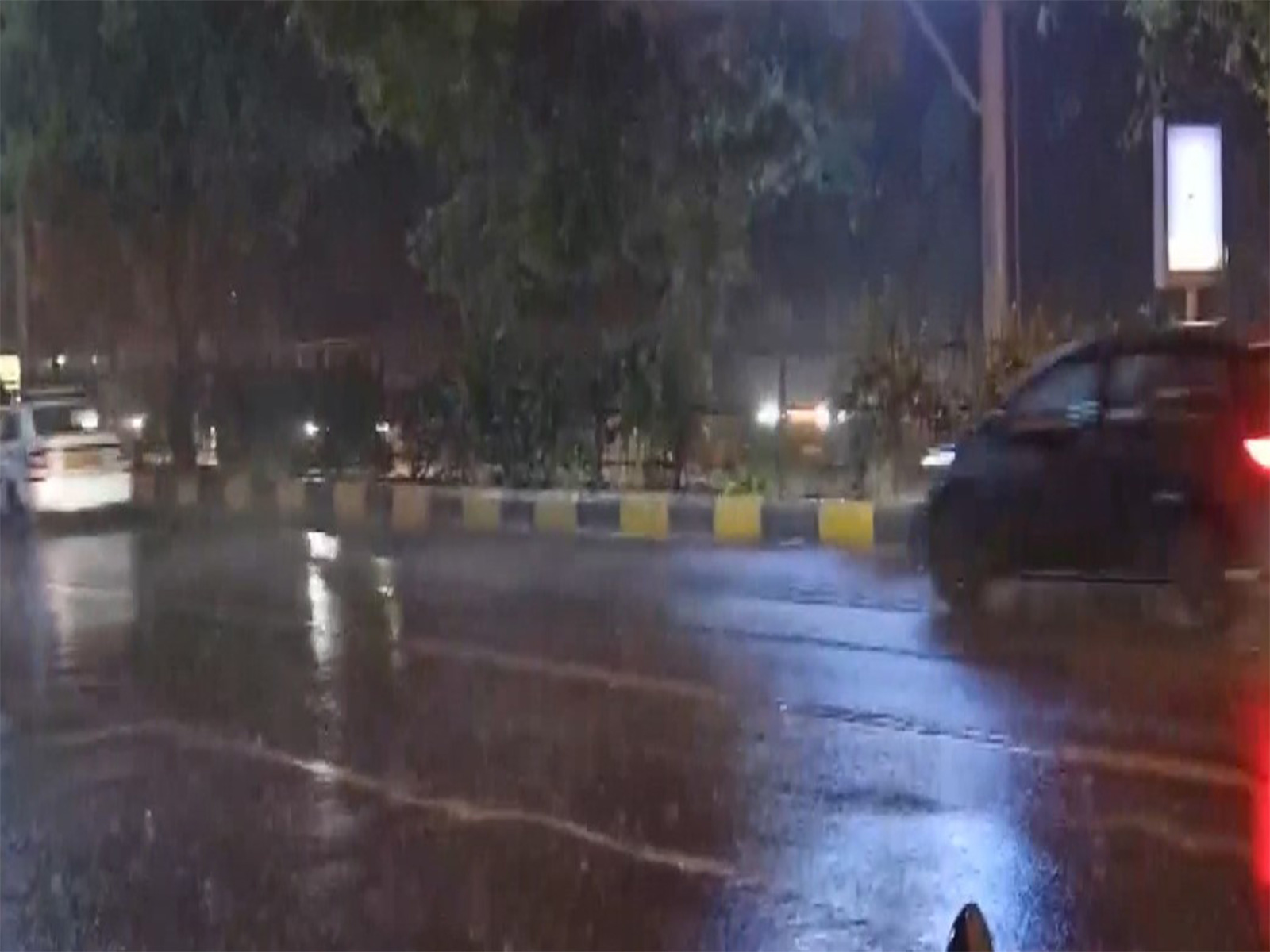
Rain lashes parts of Delhi bringing relief to residents
May 02, 2026
New Delhi [India], May 2 : The national capital witnessed rain lashing several parts on Saturday, bringing much-needed relief from a recent spell of rising temperatures.
A day earlier, the India Meteorological Department (IMD), in its latest monthly outlook, predicted that India would experience above-normal rainfall in May 2026, even as temperature patterns remain mixed across regions, with some parts expected to face above-normal heatwave conditions.
"During May 2026, maximum temperatures are expected to be normal to below normal across many parts of the country," the IMD said in a press release issued by the Ministry of Earth Sciences.
However, it added that "above-normal temperatures are likely in many parts of southern peninsular India, some parts of the northeast, and northwest India." The weather agency said minimum temperatures are expected to remain above normal over large parts of the country, although some regions in northwest, central, and adjoining peninsular India may see normal to below-normal night temperatures.
In heatwave conditions, the IMD warned that "above-normal heatwave days are likely over some parts of the foothills of the Himalayas, east coast states, Gujarat, and Maharashtra," indicating a continued risk of extreme heat in select regions.
Rainfall during the month is likely to be stronger than average nationwide. "The rainfall during May 2026, averaged over the country as a whole, is most likely to be above normal (>110% of LPA)," the IMD said, referring to the long-period average. However, it cautioned that parts of east, northeast, and east-central India could receive below-normal rainfall.
The IMD noted that broader climate signals are shifting, with oceanic conditions pointing towards a warmer phase ahead. "ENSO-neutral conditions are evolving towards El Nino conditions over the equatorial Pacific," it said, adding that models indicate El Nino development during the upcoming southwest monsoon season. It also said neutral Indian Ocean Dipole (IOD) conditions currently prevail, but "positive IOD conditions are likely to develop towards the end of the monsoon season."