Union Health Secretary calls for expanding digital medical resources to all medical colleges
Oct 09, 2026
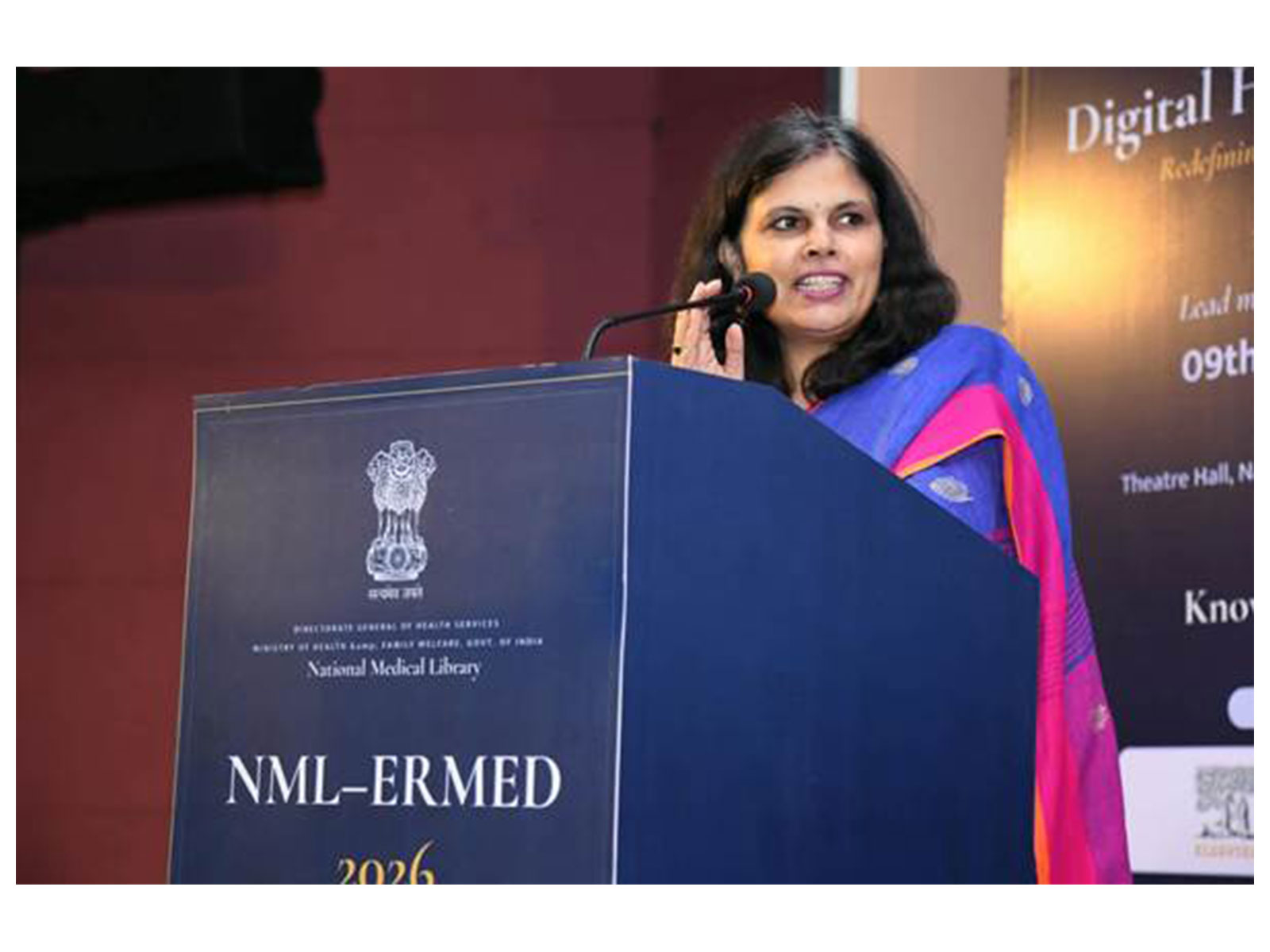
New Delhi [India], October 9 : The National Medical Library (NML), Directorate General of Health Services (DGHS), Ministry of Health and Family Welfare, Government of India, organised the 5th One-Day National Training-cum-Conference on the ERMED Consortium today at the National Medical Library, New Delhi.
The conference was held on the theme “Digital Health Resources: Redefining Access Through Libraries”, highlighting the growing importance of digital knowledge resources in strengthening healthcare delivery, medical education and evidence-based clinical practice.
The inaugural session was attended by Punya Salila Srivastava, Secretary, Ministry of Health and Family Welfare; Dr. (Ms.) Vinod Kotwal, Additional Secretary, Ministry of Health and Family Welfare, and Dr. Lovneesh G. Krishna, Director General of Health Services.
Addressing the gathering, Punya Salila Srivastava, Secretary, Ministry of Health and Family Welfare, underscored the pivotal role of the National Medical Library (NML) in facilitating access to knowledge and information and strengthening the foundations of medical education, research and healthcare delivery.
She highlighted the expansion of the NML network to 93 medical colleges and emphasised the need to extend its reach to all medical colleges across the country, particularly those in underserved areas, to ensure equitable access to quality medical literature and digital learning resources.
Emphasising that continuous learning and professional development are indispensable in the medical field, she observed that healthcare is evolving rapidly, with new diseases being identified, innovative therapies emerging and clinical practices continually advancing. She noted that well-equipped libraries and accessible digital resources are essential to strengthening professional competence and enabling healthcare practitioners to provide the best possible care to patients.
She further emphasised that digital health resources are not merely tools for accessing information but also vital enablers of a strong research culture in the country. Referring to the vision of the Prime Minister Narendra Modi, she stressed the importance of developing India’s indigenous research capabilities and cultivating a scientific temper that encourages innovation and original inquiry.
She also observed that while India may draw upon research conducted elsewhere, its larger aspirations cannot be realised without developing its own research capabilities and mindset.
As she emphasised, “We may be able to manage with research conducted elsewhere, but that alone cannot fulfil our resolve to build a strong research ecosystem of our own. For this, we must develop a research mindset, and access to digital health resources is crucial to nurturing that mindset.”
In this context, she highlighted the complementary role of the One Nation One Subscription initiative and the ERMED Consortium in broadening access to scholarly publications, facilitating evidence-based learning and creating an enabling environment for research and innovation.
She described the National Medical Library as a legacy institution with the responsibility of serving as a gateway to knowledge and contributing meaningfully to the vision of Viksit Bharat.
Looking ahead, Srivastava called upon the National Medical Library to develop a comprehensive roadmap for strengthening access to digital health resources, including exploring the role of artificial intelligence in healthcare education, research and professional development.
She emphasised the importance of extending guidance and support to States and Union Territories by facilitating the exchange of knowledge and the adoption of good medical library practices across institutions.
She encouraged the organisation of focused seminars and professional engagements to identify effective models, share best practices and improve the accessibility and utilisation of digital educational resources nationwide.
Expressing confidence in the deliberations of the conference, she urged librarians, healthcare professionals and other participants to contribute their experiences, insights and actionable recommendations towards building a more accessible, inclusive and research-oriented medical knowledge ecosystem.
She emphasised that empowering medical institutions with reliable knowledge resources and fostering a culture of lifelong learning would be instrumental in advancing medical education, strengthening research and improving patient care across the country.
Speaking at the Occasion, Dr. (Ms.) Vinod Kotwal, Additional Secretary, Ministry of Health and Family Welfare, highlighted the unique nature of knowledge, noting that while material wealth diminishes when spent, knowledge grows when shared. She observed that libraries are rooted in this very ethos of knowledge-sharing and emphasised the importance of leveraging digital resources to make quality medical and educational content more accessible to all.
She noted that the three essential pillars of a medical college are its faculty, infrastructure and knowledge resources, including books, journals and other scholarly materials, all of which play a vital role in strengthening medical education and research.