US commander highlights the threat China poses
Apr 28, 2026
Washington DC [US], April 28 : With the USA engulfed in a war of its own making against Iran, there is valid concern that the US military's capabilities in the Indo-Pacific region are being unnecessarily eroded, especially as China continues to cast a threatening pall over Taiwan.
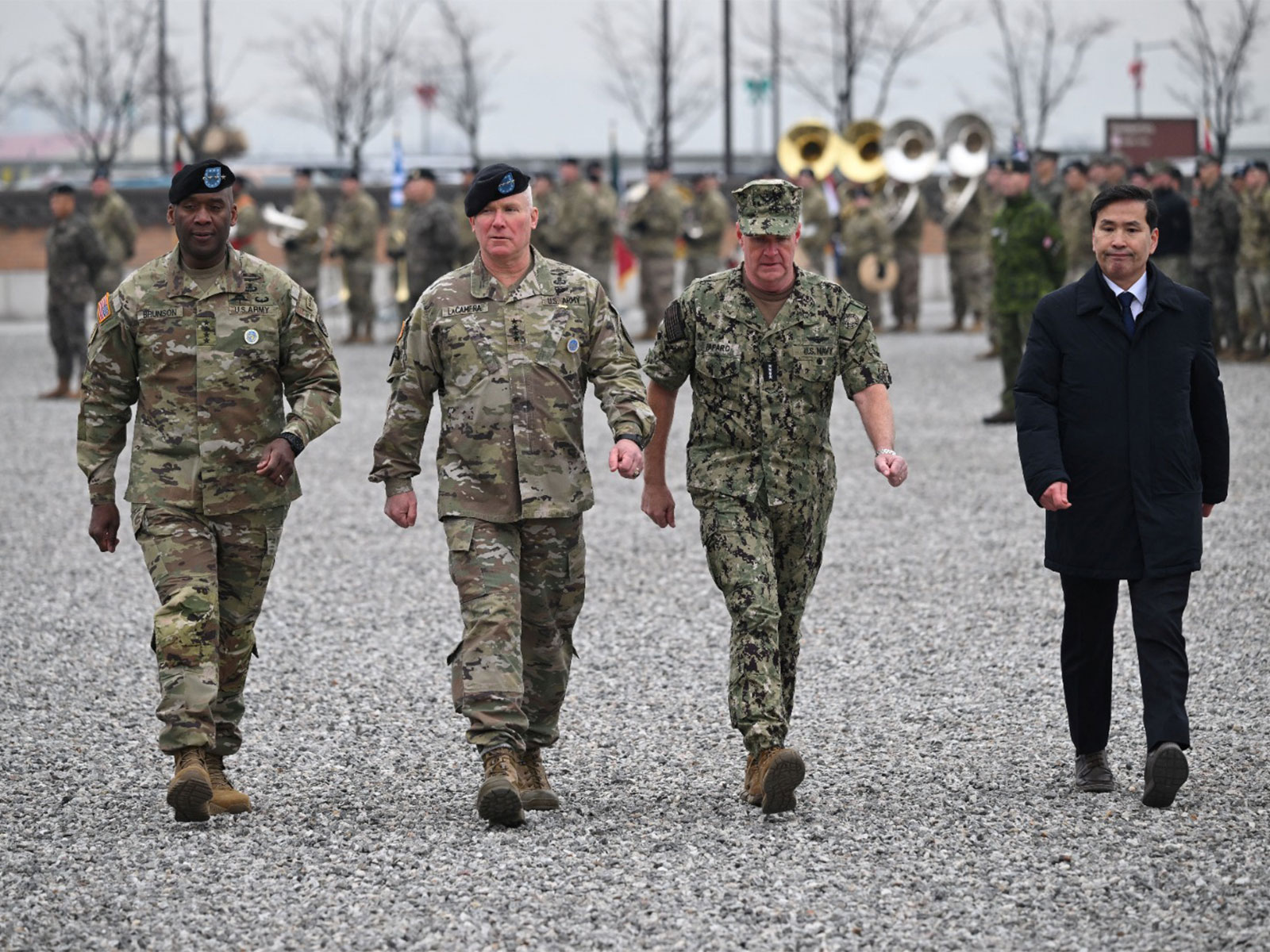
In a US Congressional Armed Services Committee hearing on 21 April, Admiral Samuel J Paparo, who is Commander of the US Indo-Pacific Command (INDOPACOM), gave written and verbal testimony about the force posture of his vast command that stretches from east of Hawaii all the way west across the Pacific to the Indian Ocean.
One of the biggest concerns about Operation Eric Fury against Iran is the depletion of American stocks of missiles and munitions that would be desperately needed in any future war against China. Some estimate that the USA has been spending US$1 billion per day on prosecuting its war against Tehran.
Paparo refused to go into specifics when asked about the USA's magazine depth, but he did admit, "There are finite limits to the magazine." He added, though, "I have all the faith in the world that they're being employed judiciously."
Nonetheless, Democratic senator Richard Blumenthal said during the hearing, "I'm under the impression that the impact has been serious." The senator argued the public needed to "appreciate the seriousness of the costs of the Iran war" and the "urgent need" to replace those finite resources being expended.
Furthermore, Blumenthal said he was "tremendously concerned" about the impact of moving military equipment from the region. The Japan-based 31st Marine Expeditionary Unit of the US Marine Corps, for example, deployed to the Middle East, while the US Navy's USS Abraham Lincoln carrier strike group also moved there.
In February, the number of American reconnaissance flights declined 30% compared to the preceding months. Paparo touched on this in his testimony, but he put a positive spin on it. He said INDOPACOM forces "have played an indispensable role in Operation Epic Fury. Our forces operating in the Central Command area of responsibility build effective global deterrence by the demonstration of capability and will, which in turn creates enduring advantage. This force employment strengthens our theatre operational approach of deterrence by denial."
The admiral said such units "will return to the Indo-Pacific better trained and more capable for any future conflict". Additionally, he said the USA "will leverage opportunities to reconstitute readiness and deliver stronger deterrence in the long term. In partnership with the services, we are making big bets on next-generation munitions, including low-cost hypersonic seeker-enabled weapons launched from air, land and sea-based platforms."
This statement avoided the question of the status of current missile inventories in INDOPACOM. Huge numbers of American missiles and precision-guided munitions have been expended against Iran. Yet the People's Liberation Army (PLA) in China is the largest military in the world, and it has a vast stock of missiles pointed at Taiwan and US targets and allies around the Asia-Pacific region.
In his opening remarks, Paparo stated, "Our strategy is clear: we must deny China the ability to achieve its objectives through military aggression, while strengthening the network of alliances and partnerships that constitutes our greatest asymmetric advantage."
He described his command's area of responsibility as a zone "where intense economic competition meets escalating geopolitical friction. This demands a combat-ready joint force to deter any attempt to subvert a free and open Indo-Pacific. No nation can dominate the United States or our allies," he asserted.
The USA envisions a balanced power structure in the Indo-Pacific region and, "To achieve this, we are committed to establishing a robust denial defence and creating a military posture in the Western Pacific that renders aggression infeasible, escalation unattractive and conflict unbearable. This strategy of deterrence by denial strengthens the foundation for effective diplomacy. It also ensures the joint force remains capable of executing decisive global strikes."
Paparao next referenced several meta-trends in modern warfare, each of them characterising precisely where the PLA is focusing its modernisation efforts. The first is the employment of information, influence, cognitive and cyber operations that shape perceptions and disrupt decision-making.
An example is Chinese-created images currently circulating, which show PLA soldiers in smart, ceremonial uniforms marching past the Presidential Office Building in Taipei in a parade.
Although produced by artificial intelligence, such images are designed to emphasise the inevitability of Chinese victory and the futility of Taiwanese resistance. The second meta trend highlighted in the Congressional Armed Services Committee hearing is the commoditization of cheap, massed, unmanned and autonomous systems that increase the impact of assaults and compress decision-making timelines.
Thirdly, Paparo highlighted the proliferation of long-range, precision strike weapons, which heat up coercion levels. China has the world's widest inventory of missile types, including hypersonic ones like the DF-17. It also holds the world's largest stocks of short- and medium-range ballistic missiles. Of greatest interest was Paparo's testimony about China specifically.
He explained, "The PLA regularly demonstrates its growing capability and capacity through persistent, provocative pressure operations. Beijing will not rule out the use of force against Taiwan; its increasingly aggressive actions near Taiwan serve not just as exercises, but as rehearsals for potential forced unification."
He also highlighted China's illegal territorial claims over contested features in the South China Sea, East China Sea and Yellow Sea. "It uses coercive behaviour and overt aggression to exert its excessive claims, including harassing the Philippines, Japan and other Southeast Asian partners."
However, Paparo warned that Chinese plans extend well beyond adjacent waters. "China's force design portends ambitions far beyond the First or Second Island Chains. It reflects its ambitions toward a global military that will project power beyond its near geography to set the rules for every relationship across the globe. To this end, China is transforming the PLA into an integrated, joint, network-centric military capable of sustained, all-domain, high-intensity conflicts at greater distances from China."
This is evident in its nuclear forces, the PLA Rocket Force, for example. It is rapidly modernising its triad of land-, sea- and air-delivered nuclear weapons. It also conducted a nuclear test at its Lop Nur test site in June 2020, and hurled an intercontinental ballistic missile (without a warhead) deep into the South Pacific in 2024.
Paparo also warned about the PLA's conventional missiles, space capabilities, cyberwarfare, hypersonic weapons and maritime power as points of alarm. He remarked that they represent "an evolving challenge to US national security and regional stability".
Paparo also warned about China's sophisticated counter-space capabilities, such as direct-ascent anti-satellite weapons, co-orbital threats and advanced jamming systems. The USA is also keeping leery eyes on growing cooperation between China and like-minded neighbours.
He testified, "The deepening cooperation between China, Russia and North Korea threatens to exacerbate and accelerate security challenges in the Indo-Pacific, degrading safety and security and accelerating existing tensions and disputes in the region."
Naturally, "Historical issues of mistrust, non-aligned goals and resource constraints limit the type and level of support they will provide each other, but each country could take opportunistic advantage of a regional crisis to advance its own objectives. Together, these countries' increasing mutual support creates a complex, interconnected challenge to US national security and regional stability."
Although President Donald Trump's exact position on Taiwan is a little unclear, especially whether he will be willing to use it as a bargaining chip when he meets with Chairman Xi Jinping in a state visit to Beijing next month, Paparo reaffirmed the USA's traditional position on Taiwan.
This is tied to the Taiwan Relations Act, where INDOPACOM "continues to provide security assistance to enable Taiwan to build a self-defence capability that is credible, resilient, asymmetric, distributed and cost-effective."
Allies remain vital to the USA, and INDOPACOM conducted more than 100 joint exercises with them last year. In fact, even as Paparao was speaking, the multilateral Exercise Balikatan had just kicked off two days earlier in the Philippines. This annually held exercise involves 17,000 troops from Australia, Canada, France, Japan, New Zealand, the Philippines and the USA.
The large scale of the US contingent in Exercise Balikatan illustrates how, even though the USA is engaged in war in the Middle East, it still has the capacity and strength to maintain full commitments to major exercises elsewhere in the globe.
Paparo acknowledged: "These operations are vital to maintaining peace and stability in the region, but they comprise only part of our comprehensive approach to deterrence. The Department of War's primary strategic objective in the Indo-Pacific is to deter conflict by prioritizing combat-credible military forces postured in the Western Pacific. Accordingly, the command operates a layer of forces west of the International Dateline that demonstrates dynamic combat power and the immediate ability to respond to adversarial action."
Paparo noted his command has four integrated concentration areas. These are to accelerate and suffuse information effects into planning; build, integrate and employ advanced all-domain dynamic combat power; strengthen alliances and partnerships; and improve theatre posture to achieve expanded manoeuvre.
As an example of the first area, INDOPACOM has been integrating artificial intelligence (AI) over the past two years, such as common operating picture assistants, to speed up the commander's decision-making cycle.
Naturally, the USA is not alone in this, for the PLA is widely leveraging AI too. Paparo called for expanded production of weapons like heavyweight torpedoes; Joint Air-to-Surface Standoff Missiles-Extended Range (JASSM-ER); Long-Range Anti- Ship Missiles (LRASM); Maritime Strike Tomahawks; Precision Strike Missiles (PrSM); and Standard Missiles 3 and 6 (SM-3/SM-6).
He continued, "We must also accelerate affordable hypersonic missile options and increase throughput of essential low-cost drones and advanced maritime mines. Current production timelines are misaligned with operational expenditures and the threats we face in today's global security environment."
He also warned that the US Air Force's fleet of air-to-air tankers is below requirements. "Every capability we employ needs millions of pounds of jet fuel in the air. While we supplement with contract air services, only military aircraft can operate in contested environments."
Paparo also highlighted the need for a strengthened integrated air and missile defence network, including lower-cost defences against massed drones, as well as protection against hypersonic weapons. Indeed, the protective umbrella over Guam serves as a pathfinder for the USA's planned Golden Dome air defence system. Such systems are necessary to counter the aerial threat that the PLA has accrued in both missiles and drones.
Paparo also demanded more submarines, aircraft carriers and associated airwings, surface combatants, amphibious ships, combat logistics force, cargo aircraft and bombers.
"The place where we have to make the most progress is in the defence industrial base to deliver the capability," he chided.
On a positive note, he praised the establishment of a submarine base able to accommodate nuclear boats in Perth, Western Australia. In contrast to the slowness of American procurements and production, the admiral told committee members that, since 2024 alone, Chinese industry had delivered twelve submarines (including nuclear-powered attack and nuclear-powered ballistic- missile submarines), an aircraft carrier, two cruisers, ten destroyers and seven frigates.
Paparo concluded with great gravity: "The Indo-Pacific is the decisive theatre for American security and prosperity in the 21st century."
He argued, "We must act with urgency to strengthen deterrence, enhance warfighting readiness and force posture, procure critical capabilities and deepen partnerships. The investments we make today will determine whether we prevent conflict through credible deterrence, or face war under suboptimal conditions."