SC constitutes panel headed by ex-judge R Subhash Reddy to probe alleged police excesses during protests
Aug 20, 2026
New Delhi [India], August 20 : The Supreme Court has constituted a five-member High-Powered Enquiry Committee (HPEC), headed by former Supreme Court judge Justice R. Subhash Reddy, to examine allegations of excessive use of force by police, paramilitary forces and other security personnel against protesters.
The other members are former Punjab and Haryana High Court Chief Justice Ravi Shankar Jha, former Delhi High Court Judge Justice Shalinder Kaur, former CBI Director Rishi Kumar Shukla and retired Meghalaya Director General of Police Dr L.R. Bishnoi.
The committee will examine allegations including excessive use of pellet guns, electric batons, lathi charges and tear gas, alleged violence against women protesters, police surveillance, the proportionality of crowd-control measures and the provision of medical assistance and compensation to victims. It will also consider allegations raised by the authorities concerning violence against police personnel and damage to public property.
Earlier on Tuesday, a bench headed by Chief Justice of India Surya Kant, along with Justices Joymalya Bagchi and V Mohana, said the proposed committee would also comprise a former High Court judge and a retired Director General of Police.
The Chief Justice had said that the consent of a former CBI Director and a former DGP, neither of whom is from any of the States involved in the matter, was obtained. The apex court said it would pass a formal order after considering all aspects relating to the constitution and functioning of the committee.
The committee is expected to examine a broad range of issues arising from student protests held in different parts of the country over alleged examination paper leaks. These include allegations of police excesses, violence against security personnel and sexual harassment of women protesters.
The bench said issues concerning the use of facial recognition technology, surveillance, privacy and the fundamental right to life and personal liberty under Article 21 of the Constitution would ultimately have to be adjudicated by the apex court itself.
The Supreme Court also expressed its intention to examine the possibility of quashing FIRs registered against student protesters in connection with demonstrations over examination paper leaks.
The bench indicated that it could consider exercising its extraordinary powers under Article 142 of the Constitution to quash such cases, while making it clear that matters involving individuals with serious criminal antecedents could be considered separately.
The bench emphasised the impact that criminal proceedings could have on young students, observing that the issue concerned "the life and future of innocent students".
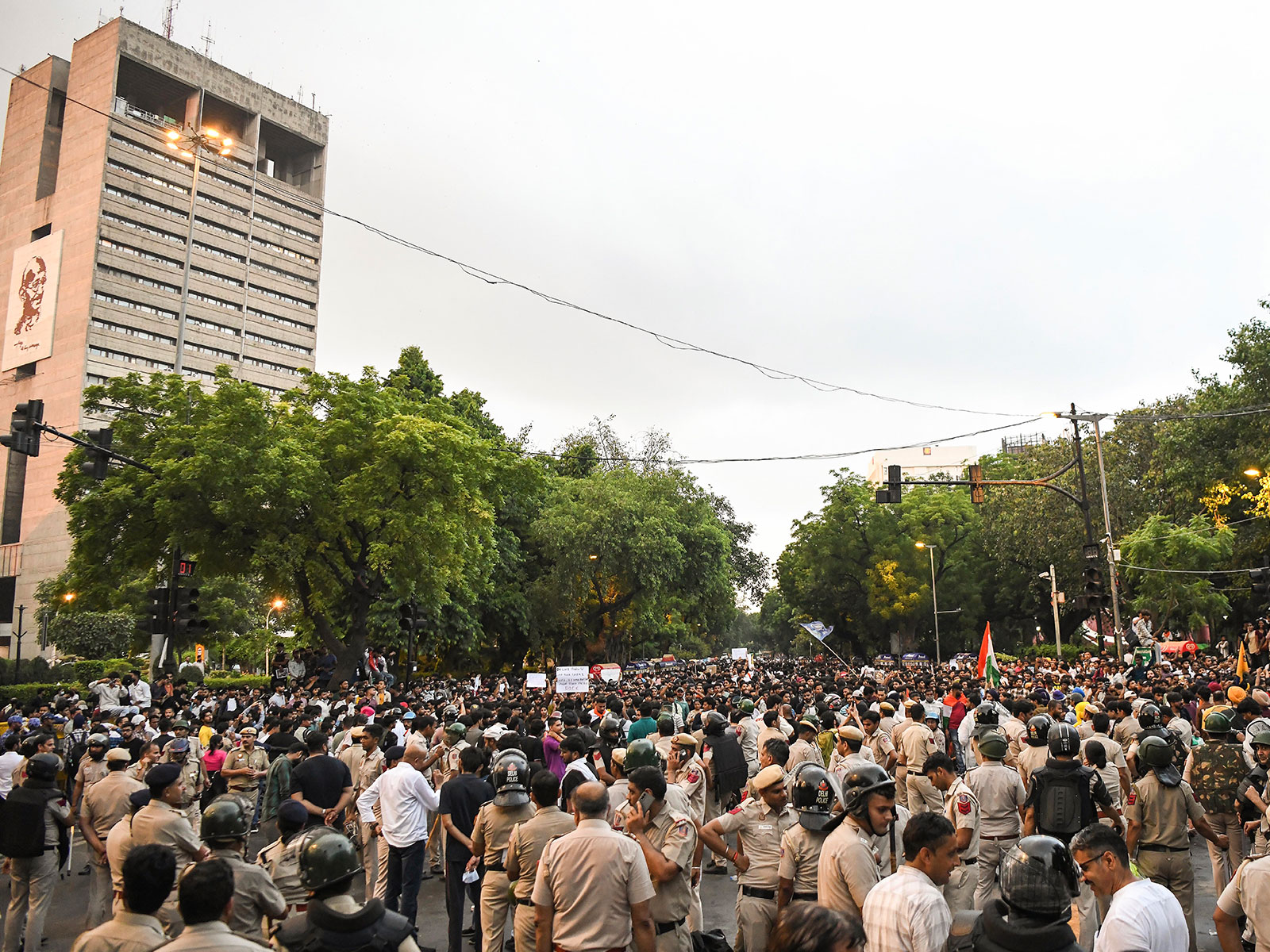
On July 20, thousands of students participated in a Parliament march organised by the CJP, demanding, among other things, the resignation of Union Education Minister Dharmendra Pradhan over alleged examination paper leaks and seeking wider reforms in the examination system.
As demonstrators attempted to move towards Parliament and breach police barricades in central Delhi, security personnel used tear gas and lathi-charge to disperse the protesters.
Several videos subsequently circulated on social media, purportedly showing protesters being manhandled by police personnel, leading to allegations of excessive use of force.
The Delhi Police, however, defended its action and maintained that force was used only after sections of the protesting crowd allegedly turned violent and engaged in stone-pelting.