Thailand's strategic recalibration opens economic opportunities for India: ORF Report
May 07, 2026
New Delhi [India], May 7 : A special report by the Observer Research Foundation (ORF) has said that changing geopolitical dynamics in Thailand are creating fresh strategic and economic opportunities for India, positioning New Delhi as a potential "third axis" alongside the United States and China. 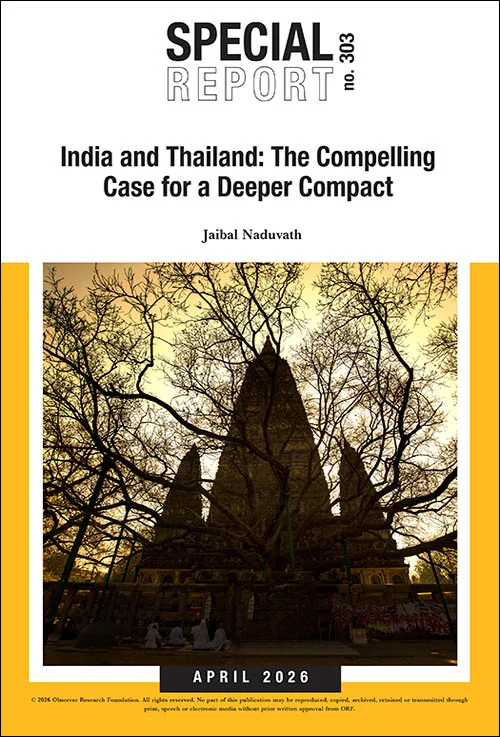
The report, titled "India and Thailand: The Compelling Case for a Deeper Compact", authored by Jaibal Naduvath, argues that growing uncertainty over Thailand's traditional partnerships is driving Bangkok to diversify its strategic options.
"The US, long Thailand's principal partner, is increasingly viewed in Bangkok as unpredictable," the report said, pointing to Washington's response to Thailand's 2014 political developments and tariff policies under US President Donald Trump.
At the same time, the report noted that while China has expanded its footprint through investments and cultural engagement, concerns remain in Bangkok over Beijing's "aggressive maritime posture, ties with Cambodia, and coercive geo-economic practices."
Against this backdrop, ORF said India is emerging as a trusted strategic partner. "While the US and China remain central to Thailand's strategic schema, Bangkok is diversifying risk, with India emerging as a third axis," the report stated.
The think tank highlighted that India's strategic autonomy and absence of "strategic baggage" make it an attractive long-term partner for Thailand. The report also stressed the deep historical and cultural ties between the two nations, saying India has remained "a civilisational reference point in the Thai imagination arising from over 2 millennia of ties."
According to ORF, the growing convergence is reflected in India's "Act East" policy and Thailand's "Act West" approach, as well as the elevation of bilateral ties to a strategic partnership.The report identified five "early-harvest sectors" that could anchor a stronger India-Thailand relationship, which are semiconductors, artificial intelligence, automotives, MSMEs, and tourism.
On semiconductors, ORF said Thailand's strength in semiconductor assembly and testing could complement India's leadership in chip design and intellectual property. "A bilateral partnership could evolve into a co-development model linking design and manufacturing," it said.
The report said, "Thailand is a global hub for semiconductor assembly, packaging and testing, but higher-value design and Intellectual Property (IP) remain offshore. India's strength lies in design and IP, supported by one of the world's largest pools of chip design engineers and Electronic Design Automation professionals, including around 20 per cent of the global integrated circuit design workforce. A bilateral partnership could evolve into a co-development model linking design and manufacturing, supported by joint ecosystems in materials, speciality chemicals, advanced packaging and Outsourced Semiconductor Assembly and Test (OSAT), without requiring advanced fabrication capabilities."
In the field of artificial intelligence (AI), the report said Thailand is seeking trusted partners to build sovereign AI capabilities, while India's large AI talent pool could help bridge capability gaps.
The report said, "Both countries aim to expand AI adoption while building sovereign capabilities. India has made significant progress with a sovereign AI stack and high levels of adoption across sectors. Thailand, which relies on foreign hyperscalers, seeks trusted partners to build its own stack, expand talent, and deepen adoption. India's pool of over one million AI professionals can help bridge this gap as Thailand develops its domestic pipeline. Early steps could include collaboration between centres of excellence, expansion of supercomputing capacity drawing on India's National Supercomputing Mission, and co-development of Thai-centric foundation and multimodal models."
The report also proposed an India-Thailand-Japan trilateral framework in the automotive sector, noting that Japanese automakers dominate both markets and could benefit from aligned manufacturing and research ecosystems.
The report said, "Thailand is the world's tenth-largest vehicle producer, with a strong manufacturing base, while engineering and design functions are distributed across global capability centres (GCCs). India hosts around 50 per cent of the world's automotive GCCs, developing vehicle platforms, EV and hybrid powertrains, battery management systems, ADAS, telematics and connected technologies. Thailand's EV ambitions can benefit from India's experience in localisation, battery systems and charging infrastructure, while India can leverage Thailand's component ecosystem and proximity to ASEAN markets. Japanese OEMs dominate both markets with deep investments in capacity and R&D. An India-Thailand-Japan trilateral could align strengths, create scale, and diversify risk for all three."
On MSMEs, the report said, "Integrating Indian MSMEs into GVCs is critical for India's Viksit Bharat aspiration, yet gaps remain in technology, skills and market access. Thai SMEs are well integrated into global production networks. Indian firms bring strengths in design, tooling and software, while Thai firms excel in precision assembly, electronics integration, testing and certification. Collaboration through task-sharing across value chains can unlock synergies. For Thailand, such a partnership aligns with its Thailand 4.0 strategy and reduces overdependence on a 2-country (China-Japan) manufacturing ecosystem. Sectoral consortia in areas such as automotive electronics, industrial machinery, IoT devices and food processing could anchor this effort," the report added.
On tourism, ORF called for major improvements in India's Buddhist tourism infrastructure, observing that only around 1.4 lakh Thai tourists visited India in 2025 despite strong spiritual links to destinations such as Bodh Gaya, Sarnath and Kushinagar.
"India must improve infrastructure, connectivity and service quality," the report said, adding that better air connectivity and hospitality investments could significantly boost tourism flows.
Summing up the strategic opportunity, the ORF report said, "For India to advance its Viksit Bharat ambitions, it needs reliable partners with aligned interests. For Thailand to emerge as a global value creator, it needs partnerships that combine scale with strategic autonomy. India and Thailand offer each other this balance."