Mumbai-Ahmedabad bullet train project installs five heavy portal beams over Ahmedabad tracks in 22 days
May 04, 2026
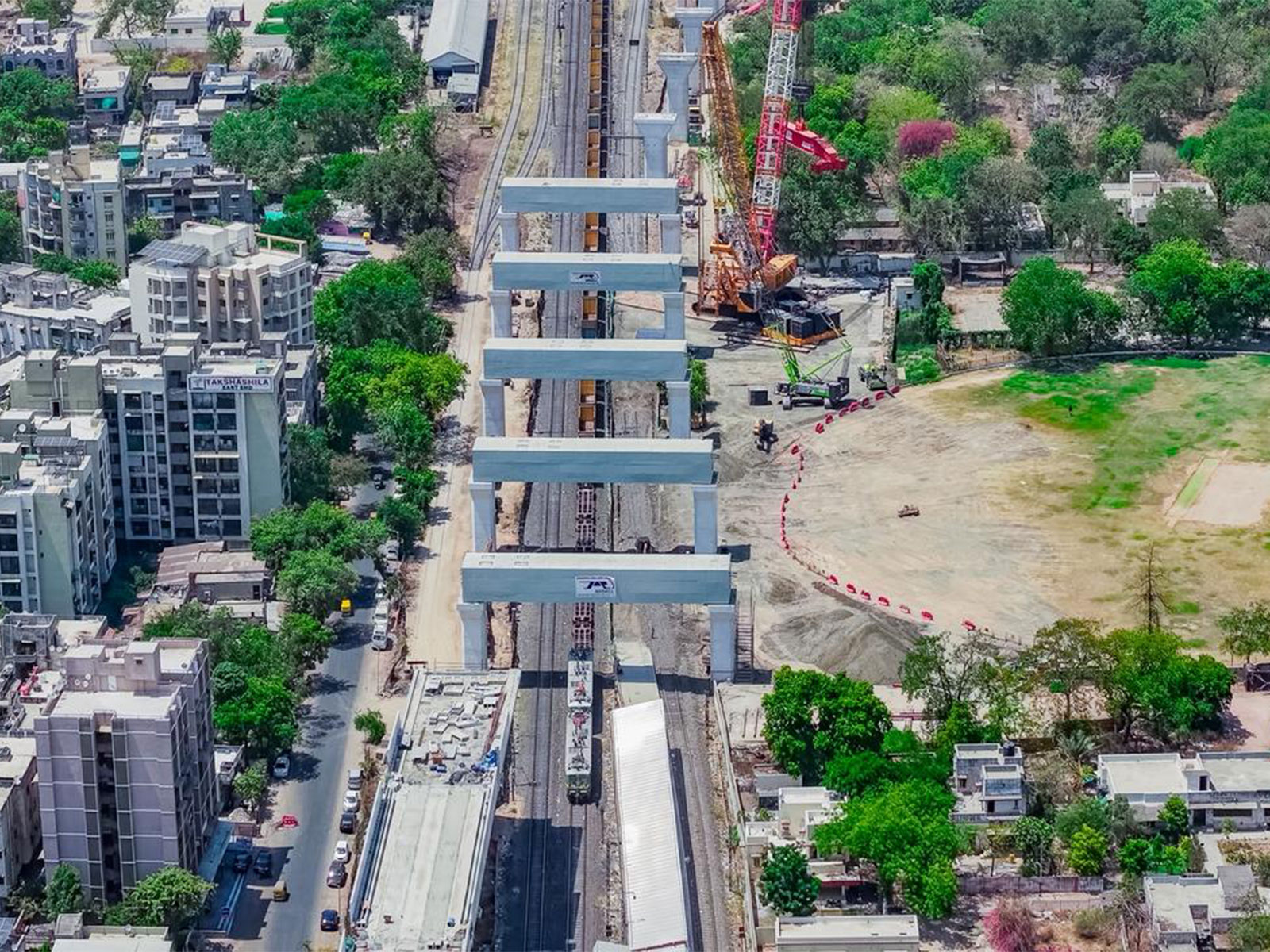
New Delhi [India], May 4 : The Mumbai-Ahmedabad bullet train project has completed the installation of five heavy portal beams over active Indian Railways tracks at Maninagar in Ahmedabad within 22 days, marking a key engineering milestone.
According to an official release, all five precast-prestressed portal beams were launched over the Ahmedabad-Vadodara railway line in a phased manner on 8th, 13th, 19th, 24th and 29th April 2026, in close coordination with Indian Railways.
The operation involved the installation of beams weighing between 1170 metric tonnes and 1360 metric tonnes. The heaviest beam, weighing around 1360 metric tonnes, was launched on April 8, making it one of the heaviest lifts carried out on operational railway tracks in the country.
The work was executed on active railway lines, including the Ahmedabad-Vadodara 'Up', 'Down' and third lines, requiring a high level of planning, coordination and safety measures. The alignment at Maninagar passes above existing railway tracks at a raised level with limited space and a span of approximately 30 to 34 metres between piers, necessitating the use of heavy portal beam structures.
These portal beams are designed to provide strong and rigid support to safely transfer loads across multiple tracks, ensuring minimal deflection and maintaining precise track alignment for safe railway operations.
The launching was carried out using a 2200 metric-ton crawler crane, marking its first use on Indian railway tracks. Each beam was installed in approximately 3.5 hours, significantly reducing the time compared to earlier operations that required up to nine-hour blocks.
Despite challenges such as limited working space, overhead electrification (OHE), and ongoing train movement, the installation was completed with continuous monitoring and safety checks.
A portal beam is a precast concrete structure measuring 34 metres in length, with a cross-section of 5.5 metres by 4.5 metres, and is installed as an integrated unit to support elevated infrastructure over railway lines.